


Replace battery cables when corrosion, looseness, frayed strands, swollen insulation, or voltage-drop testing proves the cable can’t deliver starter current reliably.
You can confirm the decision with fast checks—visual inspection, wiggle tests, heat checks, and a simple multimeter voltage-drop test during cranking.
You’ll also learn how to choose which cable to replace first (positive, negative, or ground strap), plus what to do if the problem keeps coming back after cleaning.
To begin, it helps to understand what battery cables do—and why a cable can “look okay” while still failing under load.
What do battery cables actually do in the starting and charging system?
Battery cables are heavy-gauge conductors that carry high current between the battery, starter, engine block, and vehicle electrical system, so the starter can crank and the alternator can recharge efficiently.
Next, once you know the job they do, you can spot the specific failure patterns that signal replacement rather than cleaning.
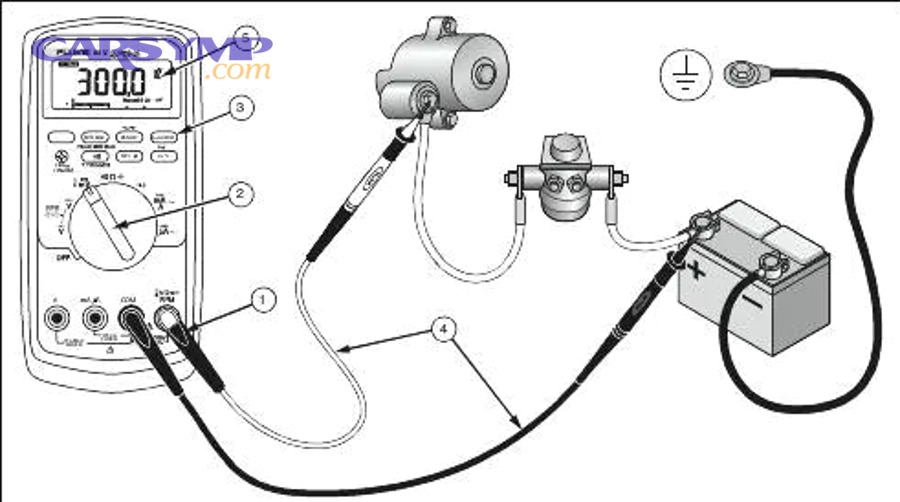
Why cables matter more during cranking than during “normal” driving
Cranking demands hundreds of amps for a few seconds, which means even tiny resistance increases can cause a big voltage drop. Specifically, a slightly corroded connection may still power lights and a radio, yet starve the starter and create slow cranking or intermittent no-starts.
To illustrate the point, think of the starter circuit as a fire hose: it only works when the path is wide open and the fittings are tight—any restriction shows up most under maximum flow.
How the ground path is part of the “same” circuit
Current leaves the battery on the positive cable, flows through the starter, and returns through the engine block and ground cable/strap to the battery negative. If the ground side is weak, the positive side can look “fine” while the system still fails.
In other words, every diagnosis should treat the ground cable and engine/chassis ground points as first-class suspects, not an afterthought.
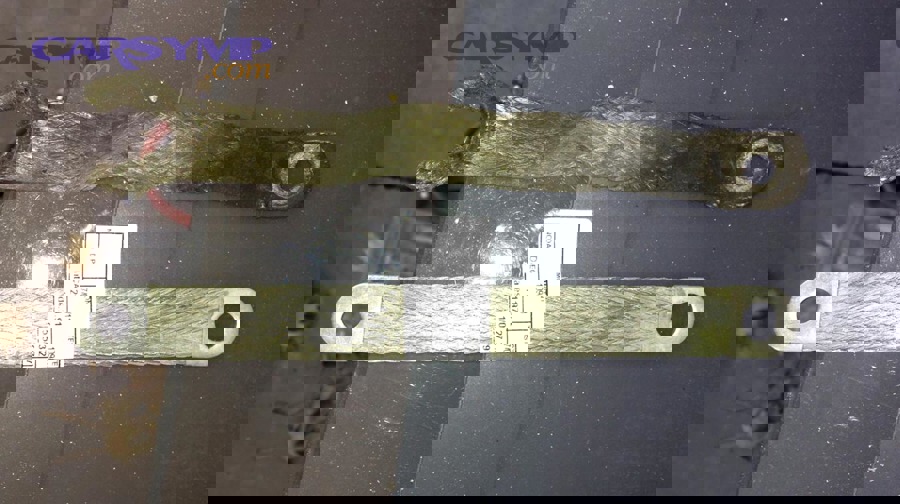
What “normal” aging looks like vs true damage
Normal aging includes minor surface dulling or light oxidation on exposed metal, especially in humid or salty climates. True damage shows up as swelling, hard/brittle insulation, green/blue corrosion creeping under insulation, cracked lugs, or heat discoloration near terminals.
From here, the practical question becomes: which visible signs are “cleanable,” and which are clear replacement triggers?
Which visible signs mean a battery cable should be replaced, not cleaned?
Replace battery cables when corrosion has migrated under insulation, the conductor is frayed or broken, the terminal lug is cracked or deformed, or the cable shows heat damage or swelling that indicates internal deterioration.
After that quick rule, you can sort the common signs into “clean-and-retorque” issues versus “replace now” issues.
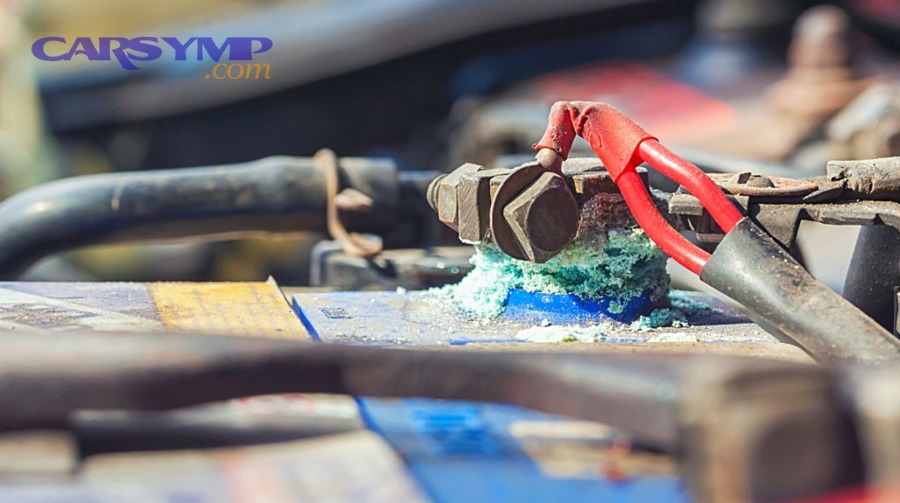
Corrosion that returns quickly or spreads under the insulation
Powdery buildup around a terminal can often be cleaned, but green/blue corrosion traveling beneath the insulation is a stronger replacement signal because it suggests copper is degrading where you can’t scrub it. This hidden corrosion increases resistance and can overheat under load.
To make the call, peel back any protective boot (if present) and inspect the lug and the first inch of conductor—if you see green staining or wetness, treat it as internal contamination, not surface dirt.
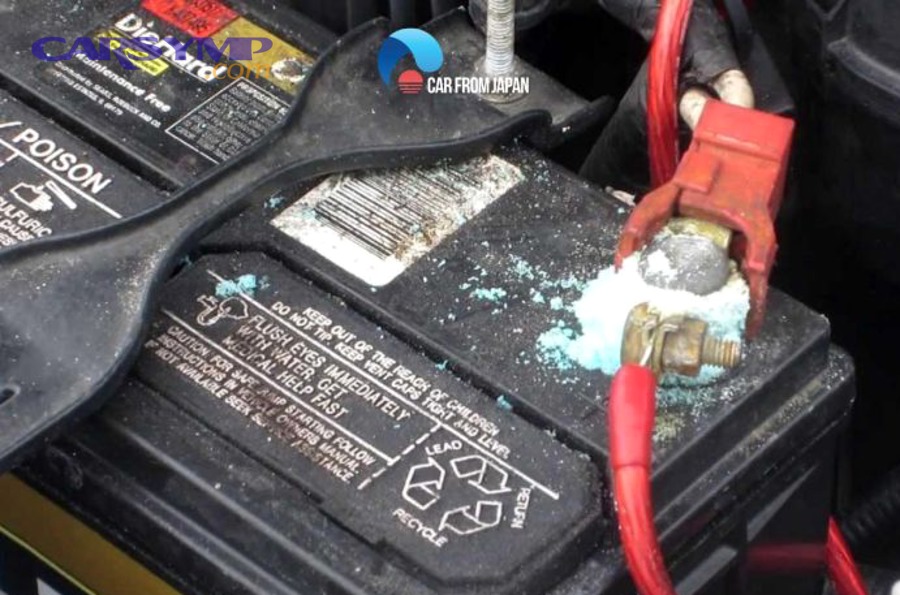
Frayed strands, stiff/brittle insulation, or “ballooning”
Frayed copper strands reduce cross-sectional area, which raises resistance and heat. Brittle insulation can crack and allow moisture intrusion. Ballooning or swelling can indicate corrosion products building inside the insulation or overheating from high resistance.
Next, even if you don’t see obvious external damage, a cable can still fail internally—so visual inspection is necessary but not sufficient.
Loose, stretched, or damaged terminal ends and clamps
If the clamp won’t tighten to a secure grip on the post, or the lug is cracked, the contact patch shrinks and resistance rises. A terminal that rotates by hand after tightening is a practical “replace” sign because it can intermittently disconnect under vibration.
From this point, you’ll want to determine whether the cable’s core is healthy or already compromised beyond what cleaning can fix.
Can a battery cable fail internally even if it looks fine?
Yes—battery cables can fail internally when corrosion creeps under insulation, strands break near the lug, or the conductor develops high resistance that only appears under heavy load.
Next, you can use three simple clues—feel, behavior, and testing—to catch internal failure before you replace the wrong part.
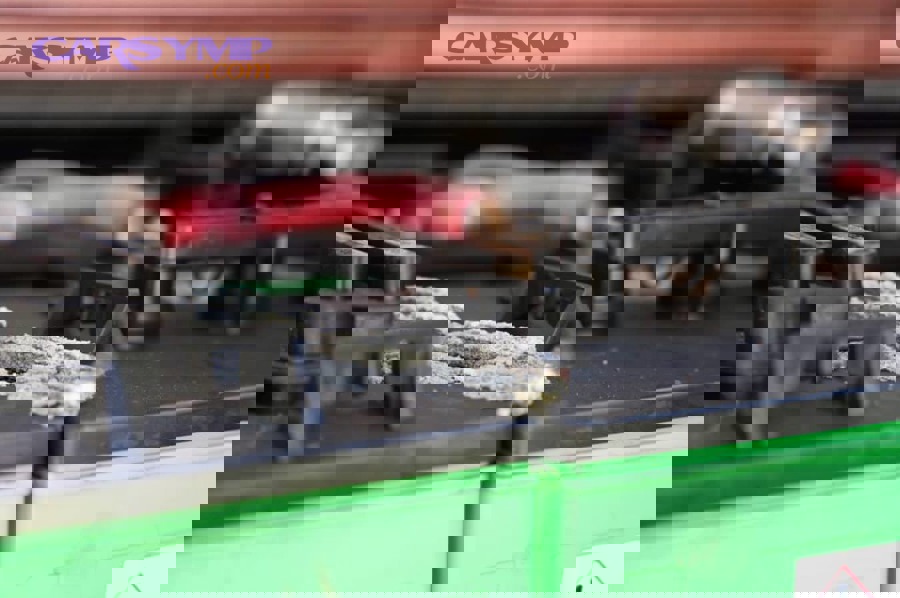
The “hot cable” clue after cranking attempts
If repeated start attempts make a cable or terminal noticeably warm (while nearby parts stay cool), that heat is often I²R loss—current squared times resistance—concentrated at a bad connection or internally corroded section.
To be clear, warmth alone isn’t proof, but it’s a strong pointer that you should measure voltage drop next rather than guessing.
Intermittent no-starts that change with vibration or steering angle
A marginal cable can pass current sometimes and fail other times depending on vibration, temperature, or how the cable is flexed. If wiggling the cable gently (with the engine off) changes interior electrical behavior, that’s an actionable sign of poor connection integrity.
After that behavioral check, the most decisive step is a voltage-drop test during cranking, because it measures resistance indirectly under real load.
Age and mileage as “risk factors,” not automatic triggers
Cables don’t have a universal replacement interval, but aging and exposure matter. One commonly cited guideline is that cables may last roughly 50,000–100,000 miles depending on conditions and maintenance.
Next, instead of replacing purely on age, you can confirm the decision with a voltage-drop test that turns suspicion into data.
How do you confirm a bad cable with a voltage-drop test?
Use a multimeter to measure voltage drop during cranking across the positive cable and the ground path; excessive drop indicates high resistance from corrosion, loose terminals, or damaged cables.
Next, follow a consistent setup so your readings mean something and your results are repeatable.
Step-by-step: positive-side and ground-side voltage drop
Step 1: Set the meter to DC volts. If your meter has a millivolt range, it can improve resolution for small drops.
Step 2 (positive side): Place the red probe on the battery positive post (not the clamp) and the black probe on the starter’s battery stud. Crank for 4–5 seconds and note the maximum drop.
Step 3 (ground side): Place the black probe on the starter housing/engine block and the red probe on the battery negative post. Crank again and note the drop.
To understand the numbers, compare them to practical guidelines used in starter-circuit testing.
This table contains typical “acceptable” voltage-drop targets during cranking, helping you decide whether to clean/retorque or replace parts in the starter circuit.
| Test location | What it isolates | Typical target during cranking | If higher than target, suspect |
|---|---|---|---|
| Battery + post to starter stud | Positive cable + its connections | ~0.3 V (often within 0.2–0.5 V total guidelines) | Corrosion at clamp/lug, damaged positive cable, loose fasteners |
| Starter housing to battery – post | Ground path (block-to-battery return) | ~0.2 V or less | Bad ground cable/strap, corroded ground point, paint/rust at contact |
| Across a single connection (post-to-clamp or lug-to-stud) | One joint only | Near 0.0–0.1 V | Loose/oxidized joint, deformed clamp, contamination between metals |
The key takeaway is directional: lower is better, and a “good looking” cable can still show a bad drop when the starter demands current.
Theo nghiên cứu của Fluke từ Resource Center, vào (không nêu rõ tháng/năm trong trang trích dẫn), mức sụt áp chấp nhận được khi thử mạch đề thường khoảng 0.2–0.5 V tổng, với khoảng ~0.3 V phía dương và ~0.2 V hoặc ít hơn phía mass/ground; cao hơn thường gợi ý ăn mòn hoặc cáp hư.
How to avoid false readings
Probe on clean metal—not on painted brackets, rusty bolts, or the outer surface of a clamp. If you probe the clamp instead of the battery post, you may miss a bad clamp-to-post connection because you’re measuring “past” the problem.
Next, if the voltage-drop numbers point to the ground side, you’ll want to decide whether the negative cable, the ground strap, or the body ground is the real culprit.
What to do with the result: clean, retorque, or replace
If voltage drop is only slightly elevated and you find obvious looseness or surface buildup, cleaning and retorquing may restore normal readings. If drop remains high after cleaning—or if you see heat damage, under-insulation corrosion, or deformed lugs—replacement is the safer and more permanent fix.
From here, a practical next step is choosing which cable to replace first when the evidence isn’t perfectly symmetric.
When should you replace the positive cable vs the negative or ground cable?
Replace the positive cable when the voltage drop is high from battery positive to starter, and replace the negative/ground cable or strap when ground-side drop is high from engine block to battery negative.
Next, you can use a “meronymy” view—each segment of the return path is a replaceable part—to pinpoint exactly where resistance lives.
Positive cable replacement triggers
High positive-side drop, visible corrosion at the starter stud lug, oil saturation near the exhaust manifold, and heat-hardened insulation near the engine are strong positives for replacing the positive cable assembly. Also, if the terminal end won’t clamp tightly to the post, replacing the terminal end (or the entire cable, depending on design) is usually more reliable than “making it work.”
Next, if your testing points to the return path, focus on the ground cable and the ground points rather than the battery itself.
Negative cable and engine ground strap replacement triggers
High ground-side drop often comes from a corroded battery negative clamp, a corroded chassis ground point, or a worn engine-to-chassis ground strap. A braided strap can degrade from flexing, corrosion, or mechanical stress and create “mystery” starting problems.
To move from suspicion to action, test each segment: battery negative post to chassis ground, chassis to engine block, and engine block to starter housing.
Why replacing only the terminal end sometimes works—and sometimes doesn’t
If damage is limited to the clamp and the conductor is clean and bright close to the end, replacing only the terminal end can be effective. However, if corrosion has wicked into the strands under insulation, replacing the entire cable is typically the better long-term solution because hidden resistance will continue growing.
Next, once you know which part is failing, it’s worth understanding the safety and reliability risks of driving with compromised cables.
What risks come from driving with damaged battery cables?
Damaged battery cables can cause intermittent no-starts, electronic resets, overheating at terminals, and in severe cases arcing that can damage components or create a fire risk.
Next, you can treat these risks as a prioritization tool: the more heat and intermittency you see, the less you should “wait and see.”
Hidden voltage loss that stresses starters and batteries
When resistance rises, the starter sees less voltage and may crank longer to achieve the same engine speed. Longer cranking increases starter heat and drains the battery deeper each attempt, which can shorten battery life over time.
Theo nghiên cứu của Battle Born Batteries từ hướng dẫn về ăn mòn cực pin, vào August 2025, ăn mòn ở cực có thể cản trở dòng điện và gây giảm hiệu năng, thậm chí khiến thiết bị/xe không khởi động khi ăn mòn nặng.
Intermittent resets that mimic “bigger” electrical problems
Loose or high-resistance connections can create brief voltage dips that reset modules, flicker lights, or cause radio/infotainment reboots. That behavior often sends people chasing alternators and batteries first, when the root cause is simply unstable delivery at the cable ends.
Next, because the fix is straightforward but safety-critical, it’s worth following a careful replacement approach rather than improvising.
Overheating, arcing, and melted insulation
If a connection arcs, it can pit metal surfaces and worsen resistance—creating a feedback loop of more heat and more damage. Melted insulation near a terminal is a strong “replace now” sign because the conductor may be compromised and nearby components can be heat-soaked.
From here, the practical question becomes: how do you replace cables correctly and avoid introducing new problems?
How do you replace battery cables safely and correctly?
Replace battery cables by disconnecting negative first, then positive, removing the old cable without stressing harnesses, installing the new cable with clean contact surfaces, and reconnecting positive first, then negative, followed by verification testing.
Next, follow a repeatable checklist so you don’t trade a starting issue for a charging or sensor issue.
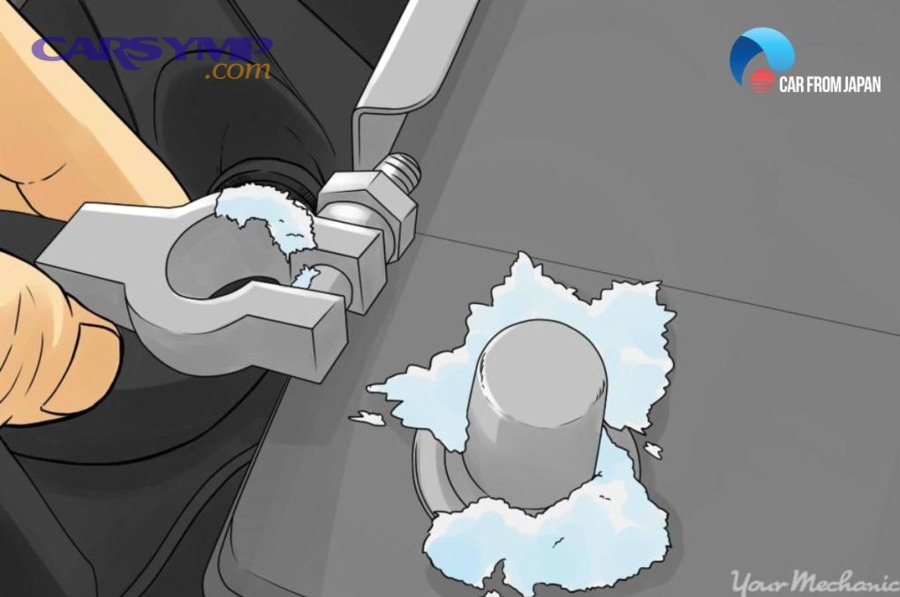
Safety checklist before you touch anything
Wear eye protection and remove rings/watches. Ensure the vehicle is in Park/Neutral with the parking brake set. If the battery is in a trunk or under-seat location, confirm you have the right access points and that the vehicle won’t auto-lock.
To avoid accidental short circuits, always plan your wrench movement so it can’t bridge from positive to body metal.
Removal order and why it matters
Disconnect the negative terminal first to “open” the return path and reduce the chance of a short if your tool touches body metal. Then disconnect the positive terminal. During reassembly, connect positive first, then negative, to reverse the risk profile.
As you remove cables, note routing clips, heat shields, and grommets—copying factory routing is not cosmetic; it prevents chafing and heat damage.
Clean contact surfaces and correct fastening
Clean battery posts and lugs to bare metal contact where appropriate, and ensure clamps fully seat on the posts (no “half-on” angles). Tighten to a secure fit—snug, not crushed. If the design uses a stud and nut at the starter or chassis ground, make sure the mating surface is free of paint, rust, and grease.
After installation, repeat the voltage-drop test; good cables should reduce drop measurably, turning the repair into a verified fix.
Video walkthrough for visual learners
If you prefer a visual reference, this video demonstrates common terminal-end replacement techniques that also apply to many cable-end repairs (tooling, clamp fitment, and safe reconnection order).
Post-replacement checks that prevent repeat failures
Start the engine and observe cranking speed and stability. Confirm charging voltage at the battery with the engine running (typical modern vehicles often show roughly mid-13s to mid-14s volts depending on conditions). Then recheck that terminals remain cool after a few starts—heat suggests remaining resistance somewhere in the path.
Next, even a perfectly installed cable won’t solve every “no-start” story, so it’s important to avoid misdiagnosis when the symptoms overlap.
How do you avoid misdiagnosis between cables, the battery, the alternator, and parasitic draw?
Avoid misdiagnosis by separating “energy storage” (battery health), “energy supply” (alternator output), and “energy delivery” (cables and grounds) using targeted tests instead of symptom guessing.
Next, you can map common symptoms to the most likely category and confirm with a short checklist.
Delivery problems (cables/terminals) that masquerade as battery failure
If your vehicle shows intermittent slow cranking, random resets, or starts fine after you touch or tighten terminals, suspect delivery first. A classic story is “battery keeps dying” even after a new battery—because the new battery can’t overcome the same high-resistance bottleneck for long, especially in cold weather or short-trip driving.
To make this concrete, high resistance forces deeper discharge per start attempt, and then the alternator must replenish more—so the system “feels” like a weak battery even when the root cause is the cable path.
Storage problems (battery health) that mimic cable issues
A weak battery can drop voltage quickly under load and mimic the same slow-crank symptom. That’s why it’s smart to combine a battery load test with cable voltage-drop testing. If both tests are marginal, replace the cable issue first only if voltage drop is clearly excessive; otherwise address the battery health as well.
When people ask about “Bad battery cell vs weak charging diagnosis,” the most reliable approach is to test each layer separately: battery under load, alternator output, and cable voltage drop under cranking.
Supply problems (alternator) and why cables still matter
An alternator that undercharges can leave the battery chronically low, but poor cables can also prevent proper charging current from reaching the battery efficiently. If the alternator tests okay at its output terminal but the battery sees low charging voltage, suspect the positive cable path and grounds.
To connect this to real-life patterns, “Why battery dies after sitting a few days” often points to parasitic draw, but a weak ground or corroded connection can also reduce effective charge acceptance—so you need data before you replace parts.
A quick decision checklist you can run at home
- Step A: Inspect terminals and cable ends; clean and retorque if only light surface buildup exists.
- Step B: Perform voltage-drop testing during cranking (positive and ground side).
- Step C: If drops are normal, test battery health (load test) and charging voltage.
- Step D: If battery repeatedly goes low while the car sits, perform a parasitic draw test rather than guessing.
If you’re tracking “Car Symptoms” across multiple events—slow crank today, dead battery tomorrow, random resets next week—this layered method prevents you from replacing the same part twice for the wrong reason.
Now that you can diagnose and replace cables confidently, it’s time to zoom out and prevent the same failure from returning in harsh conditions.
How can you extend battery-cable life in heat, salt, and stop-start cars?
You can extend battery-cable life by preventing corrosion at contact points, controlling heat and vibration exposure, and maintaining a clean, tight, well-routed connection that resists moisture intrusion.
Next, apply the following targeted upgrades and habits based on where and how your vehicle is used.
Use corrosion prevention the right way (after cleaning, not instead of cleaning)
After you restore clean metal-to-metal contact, apply a thin protective layer designed for battery terminals (or an appropriate protectant recommended for automotive use) and reinstall boots/caps if your vehicle uses them. This reduces oxygen and moisture contact that accelerates oxidation.
To keep it effective, recheck once or twice a year—especially after winter road-salt exposure or coastal humidity seasons.
Reduce heat soak and chafing with correct routing and restraints
Heat accelerates chemical reactions and can harden insulation, while chafing can open microscopic pathways for moisture. Ensure cables are clipped to factory anchors, kept away from exhaust components, and protected by loom or heat shielding where the original design included it.
Next, if your cable shows recurring damage in the same location, treat routing as the root cause—not the cable brand.
Upgrade wisely: gauge, copper quality, and sealed lugs
In high-load or modified vehicles (winches, audio amplifiers, high-compression engines), consider properly sized cable gauge and quality lugs. Better materials and sealed terminations can slow internal corrosion, especially if your vehicle lives outdoors.
However, “bigger” isn’t automatically “better”—the goal is correct sizing and robust termination, not oversized stiffness that stresses mounting points.
Verify the fix with repeatable measurements
After any maintenance, repeat the same voltage-drop test and record your numbers. Trend tracking is powerful: if drop slowly rises over months, you can intervene early with cleaning or retorque before the next no-start.
In short, prevention is not guesswork—it’s maintenance plus measurement.
FAQs about replacing battery cables
These common questions clarify the most frequent edge cases drivers face when deciding whether to clean, repair, or replace battery cables.
Can I just clean corrosion and keep the original cable?
Yes—if corrosion is superficial, the clamp fits tightly, and voltage-drop testing returns to normal after cleaning. If corrosion returns quickly, spreads under insulation, or voltage drop remains high, replacement is the more reliable fix.
How long do battery cables usually last?
It varies widely by climate and routing, but one commonly cited range is roughly 50,000–100,000 miles in typical conditions, with earlier failure possible in salt, heat, and moisture exposure.
Should I replace both cables at the same time?
Replace both if both show damage, high voltage drop, or age-related deterioration. If only one side tests bad, replacing only the failing side can be reasonable—just re-test the entire circuit afterward to confirm balanced performance.
What if I replace cables and the battery still goes low?
If delivery is verified (good voltage drop) but the battery still discharges, shift to storage and drain checks: battery load testing, alternator output verification, and parasitic draw testing while the vehicle is off.