


If you want to identify oil pan gasket leak symptoms quickly, start with the simplest pattern: oil appears at the lowest edge of the engine, then forms fresh wetness along the oil pan seam and turns into spots on the ground after parking.
Next, you should separate “oil on the driveway” from “oil pan gasket failure” by comparing leak height and leak shape, because oil from above can drip down and imitate an oil pan leak.
Then, you need to judge how serious the leak is by measuring oil loss and watching for red-flag signs like an oil pressure warning or smoke, because drivability depends on leak rate and safety risk.
Introduce a new idea: once you understand the symptom pattern and urgency, you can confirm the true leak source with a clean-and-recheck method and—when the leak is stubborn—an optional UV dye trace.
What is an oil pan gasket, and why does it leak?
An oil pan gasket is a sealing layer between the engine block and the oil pan that keeps engine oil inside the crankcase while the engine vibrates and heats, and it leaks when age, heat cycles, impact, or improper torque breaks that seal.
More specifically, the reason this matters is that the oil pan gasket sits at the lowest part of the engine, so a small seal failure can create a visible oil trail that looks dramatic even when the leak started as a slow seep.

What does an oil pan gasket leak look like underneath the car?
An oil pan gasket leak usually looks like fresh wet oil along the oil pan’s perimeter seam, followed by drops collecting on the lowest lip of the pan and eventually leaving spots on the pavement where the car is parked.
Specifically, you should focus on “freshness” and “direction” rather than the size of the puddle. Fresh leaks look glossy and wet, while older leaks look dark, dusty, and sticky because road grit adheres to oil. A classic oil pan gasket pattern starts as dampness along the bolt line, then becomes a wet seam, then becomes drips that form at the lowest point.
To keep your diagnosis consistent, use these cues:
- Early seep (slow): a thin wet line at the seam, no steady drip, oil level drops slowly.
- Active drip (moderate): droplets form after driving, drip frequency increases when the engine is warm.
- Heavy leak (severe): multiple drip points, oil streaks across the undertray or subframe, oil level drops fast.
Where does oil usually collect when the oil pan gasket is failing?
There are 4 main places oil collects during an oil pan gasket leak—based on gravity and airflow: (1) the oil pan seam/rail, (2) the lowest pan corner or lip, (3) the subframe/crossmember below the pan, and (4) the splash shield or undertray edge.
Then, you can use that grouping to avoid a common trap: oil does not always drip straight down. When you drive, air moves oil backward, so you may see oily wetness toward the rear of the pan even if the leak started near the front. Also, a plastic undertray can catch oil and release it at one corner, creating a misleading drip location.
Practical check: if the oil pan rail is wet even after cleaning, and the wetness returns first at the seam rather than from above, the oil pan gasket becomes a primary suspect.
Can a leaking oil pan gasket cause a burning oil smell or smoke?
Yes—an oil pan gasket leak can cause a burning oil smell or light smoke for at least three reasons: leaked oil can reach hot exhaust parts, oil can spread onto the underbody and vaporize near heat, and oil can drip onto surfaces that get hot after a drive.
However, you should connect smell and smoke to timing. A burning smell that appears after highway driving and then intensifies when you stop at a light often means oil is heating on or near the exhaust. Smoke that rises from the engine bay can occur if oil travels to a hot area higher than the pan—either because the leak is not actually from the pan or because airflow carried it.
According to a study by Xi’an University of Science and Technology from the College of Safety Science and Engineering, in 2025, experiments on engine lubricating oil on 300–500°C hot surfaces showed ignition delay times dropping as temperature rose (with 450°C noted as a critical turning point), supporting why oil contacting very hot exhaust components can become a serious fire hazard. (Source: PLOS One/PMC) (pmc.ncbi.nlm.nih.gov)
What are the most common oil pan gasket leak symptoms car owners notice first?
There are 6 main types of oil pan gasket leak symptoms—based on what a driver can observe without tools: (1) spots or puddles after parking, (2) wet oil around the oil pan seam, (3) a dropping dipstick level, (4) a low oil warning/pressure warning risk, (5) burning oil odor, and (6) oily grime on the undercarriage.
Next, you should treat these symptoms as a chain rather than isolated clues, because an oil pan leak often begins as seam dampness and only later becomes a driveway stain.
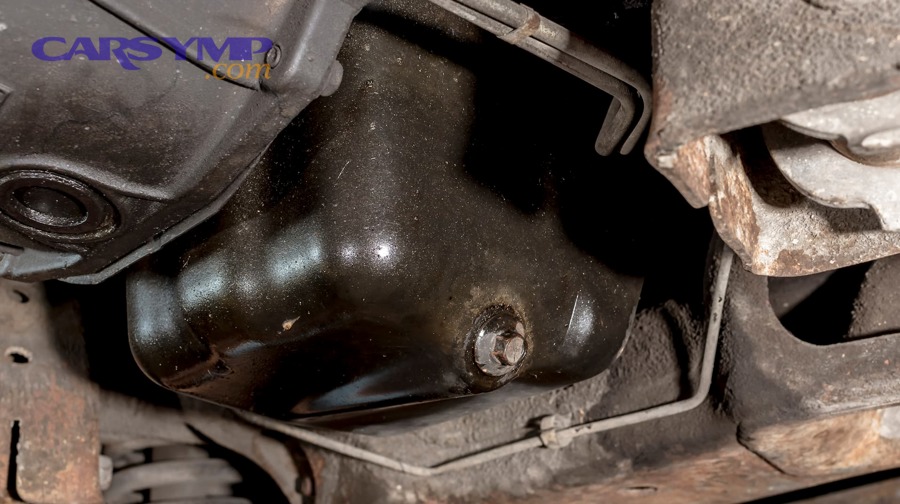
Is oil on the driveway always an oil pan gasket leak?
No—oil on the driveway is not always an oil pan gasket leak for at least three reasons: oil can drip from higher gaskets and collect on the pan, oil can leak from service points like the filter or drain plug, and oil can travel along shields and brackets before it drops.
Then, use a controlled test so you stop guessing:
- Place a piece of clean cardboard under the engine overnight.
- Note the spot location relative to the engine bay.
- Check the dipstick level the next morning (engine off, level ground).
- Inspect the highest wet point under the engine with a flashlight.
If the highest wet point is above the oil pan rail, you likely have a different source. If the highest wet point is the oil pan seam, the oil pan gasket moves back to the top of the list.
What warning lights or oil level changes can happen with an oil pan gasket leak?
An oil pan gasket leak can trigger oil level changes that range from “slowly dropping dipstick readings” to urgent warnings, because the leak reduces the oil reserve and can eventually starve the oil pump during turns, braking, or high RPM.
More specifically, you must separate two warnings:
- Low oil level message (if equipped): oil quantity is reduced; you may still have normal pressure right now.
- Oil pressure warning light: oil pressure is dangerously low right now; you should stop the engine as soon as it is safe.
An oil pan leak often starts as a nuisance but can become an engine-risk event if the driver does not monitor oil level. That is why “oil pan leak” symptoms should always include a simple habit: check the dipstick more frequently until the leak is repaired.
Which symptoms mean the leak is getting worse fast?
There are 5 symptom clusters that usually mean an oil pan gasket leak is worsening quickly—based on rate and risk: (1) puddles growing day-to-day, (2) drips appearing while the engine idles, (3) oil level dropping noticeably between short drives, (4) smell or smoke increasing after driving, and (5) oil spreading onto belts, mounts, or wiring.
More importantly, you should treat “rate” as the deciding factor. A small damp seam might stay stable for months, but a fresh drip that starts after an oil change, after an impact, or after a long high-speed drive can accelerate fast.
To make this measurable, track two numbers:
- Time: how long it takes to form a visible drip after shutdown
- Volume: how much the dipstick drops per week (or per 100 miles)
These simple measurements also help a mechanic confirm severity without relying on vague descriptions.
How do you tell an oil pan gasket leak from other engine oil leaks?
An oil pan gasket leak wins the “lowest seam wetness” test, a drain plug or filter leak is best identified by “single-point dripping,” and valve cover or rear main leaks are most often confirmed by “oil starting higher and traveling downward.”
Then, you can apply the same comparison criteria every time:
- Leak height: where the oil begins (highest wet point)
- Leak shape: seam line vs single point vs broad wet area
- Leak timing: after service vs after heat/drive vs constant seep
- Leak path: straight down vs blown backward by airflow
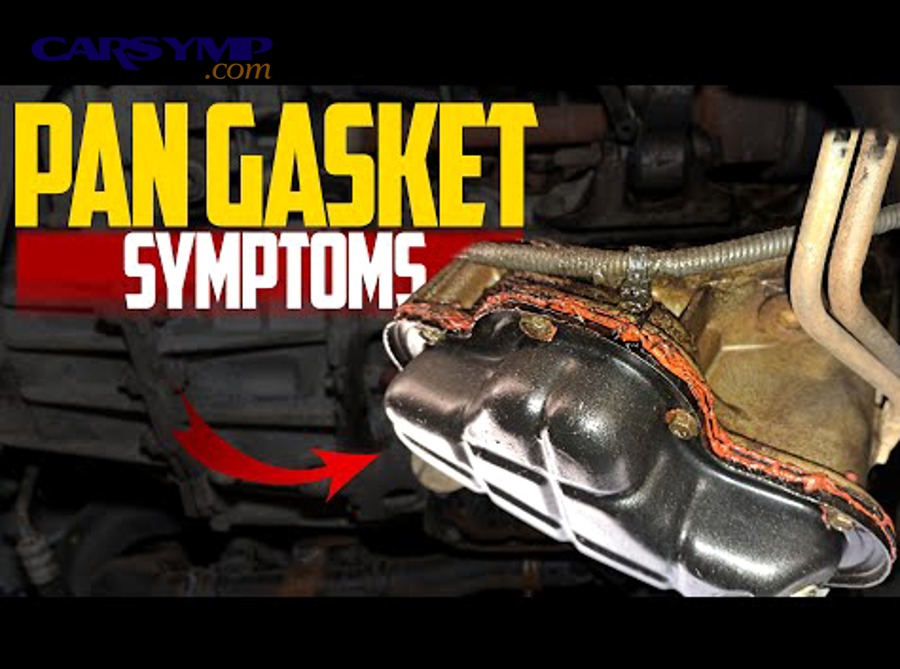
Oil pan gasket leak vs drain plug or oil filter leak: what’s different?
An oil pan gasket leak wins on “perimeter seam wetness,” while a drain plug or oil filter leak is best for “one obvious drip point” and often appears soon after service or when the engine is running.
However, you should not overthink this comparison. A drain plug leak usually creates oil concentrated around the plug and may drip from the plug head. An oil filter leak typically makes the filter and nearby housing wet, and oil can run down the engine block in a narrow path.
This is the practical takeaway for fast troubleshooting:
- If the oil is centered on the drain plug or filter, suspect a service-point leak first.
- If the oil is evenly wet along the pan rail or corners, suspect the oil pan gasket first.
If you are planning engine oil leak repair at home, always check the filter and drain plug before assuming a gasket job, because they are easier fixes and are common after oil changes.
Oil pan gasket leak vs valve cover gasket leak: how can oil from above fool you?
An oil pan gasket leak stays low, but a Valve cover gasket leak diagnosis often starts at the top of the engine and then “paints” the lower engine with oil as gravity pulls oil downward.
Next, look for “oil from above” indicators:
- Oil wetness on the side of the engine block
- Oil residue around the valve cover perimeter
- Oil pooling near ignition components (engine-specific)
- Oil trails that start high and end on the oil pan
This is why many drivers think they have an oil pan leak when the real issue is higher. The pan becomes the collection tray, not the cause.
Oil pan gasket leak vs rear main seal leak: how does the leak location change?
Oil pan gasket leaks usually show wetness along the oil pan seam, but rear main seal leaks most often show oil concentrated near the transmission bellhousing area, because the rear main seal sits where the crankshaft exits the engine.
Meanwhile, the confusion happens because both leak zones can drip near the center of the car. Use the “bellhousing vs pan rail” rule:
- Wet bellhousing edge and back-of-engine area → rear main becomes more likely
- Wet pan rail all around, especially corners → oil pan gasket becomes more likely
If the leak is severe and hard to see, a shop may recommend a dye trace to separate overlapping leak paths.
Can you drive with oil pan gasket leak symptoms?
Yes—but you can drive with oil pan gasket leak symptoms only if three conditions stay true: the oil level remains safely within range, the leak rate is slow and stable, and there is no smoke, burning odor escalation, or oil pressure warning.
Then, you should treat this decision as a safety checklist instead of a guess, because “Can you drive with an oil leak” depends on rate and risk, not on the name of the gasket.

How do you rate the leak as mild, moderate, or severe at home?
There are 3 main leak severity levels—based on drip frequency and oil loss: mild (seep/wet seam), moderate (regular drips after driving), and severe (steady drip or fast oil loss), and you can rate them by measuring spots and dipstick changes over time.
Next, use this practical rubric (imperfect but useful):
- Mild: damp seam, occasional small spot; dipstick barely changes week to week
- Moderate: repeated spots after each drive; visible drips form on the pan lip; dipstick drops noticeably over a week
- Severe: drips while idling or continuous dripping after shutdown; rapid dipstick drop; smoke/odor risk rises
To make the rubric more reliable, do two things:
- Clean the area once (so you are measuring fresh oil, not old grime).
- Track oil level consistently (same parking spot, same dipstick checking method).
This approach prevents both panic (“one old stain looks huge”) and denial (“it’s fine until it isn’t”).
When should you stop driving immediately and get a tow?
You should stop driving immediately and get a tow if any 3 of these triggers appear: an oil pressure warning light, loud ticking/knocking with low oil, visible smoke from the engine bay, a rapidly dropping oil level, or strong burning odor that worsens during the drive.
More importantly, do not “limp it home” with an oil pressure warning, because pressure loss can damage bearings quickly. Also, do not ignore smoke, because the most dangerous version of Oil burning smell and smoke causes is oil contacting very hot surfaces.
If you must move the car a short distance for safety, shut the engine off as soon as possible and seek professional help.
How can you confirm the oil pan gasket is the real source of the leak?
You can confirm the oil pan gasket is the real leak source with a clean–run–recheck method in 4 steps: clean the suspected area, run and warm the engine, re-inspect the highest wet point, and verify whether oil reappears first at the oil pan seam.
Then, you can escalate to a dye trace only if the leak remains ambiguous, because dye is most useful for slow leaks that spread across multiple surfaces.
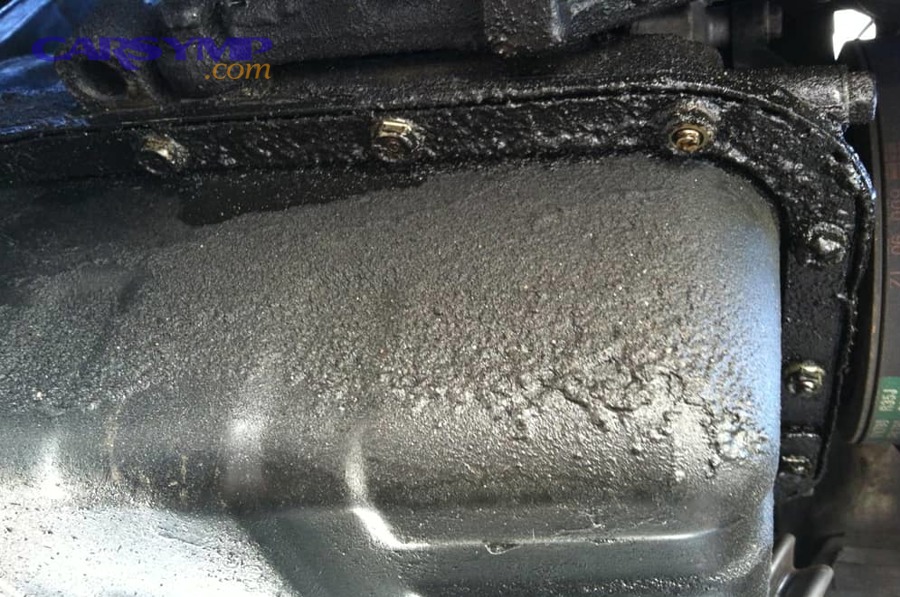
What’s the simplest DIY check to trace an oil leak to the oil pan seam?
The simplest DIY check is to degrease the underside, dry it completely, drive until warm, then inspect the oil pan rail with a flashlight to see whether fresh oil starts at the seam before it appears anywhere else.
Specifically, do it like this:
- Safety first: park level, cool engine, use wheel chocks, and never crawl under a car supported only by a jack.
- Clean: use degreaser and a brush on the oil pan seam and the nearby block surface.
- Dry: wipe and let it air dry so new oil stands out.
- Warm: idle 10–15 minutes and/or take a short drive.
- Inspect: look for the first bead of oil at the seam; follow the trail upward if needed.
If the first fresh wetness appears above the seam, shift your diagnosis upward instead of forcing the oil pan gasket conclusion.
Should you use a UV dye test for oil leak tracing?
Yes—when the leak is slow, messy, or shared across multiple possible sources, you should use a UV dye test for oil leak tracing because it highlights the exact leak path, reduces misdiagnosis, and helps confirm whether the oil pan gasket replacement is actually necessary.
However, dye is not your first move when the leak is obvious. If the drain plug is dripping or the filter is wet, fix those first. Dye becomes valuable when you have “oil everywhere” and you need a single truth.
Here is the high-level workflow:
- Add the correct dye for engine oil
- Drive enough time for dye to circulate and leak
- Scan with UV light in low ambient light
- Follow the glowing trail to the highest origin point
What mistakes cause misdiagnosis (and wasted repairs)?
There are 6 common mistakes that cause oil leak misdiagnosis—based on process failures: skipping cleaning, chasing the puddle location, ignoring leaks from above, overlooking undertrays, confusing fluids, and assuming “tightening bolts” fixes a failed gasket.
Next, connect each mistake to the consequence:
- If you skip cleaning, you cannot tell new oil from old residue.
- If you chase the puddle, you may repair the wrong seal because oil travels.
- If you ignore upper leaks, you may miss a valve cover gasket leak diagnosis and replace the wrong gasket.
- If you forget the undertray, you may think the oil pan gasket is leaking because the tray dumps oil at a corner.
- If you confuse fluids, you may mislabel the leak and waste time.
- If you overtighten, you can deform the sealing surface or squeeze out gasket material and worsen the leak.
This is why accurate diagnosis is a core part of engine oil leak repair: the best repair is the one aimed at the true source.
Contextual Border: You now have a complete symptom-and-differentiation framework, plus an urgency checklist and confirmation method. Next, you can expand into cost expectations and prevention strategies that strengthen long-term reliability.
How much does an oil pan gasket repair cost, and how can you prevent future leaks?
There are 3 main cost tiers for oil pan gasket work—based on access difficulty: low (easy access), mid (partial obstruction), and high (subframe/steering components or complex sealing), and prevention relies on correct installation, monitoring, and protecting the oil pan from future damage.
Next, you should treat “cost” and “prevention” as two halves of the same decision, because the cheapest oil pan gasket replacement becomes expensive if the leak returns due to poor torque practices or unaddressed crankcase pressure.
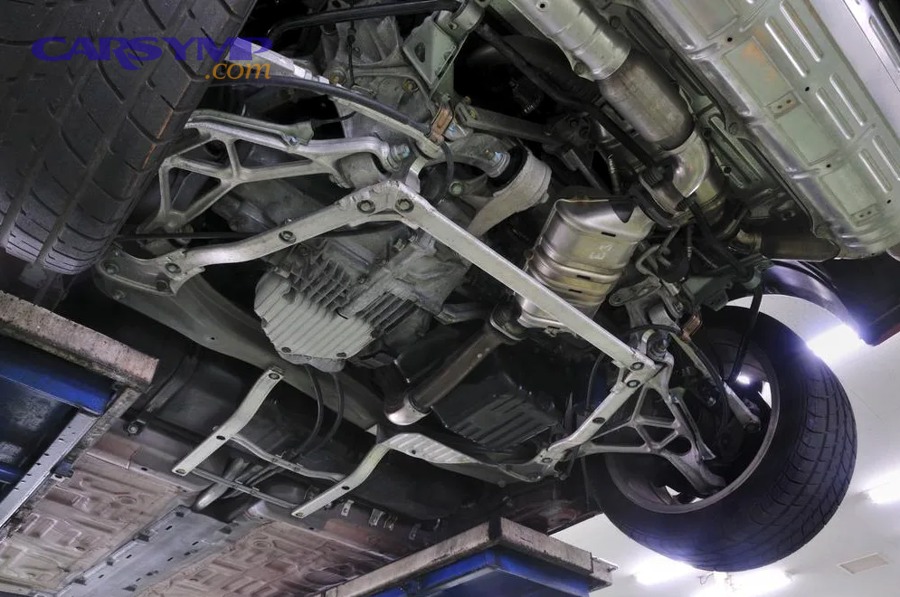
What factors make oil pan gasket replacement expensive on some cars?
There are 6 factors that increase oil pan gasket replacement cost—based on labor time: limited access, subframe interference, AWD components, steering rack clearance, engine mount support requirements, and sealing method complexity.
More specifically, “access” controls cost more than the gasket price. The gasket may be inexpensive, but labor rises when the pan cannot drop straight down. Some vehicles require supporting the engine, removing crossmembers, or working around exhaust sections. That extra labor becomes the primary cost driver.
If you are comparing estimates, ask a direct question: “What must be removed to access the oil pan?” The answer usually explains the quote.
Is DIY oil pan gasket replacement worth it for most car owners?
Yes—DIY oil pan gasket replacement can be worth it for many car owners for three reasons: it can save labor cost, it teaches you to verify leak sources, and it allows careful cleaning and torque control—if you can safely lift the vehicle and follow torque specifications.
However, DIY is not always the best choice. The job becomes risky when the car needs major disassembly, when rusted fasteners are likely to snap, or when the manufacturer uses sealant procedures that require precise cure timing and clean surfaces.
If you do DIY, treat these as non-negotiables:
- Safe support (quality jack stands, stable ground, wheel chocks)
- Correct torque pattern and torque values
- Proper surface cleaning and gasket alignment
- Oil level verification after reassembly and after the first heat cycle
How do you prevent future under-car oil leaks after the repair?
There are 5 main prevention moves—based on what causes repeat leaks: torque correctly, keep the PCV system healthy, protect the oil pan from impacts, verify oil level routinely, and fix small leaks early before oil spreads to seals and rubber parts.
More importantly, prevention is not only “install a new gasket.” A high crankcase pressure condition can push oil past seals and make minor seepage worse, so a basic PCV check is a smart companion step on higher-mileage engines. Also, a dented or warped pan can defeat a new gasket, so inspection matters.
This is the practical prevention loop:
- Install correctly (clean, align, torque)
- Confirm no fresh wetness after driving
- Recheck oil level over the next week
- Inspect periodically for new seepage
- Address pressure or impact issues early
When is the oil pan itself (not just the gasket) the real problem?
The oil pan is the real problem when the sealing surface is warped, dented, corroded, or stripped, because a new gasket cannot compensate for a damaged mating surface.
On the other hand, a gasket-only failure is more likely when the pan is intact but the seal material has aged and hardened. Use this comparison rule:
- Pan damage signs: visible dents near the sealing rail, distorted bolt holes, rust-through, persistent leaks after correct installation
- Gasket failure signs: seep at the seam with an otherwise solid pan, improved sealing after correct replacement
If the pan is damaged, replacing it may be the most reliable long-term fix—even if the upfront cost is higher—because it restores the sealing geometry that the gasket needs.