


If you want to locate an exhaust leak without guessing, follow a front-to-back process: narrow the zone, pinpoint the joint or crack, then confirm the leak path with a low-risk test. That approach is faster than swapping parts because it turns “I hear a noise” into “the leak is at this flange seam.”
Next, you’ll learn the most common leak locations from the exhaust manifold to the muffler, plus the symptom patterns that point to each zone—so you don’t confuse a heat shield rattle with a real leak.
Then, you’ll get a safe DIY workflow that starts cold, uses simple tools, and avoids the two biggest hazards: burns and carbon monoxide exposure. This workflow is designed to be repeatable, so you can confirm your result.
Introduce a new idea: once you can pinpoint and confirm the leak location, you can decide whether you’re looking at exhaust leak repair that’s a quick clamp fix, a gasket replacement, or something that needs a shop-level smoke test.
What is an exhaust leak, and why does finding the exact location matter before you repair it?
An exhaust leak is an unintended opening in the exhaust system—at a gasket, flange, crack, flex section, or rust hole—that lets exhaust gases escape before they’re routed safely out the tailpipe; locating the exact opening matters because every leak type has a different fix and risk profile.
More importantly, exhaust leaks are rarely “just noise.” A small leak near the front of the system can pull fresh air into the stream during low flow conditions, which can confuse engine control feedback, while a larger leak can dump hot gas and soot where you don’t want it. If you skip location work and jump straight to parts, you often end up doing Temporary fixes vs proper repairs backwards—patching a symptom while the real failure keeps growing.
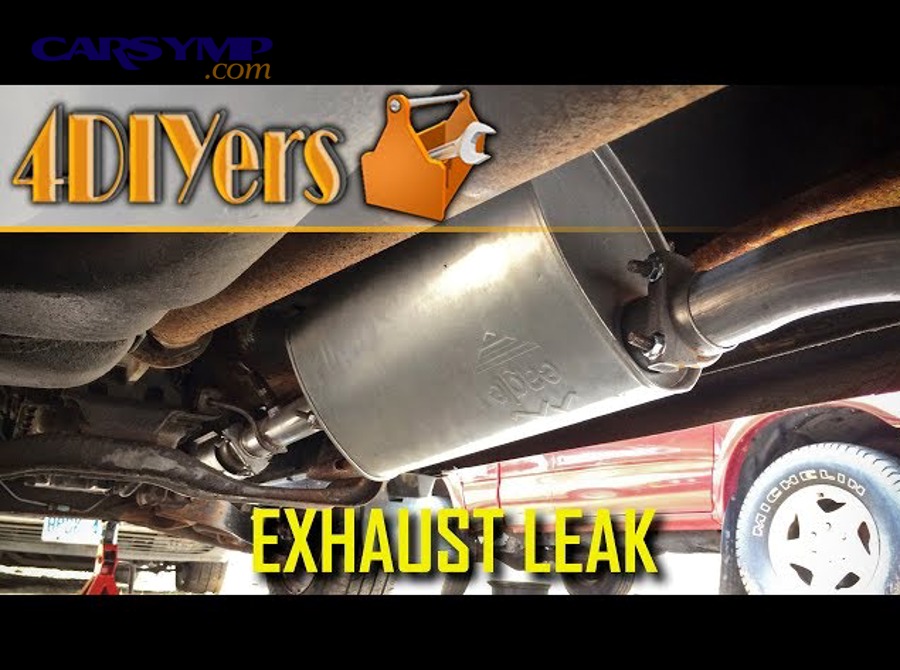
What are the most reliable signs that point to an exhaust leak (sound, smell, soot, performance)?
There are 4 main signs of an exhaust leak—sound, smell, soot, and behavior—based on how and where gases escape.
1) Sound (most common):
- Ticking on cold start near the engine bay often suggests a manifold or gasket leak. The tick can soften as metal expands.
- Putter / chuff sound under the car often points to a mid-pipe joint, flange, or flex section.
- Louder under load (accelerating up a hill) frequently indicates a leak that “opens” with movement or pressure.
2) Smell (most important safety clue):
- Exhaust odor outside the car can simply mean a leak under the vehicle.
- Exhaust odor inside the cabin, especially at idle or low speed, is a red flag—treat it as urgent.
3) Soot patterns (most diagnostic):
- Dry black soot at a seam, clamp, donut gasket, or flange usually marks the leak exit.
- On stainless sections, you may see a dark “carbon track” line where gas blows past a joint.
4) Performance/driveability (supporting clue):
- Occasional “lean” behavior, rough idle, or trim-related codes can happen when leaks are upstream of sensors.
- On some cars, you can feel a slight loss of response due to reduced scavenging/backpressure balance (more noticeable on small turbo engines).
Can an exhaust leak be dangerous, and when should you avoid running the engine during testing?
Yes—an exhaust leak can be dangerous because it can expose you to carbon monoxide, it can direct hot exhaust onto wiring or plastic, and it can increase the chance you’ll test unsafely under a running vehicle.
Use these three safety stop rules:
- Stop immediately if you smell exhaust inside the cabin with windows up, especially if you feel headache, dizziness, or nausea. A damaged exhaust or blocked tailpipe can push CO into occupied spaces. (pmc.ncbi.nlm.nih.gov)
- Do not run the engine in a closed garage, even with the door open—ventilation is still unreliable.
- Avoid prolonged tailpipe blocking tests. Brief restriction can help locate leaks, but excessive backpressure is unsafe and can damage components.
Evidence: According to a study by Tufts University School of Medicine from the Department of Emergency Medicine, in 2004, lethal carbon monoxide levels occurred within 2.5 minutes in a snow-obstructed vehicle when windows were closed. (pmc.ncbi.nlm.nih.gov)
Where do exhaust leaks usually happen from manifold to muffler?
There are 3 main leak zones in an exhaust system—front, mid, and rear—based on where heat cycling, movement, and corrosion stress concentrate.
Instead of crawling the entire length randomly, start by understanding “where leaks like to live.” The front fails from heat and hardware fatigue, the middle fails from movement and flexing, and the rear fails from moisture and rust. That map lets your inspection feel intentional, not like a scavenger hunt.
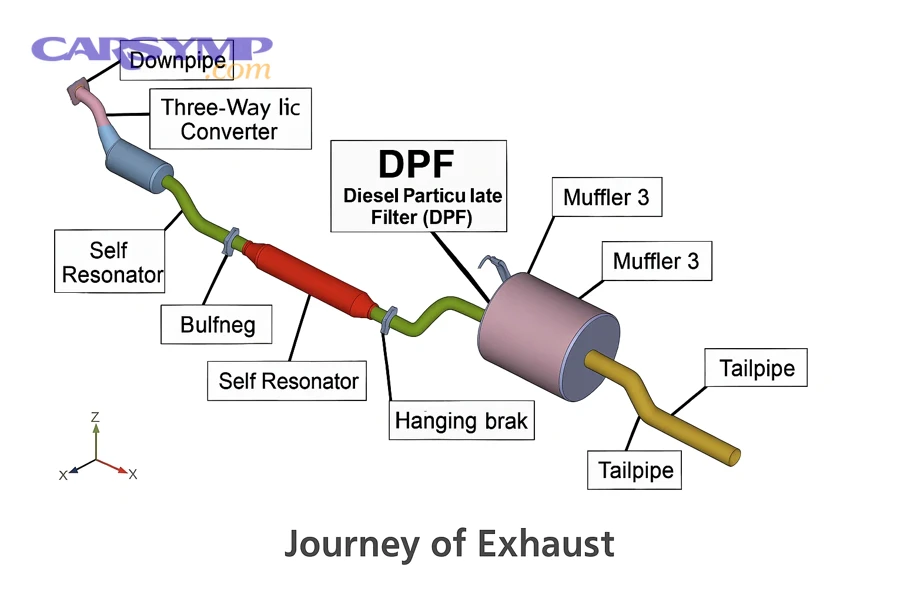
Which front-end leak points are most common (manifold, gasket, donut, downpipe, flex pipe)?
Front-end leaks usually happen at interfaces—places where two parts meet—or at thin sections that flex.
Most common front leak points (in order):
- Exhaust manifold-to-head gasket area: heat cycling loosens hardware; gaskets crush and fatigue.
- Cracked manifold runners or collector: common on older cast manifolds or stressed turbo setups.
- Donut gasket / ball-and-socket joint: designed to move; eventually it wears and leaks.
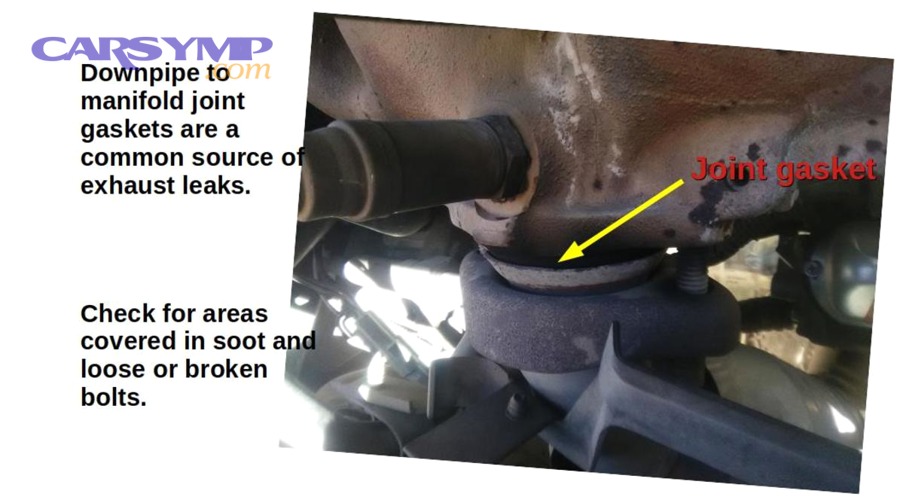
- Downpipe flange gaskets: bolts loosen, studs break, gaskets warp.
- Flex pipe braid/inner bellows: road salt + movement + vibration = tears or pinholes.
Fast clue: if the noise is loudest at the top of the engine bay and sounds like a metallic tick on cold start, start here first.
Which mid-to-rear leak points are most common (cat joints, resonator, muffler seams, tailpipe rust-through)?
Mid-to-rear leaks cluster where the pipe is clamped, welded, or hangs under the car.
Most common mid/rear leak points:
- Flange connections before/after the catalytic converter: gaskets blow out; bolts rust away.
- Slip joints and clamps: clamp loses tension, pipe corrodes under the band.
- Resonator seams and welds: weld fatigue cracks.
- Muffler inlet/outlet seams: moisture traps inside; rust-through starts at seams.
- Tailpipe sections near bends: condensation and road debris accelerate corrosion.
A useful mental model: the rear of the system is a corrosion environment, so look for swelling, flaking, and wet-looking soot deposits.
How do you tell a heat shield rattle from a true exhaust leak noise?
An exhaust leak is usually a gas sound (tick/chuff/putter), while a heat shield issue is usually a metal sound (rattle/buzz).
Exhaust leak pattern:
- Often louder under load
- Has a puffing rhythm that tracks engine pulses
- Often leaves soot evidence
Heat shield rattle pattern:
- Often worse at specific RPM ranges (resonance)
- Can change when you tap the shield with the engine off (after cooling)
- Rarely leaves soot
If you’re unsure, don’t decide by sound alone—use a confirmation test under the next section. That’s how you avoid “fixing” a rattle with a gasket, or chasing a leak by tightening heat shield bolts.
What is the safest step-by-step workflow to locate and confirm an exhaust leak at home?
The safest workflow is a 4-step method—cold start observation, visual inspection, sound localization, and leak confirmation—designed to pinpoint the exact leak location without touching hot parts or breathing fumes.
To make this reliable, repeat the same sequence every time you test. That consistency is what turns a one-off guess into a confirmed diagnosis.
What should you check first during a cold start to narrow the leak area quickly?
Start cold because metal expansion can temporarily “seal” small cracks and change sounds.
Cold-start checklist (2–3 minutes max):
- Stand outside, not behind the tailpipe. Listen near the engine bay, then along the side of the car.
- Note the character: tick (front), chuff (mid), roar (rear).
- Look for visible pulses: sometimes you can see condensation “puff” from a seam on cold mornings (don’t confuse normal tailpipe vapor with a leak).
- Smell test with distance: if odor is strong near the front wheel well or firewall area, prioritize the front zone.
If the tick fades after a few minutes, that’s still a clue—it often means a front-area leak that tightens as parts warm.
What visual inspection steps find most leaks without special tools?
Visual inspection finds a surprising percentage of leaks because exhaust leaks leave tracks.
Do this with the engine OFF and cool:
- Scan for black soot around: manifold flange, downpipe flange, slip joints, clamp edges, and weld seams.
- Look for missing bolts, broken studs, or crooked flanges (a warped flange can’t seal even with a new gasket).
- Check the flex pipe for frayed braid, dents, or dark soot staining.
- Inspect hangers: if the system sags, joints can pull apart and leak.
Tip that speeds everything up: wipe suspicious seams with a dry rag. Fresh soot reappearing after a short drive often marks the true leak.
Which listening techniques work best to pinpoint the leak (and what should you avoid)?
The best listening technique is directed listening—focusing sound from specific zones—without putting hands near moving belts or hot metal.
Good options:
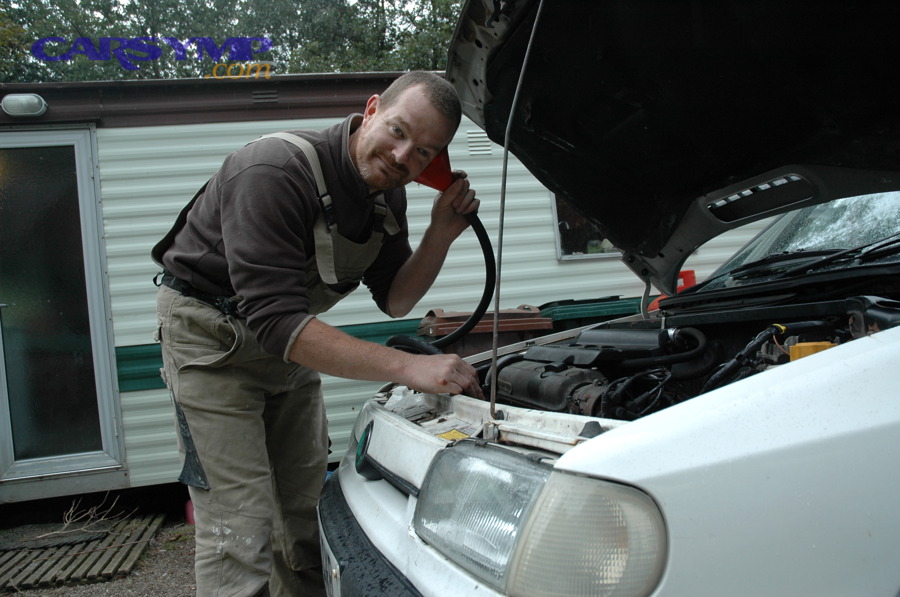
- A length of hose (acts like a stethoscope): one end near your ear, the other end moved near seams (keep distance; don’t touch hot parts).
- A helper who lightly holds RPM around 1,500–2,000 while you listen from the side of the car (never under an unsupported vehicle).
Avoid:
- Touching exhaust to “feel” leaks—burn risk.
- Listening directly from behind the tailpipe—fume exposure.
- Running the car for long periods in still air—CO risk.
If you’re getting inconsistent sound cues, transition to a confirmation method rather than listening longer.
How do you confirm a suspected leak using low-risk tests (paper/tissue, soapy water, brief tailpipe block)?
There are 3 low-risk confirmation methods, each best for specific leak types.
1) Paper/tissue test (good for accessible joints):
- Hold a small strip of tissue near a seam (not touching).
- If it flutters in a repeating pulse away from the seam, you likely found the leak.
2) Soapy water bubble test (best for pinpointing small leaks):
- Mix dish soap with water in a spray bottle.
- Spray suspected seams when cool or only mildly warm (avoid rapid cooling on very hot components).
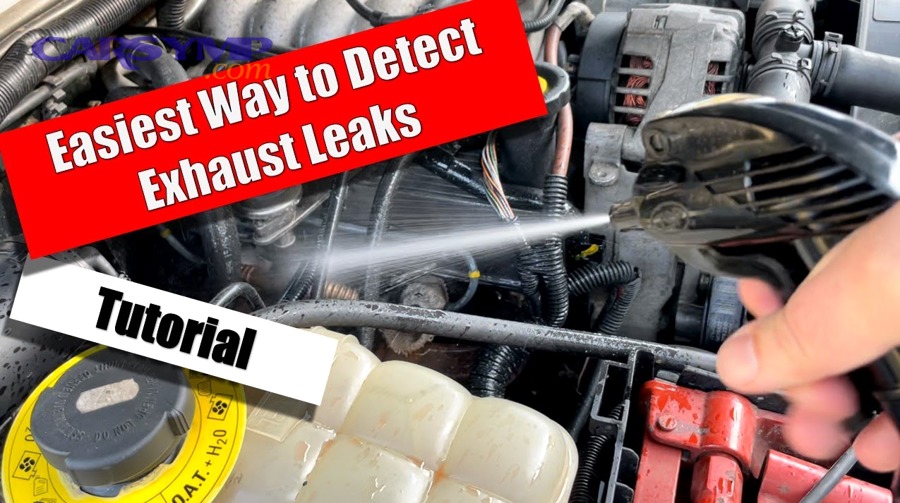
- A leak produces growing bubbles or a foamy “breathing” effect at the exit point.
3) Brief tailpipe block (fast zone confirmation, not pinpoint precision):
- Use a rag to partially restrict the tailpipe for 1–2 seconds while a helper idles the engine.
- Listen for a sudden increase in hiss/chuff at the leak point.
- Release immediately; do not maintain backpressure.
This is also where you start thinking ahead to repair quality: confirmation should lead you to the right exhaust leak repair approach—tighten, reseal, replace a gasket, or replace a rusted section—rather than guessing.
Which detection method should you choose for your situation: simple DIY vs advanced testing?
Soapy water wins for pinpoint accuracy, a brief tailpipe restriction is best for fast zone confirmation, and a smoke test is optimal when leaks are hidden or multiple—so the “best” method depends on your access, leak size, and whether you need proof before buying parts.
However, choosing a method is easier if you compare them using the same criteria: precision, safety, cost, and repeatability. The table below summarizes what each method is best at so you can match the tool to the problem.
Method comparison table (what it contains): This table compares common exhaust leak detection methods by accuracy, best use case, and safety notes.
| Method | Best for | Precision | Safety notes |
|---|---|---|---|
| Visual soot inspection | Most leaks with carbon tracking | Medium | Cool engine; use eye protection |
| Hose/listening | Narrowing zone quickly | Medium | Keep away from belts/hot parts |
| Tissue/paper | Confirming airflow at seams | Medium | Avoid hot surfaces; short tests |
| Soapy water | Pinpointing small leaks | High | Don’t spray super-hot components |
| Brief tailpipe restriction | Amplifying leak sound | Low–Medium | Keep it brief; avoid high RPM |
| Smoke machine | Hidden/multiple leaks | Very high | Low-pressure only; shop preferred |
Is soapy water better than the “tailpipe block” test for finding small leaks?
Soapy water wins for small leaks, while the tailpipe block test is better for quickly confirming “yes, there’s a leak somewhere.”
Soapy water advantages (small leaks):
- Shows exact exit point (bubbles form at the hole).
- Helps you distinguish seam leak vs cracked weld.
- Works well when the leak is quiet but still present.
Tailpipe restriction advantages (fast confirmation):
- Makes leaks louder quickly, especially mid/rear leaks.
- Useful when you can’t visually access the leak but can hear it.
Best practice: use tailpipe restriction to confirm the zone, then use soapy water to pinpoint the exact seam you’ll repair.
When is a smoke test the fastest way to find the exact leak location?
Yes—a smoke test is the fastest way when leaks are hidden, intermittent, or multiple, or when the system layout makes listening unreliable.
A smoke machine pushes visible vapor through the exhaust at low pressure, and the leak shows itself as smoke exiting at the failure point. It’s especially effective when:
- The leak is above a heat shield you can’t remove easily
- The leak is near complex flanges on turbo/downpipe setups
- You suspect more than one leak (common on rust-belt vehicles)
If you’re already considering “patching for now,” a smoke test can prevent the classic mistake of sealing the loud leak while missing the dangerous one nearer the cabin.
Do scan-tool clues (fuel trims/O2 behavior) help confirm an exhaust leak location?
Yes—scan data can support diagnosis, but it rarely pinpoints location by itself because it reflects what the ECU thinks is happening, not where the hole physically is.
This is where “How leaks affect O2 readings and fuel trims” matters in plain terms:
- If a leak is upstream of the upstream O2 sensor, fresh air can enter and cause the sensor to report a leaner condition than reality.
- The ECU may respond by adding fuel (positive trims), especially at idle and light load where exhaust flow is lowest and reversion effects are more noticeable.
Evidence: According to a study by Opole University of Technology from the Faculty of Mechanical Engineering, in 2018, researchers simulated an exhaust leak near the wideband oxygen sensor and observed clear shifts toward lean operation (reported lambda rising to about 1.14–1.17 versus about 1.02 in factory configuration), alongside altered oxygen sensor signals on dynamometer testing. (oeconomia.pl)
How can you verify you found the true leak location before spending money on parts?
You can verify the true leak location by using a 3-part proof checklist—repeatable symptom reproduction, visible/physical confirmation at the seam, and a before/after re-test—so you don’t replace gaskets, sensors, or mufflers that aren’t actually leaking.
In addition, verification is the moment you decide whether you’re doing Temporary fixes vs proper repairs. A verified leak at a flange might deserve a gasket and hardware refresh, while a verified rust hole in a muffler case may mean section replacement—not a patch that fails next month.
What are the most common false positives that mimic an exhaust leak?
There are 5 common false positives that people mistake for exhaust leaks, grouped by sound source:
- Heat shield rattle (buzzing at certain RPM)
- Accessory bearing noise (whine or chirp that changes with load)
- Injector ticking (fast, even tick that doesn’t “puff”)
- Valve train tick (top-engine tick that follows RPM smoothly)
- Loose hanger contact (thump or resonance as the exhaust hits the body)
A practical rule: if you can’t find soot, can’t provoke bubbles, and the sound behaves like resonance (only at one RPM band), assume false positive until proven otherwise.
What quick re-test confirms success after tightening or repositioning clamps/hangers?
Yes—success is confirmed when the same test that identified the leak no longer shows it, and the symptom disappears under the same conditions.
Quick re-test routine (5 minutes):
- Repeat your original confirmation test (soapy water or tissue) at the same seam.
- Start cold if the leak was cold-start dependent.
- Do a short drive, then recheck for fresh soot at the same location.
If the leak is confirmed gone, you’ve earned the right to stop chasing sensor codes and move forward with long-term repair planning. If it returns, that’s your signal to upgrade from a “tighten” approach to a true exhaust leak repair—new gasket, new clamp, or replacement of the compromised section.
At this point, you should be able to pinpoint and confirm the leak location from the manifold to the muffler using safe DIY checks. Next, we’ll expand into advanced diagnostics, edge cases, and related questions that help in less common situations.
What advanced diagnostics and edge cases help when the exhaust leak is hard to find?
Advanced diagnostics matter when the leak is too small to hear, too hidden to see, or too complex to isolate—and the goal remains the same: locate, confirm, then choose the correct repair path instead of guessing.

In addition, edge cases are where DIYers lose time. Intermittent leaks, turbo/downpipe joints, and sensor-related confusion can make a real leak look like a fuel problem—or make a fuel problem look like a leak—unless you use the right tool for proof.
How does a professional smoke machine test work, and what can it reveal that DIY methods miss?
A smoke test is a low-pressure vapor test that reveals leak points by making escaping flow visible.
How it works (conceptually):
- The system is lightly sealed at an opening.
- Smoke is introduced at controlled pressure.
- Leak points show as smoke trails from seams, cracks, or pinholes.
What it can reveal that DIY misses:
- Leaks above heat shields or tight clearances
- Multiple pinholes along a rusted seam
- Leaks that only open when the system is positioned a certain way (movement-induced gaps)
Smoke testing is often the fastest way to prevent “repair whack-a-mole,” where you fix one leak and immediately hear the next.
Can ultrasonic leak detectors or electronic listening tools pinpoint tiny leaks better than your ear?
Yes—ultrasonic tools can outperform your ear for tiny leaks because they detect high-frequency turbulence that’s hard to perceive in a noisy environment.
Where they help most:
- Small pinholes at weld seams
- Leaks hidden behind shields
- Noisy shops or windy outdoor conditions
Where they struggle:
- Very large leaks (everything “sounds loud”)
- Areas with lots of other high-frequency noise sources
Think of ultrasonic detection as a precision tool for the last 10% of cases where the leak is real, but your senses can’t isolate it.
What changes if the vehicle has a turbo/downpipe or modified exhaust (and why do leaks behave differently)?
Turbo/downpipe systems change leak behavior because the front section can run hotter, see different pressure dynamics, and include more specialized joints.
Key differences:
- Higher heat and stress near turbine housings and v-band clamps
- More potential for standing-wave/reversion effects at low flow, which can influence sensor readings
- Modified systems can introduce misalignment (pipes not perfectly seated), creating “looks tight but leaks” joints
If you have modifications, prioritize precise confirmation (soapy water or smoke) over sound alone, because resonance and thin-wall tubing can mislead you.
Is it possible the “exhaust leak” is actually something else (condensation, drone, NVH resonance)?
Yes—sometimes what sounds like an exhaust leak is actually normal condensation vapor, exhaust drone, or resonance from a loose component, and you can rule these out with a simple contrast check.
Leak vs condensation:
- Condensation vapor is typically visible at the tailpipe on cold days and disappears as the system warms.
- A leak often produces soot tracks and local pulses at a seam.
Leak vs drone:
- Drone is a low-frequency cabin resonance at a steady speed/RPM.
- A leak is usually a localized tick/chuff that changes with load.
Leak vs NVH contact:
- Contact issues often appear after exhaust work (pipe touching a brace).
- A true leak leaves evidence (bubbles/soot) and responds to confirmation tests.
If you keep the rule “confirm at the seam,” you won’t get trapped fixing the wrong problem—whether you’re doing a temporary patch or planning a proper replacement.