


No, you should not keep driving far or “just ignore it” when your car smells like oil is burning, because that odor often signals oil contacting hot parts, reduced lubrication, or an emerging fire risk.
To reduce damage, your first goal is to decide whether you can move the car a short distance to a safer spot or whether you should shut it down immediately and arrange a tow.
Next, you’ll want a quick, practical way to narrow the likely source (leak on exhaust, spill after service, PCV blow-by, turbo issues, or accessory belt contamination) so you can describe it clearly to a shop.
To start, the steps below focus on safety-first triage, then simple checks you can do in minutes, and finally repair planning and prevention so the problem doesn’t come back.
Can you drive when your car smells like oil is burning?
Usually no—you should only drive briefly (or not at all) because the smell can mean oil is hitting the exhaust, oil level is dropping, or heat is building near wiring and hoses.
To begin, treat this as a risk decision, not a comfort issue: your next action depends on how intense the odor is, whether you see smoke, and whether the oil level is safe.

When it might be okay to drive a very short distance
It may be acceptable to drive only a short distance (think: to a safer shoulder, nearby parking lot, or the closest service bay) if the odor is mild, there’s no smoke, temperatures are normal, and the oil level is within the safe range.
Next, keep speed low, avoid hard acceleration, and turn off the HVAC “fresh air” intake if fumes are entering the cabin.
- Mild odor that fades at idle and does not worsen under load.
- No visible smoke from the engine bay or undercarriage.
- No warning lights for oil pressure or overheating.
- Oil level safe on the dipstick, with no signs of rapid loss.
When you should stop immediately and not continue
Stop driving immediately if you see smoke, the smell is strong or suddenly worse, oil pressure warning appears, temperature rises, or you hear new mechanical noise that suggests lubrication loss.
In that case, shut the engine off, move to safety, and plan for a tow—continuing can turn a manageable leak into engine damage or an under-hood fire.
- Smoke or haze drifting from the hood seam or wheel wells.
- Oil pressure light or “low oil pressure” message.
- Temperature climbing or coolant warning.
- Burning odor in the cabin that stings eyes or causes coughing.
- Fresh puddle forming quickly when you park.
Why the risk is higher than many drivers assume
The smell can come from oil dripping onto parts that run extremely hot (like exhaust components), and that heat can degrade rubber, wiring insulation, and nearby plastic, even if you never see flames.
Additionally, if the underlying issue is low oil level or pressure, the engine can suffer accelerated wear in minutes under load.
What should you do right now to reduce risk and damage?
Do three things: get to a safe stop, check oil level, and look for visible leaks or smoke before deciding whether to drive, idle, or shut down.
Next, your goal is to gather a few clear observations—because the right diagnosis depends on when the odor appears, where it seems strongest, and what changed recently.
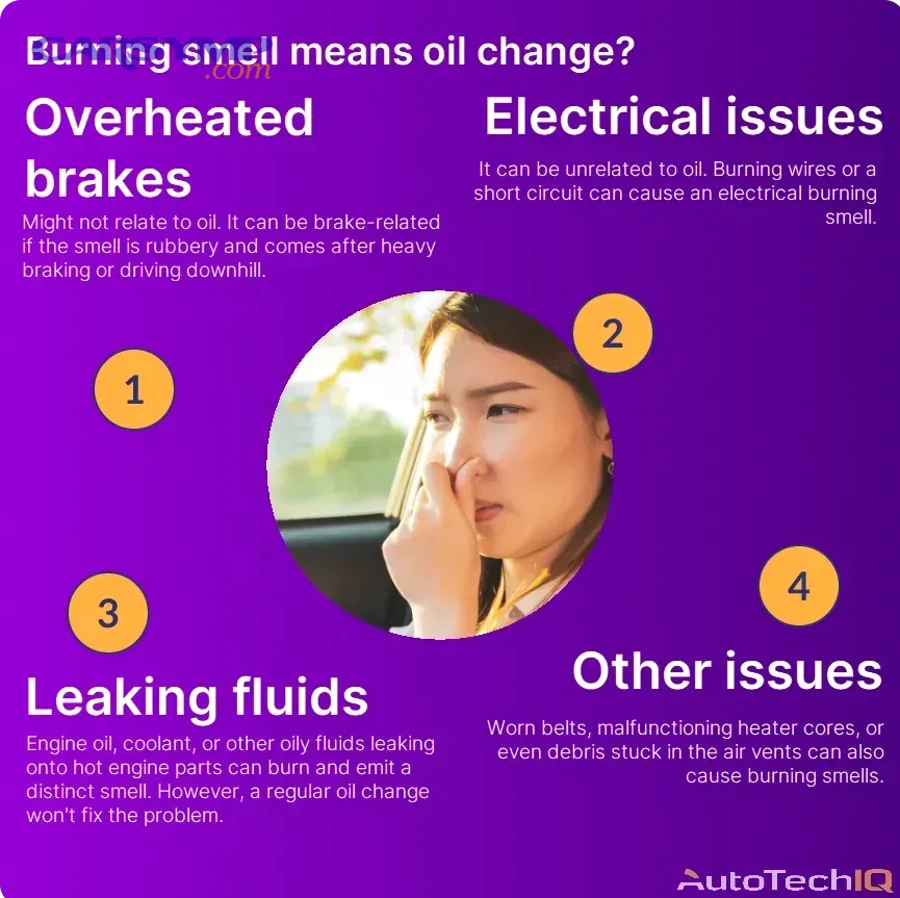
Step 1: Make a safety-first stop and avoid feeding a potential fire
Pull over safely, shift to park, set the parking brake, and keep people away from the front of the car until you confirm there’s no active smoke plume.
To start, avoid opening the hood immediately if you see heavy smoke—sudden airflow can intensify a fire if one is starting.
- Turn off the engine if the odor is strong or worsening.
- Do not park over dry grass or flammable debris if you suspect dripping fluids.
- If smoke is heavy, step back and call for help.
Step 2: Check the oil level the right way
Check the dipstick on level ground after a short wait (a few minutes) so oil drains back, then confirm the level is between the safe marks and note whether it looks unusually thin, foamy, or contaminated.
Next, if the level is low, do not assume “topping off fixes it”—low oil can be a symptom of an active leak or consumption issue that will return under driving conditions.
- Below minimum: shut down and avoid driving.
- At minimum: only move the car a short distance if no smoke and temps are stable.
- Overfilled: avoid driving; overfill can increase crankcase pressure and push oil into places it shouldn’t go.
Step 3: Quick visual checks that help pinpoint the source
Look for wet oil on the back of the engine, around the valve cover area, and on the exhaust heat shields; also check for fresh drips near the front subframe and on splash shields.
After that, sniff carefully around the wheel wells and near the hood gaps—odor location can hint whether oil is dripping down the rear of the engine onto hot exhaust parts.
- Wet oil on heat shield often points to a leak above it.
- Oil on undertray can spread odor widely, masking the true leak point.
- Oil near serpentine belt can create odor and belt noise.
What are the most common causes of an oil-burning odor while driving?
There are five main causes: oil leaking onto hot exhaust parts, oil spilled during service, crankcase ventilation problems, oil contacting belts/pulleys, or oil burning internally in the engine or turbo system.
To understand which one fits, match the timing (cold start vs after warming up), the location (front vs rear of engine), and any recent work (oil change, gasket repair, PCV service).

Leak dripping onto exhaust components
This is the classic scenario: oil escapes from a gasket or seal above the exhaust and lands on hot metal, producing an odor that often worsens after the engine warms up and can intensify in stop-and-go traffic.
Next, look for smoke wisps that appear after idling, then fade once airflow increases while driving.
- Valve cover area and rear of engine (common on many transverse engines).
- Oil filter housing or cooler seals on some platforms.
- Oil pressure switch or sender leaks that spray fine mist.
Oil spilled during an oil change or top-off
If the smell started right after service, spilled oil on the engine cover, exhaust heat shield, or undertray can cook off for a short period, especially after a longer drive.
However, if it persists beyond several drives or gets stronger, assume a leak or incorrect installation rather than “normal burn-off.”
- Oil on the exhaust shield near the filter area.
- Oil residue on the undertray spreading odor with airflow.
- Loose filter or drain plug causing a slow, ongoing drip.
Crankcase ventilation and pressure issues
A restricted PCV system can raise crankcase pressure, pushing oil mist into the intake or past seals, which can create odor and sometimes blue smoke on acceleration or after idling.
Next, pay attention to idle quality and whether you see oily residue in the intake tract.
- Oil mist collects in intake piping and burns intermittently.
- Seals weep more under pressure, especially when hot.
- Odor can be stronger after highway runs.
Oil contamination on belts, pulleys, or rubber parts
Oil on a serpentine belt can smell hot and also lead to squeal, slipping, or premature belt failure; it can fling oil around the engine bay, making the source look worse than it is.
After that, check belt surfaces for a glossy, wet look and inspect nearby seals and gaskets above the belt line.
- Front crank seal leaks can spread oil across pulleys.
- Power steering or engine mount areas can collect drips.
- Odor often peaks after longer driving when everything is hottest.
Internal oil burning (engine or turbo-related)
When oil is burning inside the engine, the odor can be accompanied by blue smoke from the exhaust, increased consumption, and deposits around the tailpipe; turbo seals can create similar signs plus oily charge pipes.
Next, track oil level over time—rapid consumption is a strong diagnostic clue.
- Blue smoke after idling can suggest valve seal wear.
- Blue smoke under acceleration can suggest ring blow-by.
- Turbocharged engines may show oil in intercooler piping.
How can you tell if the smell is dangerous or just temporary?
It’s dangerous when it’s strong, worsening, paired with smoke, or linked to oil loss; it’s more likely temporary when it began right after service and fades steadily without smoke or level change.
To make the call, compare symptoms across three checks: intensity trend, smoke/heat signs, and oil level stability over a short window.

Trend test: does it worsen with heat and time?
If the odor grows stronger as the engine warms and becomes sharp after a longer drive, treat it as a persistent heat-contact issue until proven otherwise.
Next, note whether it peaks after stopping (heat soak), which commonly happens when oil is sitting on hot shields or exhaust parts.
- Worsening: likely active leak or ongoing burning source.
- Fading: could be spilled oil cooking off, but monitor closely.
Smoke and residue test: what do you see and where?
Light wisps near the firewall side of the engine, or smoke that appears at idle, often points to oil contacting hot parts; thick smoke or dripping requires immediate shutdown.
After that, check the undertray and heat shield edges for fresh wetness, because oil can hide above them and drip only when hot and thin.
Oil level stability test: measure, don’t guess
Check the dipstick now, then recheck after a short controlled drive or after the engine cools, and look for noticeable loss; any drop suggests a leak or consumption severe enough to stop driving longer distances.
Next, if you add oil, record how much—tracking consumption is more reliable than memory.
Cabin exposure test: are fumes entering the interior?
If fumes enter the cabin, especially with the heater on, the situation is more urgent because it can indicate engine-bay smoke being pulled into the HVAC intake near the cowl area.
Next, switch the HVAC to recirculation and plan to stop driving if the odor persists inside.
How do you diagnose the source at home in 10–20 minutes?
Use a simple four-part check: inspect for wetness above the exhaust, check the oil filter/drain area, look for belt contamination, and do a short idle test to see where smoke begins.
To start, you’re not trying to “fix it” in the driveway—you’re trying to narrow the leak zone so repairs are faster and safer.

Check 1: Look above hot zones first
Use a flashlight to inspect the highest wet point you can see above the exhaust area, because oil flows downward and the topmost wetness is often closest to the true leak source.
Next, inspect around gasket seams and sensor bodies where oil can seep and then drip onto hot shields.
- Back of engine near firewall (common drip path to exhaust).
- Oil filter housing perimeter and cooler lines (platform-dependent).
- Oil pressure switch/sender area for wet electrical connector.
Check 2: Inspect the oil service points
Verify the oil filter is properly seated, the drain plug area is dry, and the undertray isn’t soaked—fresh oil here can mimic a major leak elsewhere when airflow spreads it.
After that, wipe suspect areas and see if oil returns after a short idle.
- Dry paper towel test around the filter base.
- Look for a thin stream pattern from a loose plug.
- Check for double-gasketed oil filter (rare but messy).
Check 3: Belt and pulley contamination
Inspect the serpentine belt path for oil shine and check nearby seals, because oil flung by pulleys can coat the engine bay and create a confusing odor trail.
Next, listen for squeal or chirp that changes with steering or A/C load—belt slip often accompanies contamination.
Check 4: Controlled idle test for smoke origin
With the car in park and the hood open, let it idle briefly and watch for the first place smoke appears; the earliest smoke point often reveals where oil contacts heat.
However, if smoke increases quickly or you see active dripping on hot parts, shut down immediately.
What does it cost to fix, and what repairs are most typical?
Costs vary widely, but most fixes fall into three buckets: cleaning and rechecking after service, replacing an external gasket or seal, or addressing internal oil burning that increases consumption.
To plan smartly, estimate cost based on access difficulty (top vs rear vs undercarriage), whether parts are bundled (housing assemblies), and whether cleaning/UV dye is needed to confirm the leak.

This table helps you map common symptom patterns to likely repair categories and typical urgency, so you can prioritize what to fix first.
| What you notice | Common repair category | Urgency | Why it matters |
|---|---|---|---|
| Odor after service, no smoke, no oil loss | Cleaning + recheck | Low to Medium | Spilled oil may burn off, but leaks must be ruled out |
| Odor worsens hot, light smoke at idle | External leak onto hot surface (gasket/seal) | High | Heat contact can damage hoses/wiring and escalate risk |
| Oil drops on dipstick, wet undertray | External leak with active loss | Very High | Low oil can cause rapid wear and engine damage |
| Blue exhaust smoke + rising oil consumption | Internal burning (rings/valve seals/turbo) | Medium to High | Can foul catalysts and worsen over time |
Typical external repairs that often solve the problem
Many cases are fixed by replacing a leaking gasket or seal and cleaning the affected heat shield area, then verifying no oil contacts hot parts during a test drive.
Next, ask whether the shop will confirm the leak origin (cleaning or UV dye) before replacing parts, because oil migration can mislead.
- Valve cover gasket or grommets (common leak point on many engines).
- Oil filter housing seals or cooler seals (platform-dependent).
- Oil pan gasket or drain plug sealing washer issues.
- Front/rear main seal leaks (more labor-intensive, varies by vehicle).
When internal burning becomes the main suspect
If oil level drops without clear external wetness, or you see blue smoke from the tailpipe, internal consumption becomes more likely and may require further testing rather than immediate gasket replacement.
After that, a shop may check PCV function, compression/leak-down, turbo system condition, and evidence of oil in intake plumbing.
How to talk to a shop so you get a faster, more accurate repair
Give the shop a short, structured description: when the odor appears (cold start vs hot), whether smoke is visible, where it seems strongest, and whether oil level changes over 1–2 checks.
Next, mention any recent service, because “started right after an oil change” shifts the diagnostic priority immediately.
- “Odor starts after 10 minutes of driving and peaks at stoplights.”
- “Light smoke from the rear of the engine bay after idling.”
- “Oil level dropped from mid-mark to near-min in two days.”
How can you prevent the smell from coming back after repair?
Prevent recurrence by combining correct oil service habits, leak verification after repairs, and monitoring oil level and crankcase ventilation—because many repeat cases come from missed residue, re-leaks, or pressure issues.
To begin, focus on the simple habits that stop oil from ever reaching hot surfaces again.

Clean-up and verification after any leak repair
After fixing a leak, residue left on heat shields and undertrays can continue producing odor, so cleaning and a follow-up inspection are part of a complete repair, not an optional extra.
Next, confirm with a short recheck: look for new wetness after a few heat cycles.
- Clean heat shields and the underside where oil previously dripped.
- Ensure undertray is not saturated and can drain/vent properly.
- Recheck the same spots after 2–3 drives.
Better oil-change habits that reduce future problems
Use the correct oil spec and fill volume, tighten the filter properly, replace crush washers when required, and wipe any spilled oil immediately—small spills are the most common “mystery odor” after service.
After that, confirm there’s no seepage around the filter base and drain plug right away, not days later.
Monitor oil level and consumption patterns
Check oil level on a consistent schedule and record it, because early detection of small losses prevents the chain reaction of low oil, heat, and accelerated wear.
Next, if your vehicle is known to consume oil, shorten your check intervals and keep top-off oil in the trunk.
Address crankcase ventilation health
Keeping the PCV system functioning reduces crankcase pressure, helps seals last longer, and can reduce the likelihood of oil mist entering the intake and producing intermittent odor.
Next, if you notice sludge, frequent short trips, or poor idle, ask a shop to evaluate ventilation rather than repeatedly chasing small leaks.
Contextual Border: The main safety and diagnosis steps above apply to most vehicles. The section below expands into related scenarios, edge cases, and closely linked odor comparisons so you can avoid misdiagnosis.
Related scenarios, edge cases, and practical FAQs
This section covers uncommon but important situations and closely related odor sources, so you can separate oil-related smells from look-alikes and avoid replacing the wrong parts.
Next, use these questions when symptoms don’t match the “typical leak onto exhaust” pattern.

What if the smell started right after service and you suspect a spill?
If the odor began immediately after maintenance, mention the phrase Burning smell after oil change diagnosis when you describe symptoms, then focus on whether the odor fades across a few heat cycles and whether oil level stays stable.
However, if the smell intensifies, returns every drive, or you see wetness, treat it as an active leak rather than normal burn-off.
What if you see smoke from under the hood but can’t find a leak?
If you have intermittent smoke, describe it using Smoke from engine bay diagnosis language: when it starts, where it appears first, and whether it’s worse at idle—this helps a shop check heat shields, rear-of-engine leaks, and undertray pooling.
Next, ask whether they can clean and use UV dye to confirm the true source instead of guessing from migrated oil.
How do you avoid confusing oil odor with coolant odor?
When you’re unsure, use Oil leak vs coolant leak smell comparison thinking: oil odor is often sharp and acrid with heat contact, while coolant odor tends to be sweet and can leave crusty residue near hoses, radiator, or the reservoir area.
Next, check fluid levels in both systems and look for evidence: oily wetness versus dried white/green residue.
FAQ: Quick answers people search for most often
- Will the smell go away on its own? Sometimes spilled oil cooks off, but recurring odor usually means an ongoing leak or pressure issue.
- Is it okay to idle in place if I don’t drive? Not necessarily—heat soak at idle can worsen oil-on-exhaust burning and increase smoke.
- Can I just add oil and keep going? Topping off may prevent immediate low-oil damage, but it does not remove the heat-contact risk if oil is dripping onto hot parts.
- What’s the single best clue? Whether the odor worsens hot and whether oil level changes—those two observations steer diagnosis quickly.
Later in the diagnostic process, you can safely use the exact phrase burning oil smell in your notes to a mechanic, because it captures the symptom precisely—just make sure you also include when it happens, whether smoke is present, and whether oil level is dropping.
- oil leak onto exhaust
- oil level check
- engine bay smoke
- PCV pressure
- undertray oil pooling
- seal and gasket leak points