


If your car suddenly smells “off,” the odor alone can help you compare an oil leak versus a coolant leak—often before you ever see a puddle. Oil typically creates a hot, sharp, smoky odor when it hits warm engine parts, while coolant more often produces a sweet, syrupy smell as it warms up or evaporates.
Beyond the scent, you can narrow the answer by asking three quick questions: Where does the smell enter the cabin, when does it happen (cold start vs fully warmed), and what secondary symptom appears (steam, smoke, temperature changes, or warning lights)?
Next, a simple “look–touch–confirm” routine can prevent guesswork: check fluid levels, trace wet spots, and match the smell to the leak location (valve cover area versus radiator/hoses/heater core). That approach reduces misdiagnosis—especially when one leak masks the other.
To begin, here’s a structured comparison that moves from smell signatures to root causes, then to safe next actions, using a clear flow that connects each clue to the next decision.
What does an oil leak smell like compared to a coolant leak?
Oil leak odor is usually sharper and smokier when oil drips onto hot metal, while coolant leak odor is often sweeter and more “syrupy” as coolant heats and evaporates. However, the strongest clue is how the smell changes with temperature and airflow.
Next, connect the smell to where heat lives under the hood, because heat transforms mild wetness into loud odor.
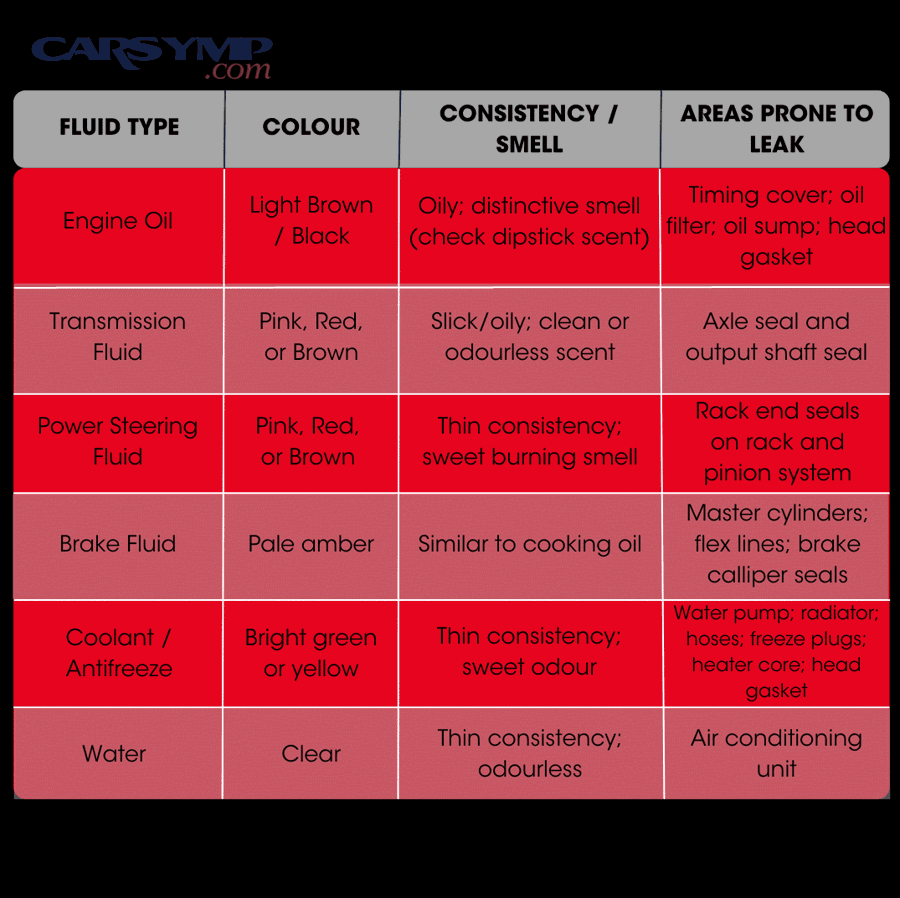
Oil smell profile: hot-metal, smoky, sometimes tar-like
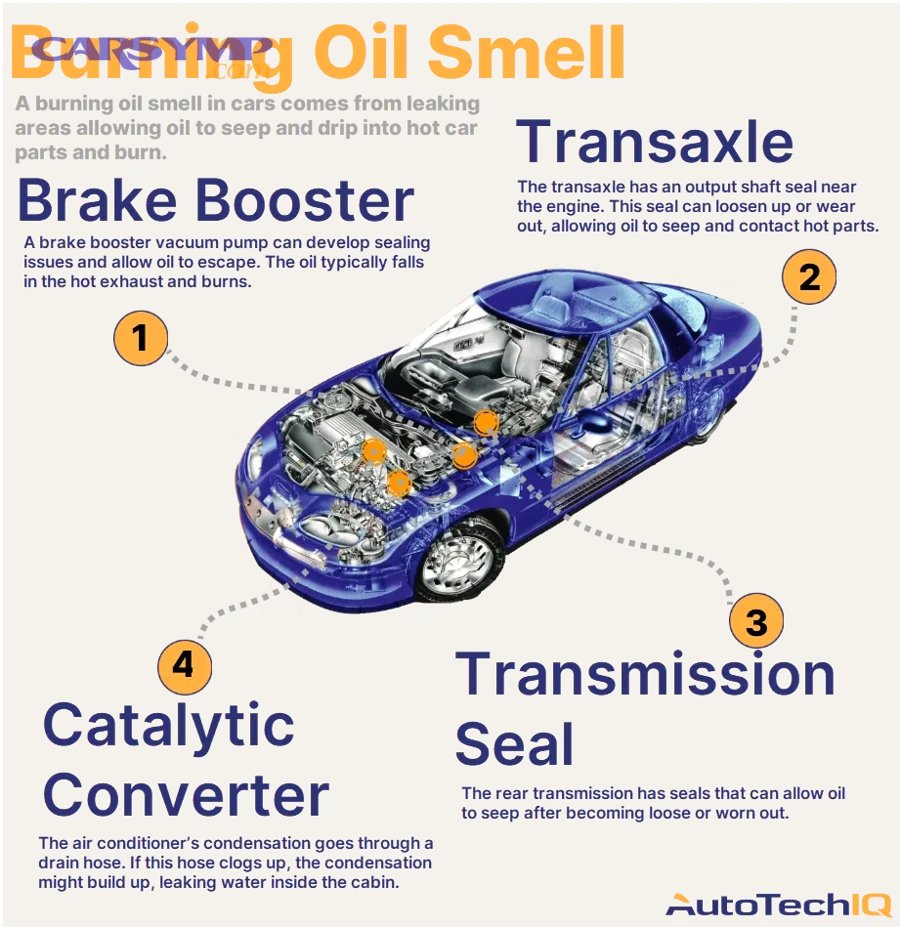
Oil rarely smells strong when it is simply pooling; it smells intense when it reaches a hot surface. Cụ thể, oil that lands on the exhaust manifold, turbo housing, downpipe, or catalytic converter can produce a pungent, eye-watering odor and faint haze.
To connect this clue, ask whether the smell increases after spirited driving or idling at a stoplight—both raise under-hood temperatures and reduce airflow.
- When strongest: after the engine is fully warm, in traffic, or after highway driving.
- Where noticed: near the hood seam, through HVAC intake, or around the wheel well if oil reaches a hot exhaust section downstream.
- Common feel: oily film on nearby components; dust sticks to it, creating a grimy “baked-on” surface.
Coolant smell profile: sweet, chemical, sometimes “maple-like”
Coolant odor often registers as sweet and slightly sharp, especially near the radiator cap area, upper hose connections, and the heater core circuit. Ví dụ, a small seep can smell strong even if it leaves little visible residue because warm coolant can vaporize quickly.
To move forward, check whether the smell is strongest right after shutdown—heat soak can push coolant vapor out of a small leak.
- When strongest: during warm-up, after shutdown, or when the cooling fan cycles.
- Where noticed: front grille area, near the coolant reservoir, or inside the cabin if the heater core leaks.
- Common feel: slightly slick, watery film; sometimes leaves a chalky/white or crusty residue after drying.
Why the same car can “mix” smells and confuse you
Oil and coolant odors can overlap because both can land on hot surfaces and both can be carried into the cabin by airflow. Cụ thể hơn, a valve cover leak can mimic coolant smell when it burns lightly and mixes with road moisture, while a coolant leak near the exhaust can mimic a smoky odor.
So, the best comparison always includes smell + location + symptom—not smell alone.
Where do you usually smell it, and what does that location mean?
The location of the smell—engine bay, exhaust area, cabin vents, or under the car—directly points to which system is leaking. If you map odor entry points, you can narrow the leak source before any tools come out.
After that, you can “móc xích” to the next step: match the likely smell zone to the most common leak components in that zone.

Smell strongest under the hood near the top of the engine
This pattern often favors an oil leak from the valve cover gasket, oil filler cap seal, PCV-related blow-by mist, or cam carrier areas. Cụ thể, oil seeps at the top can drip down onto hotter parts later, creating delayed odor after driving.
To link forward, use a flashlight and look for a wet “edge line” along gasket seams and around the oil fill area.
Smell strongest at the very front of the car
This often favors coolant leaks at the radiator end tanks, upper/lower radiator hoses, hose clamps, radiator cap area, or the reservoir seam. Ví dụ, a tiny crack at the radiator neck can vent vapor under pressure and smell sweet without leaving a big puddle.
Next, compare the reservoir level before and after a few drives—coolant loss trends are more diagnostic than a one-time glance.
Smell comes through HVAC vents, especially with heat on
This pattern frequently points to coolant in the heater circuit, such as a heater core seep, heater hose connection leak at the firewall, or a coolant control valve leak (where applicable). Cụ thể hơn, you may also notice persistent windshield fogging or damp carpet in front footwells.
To transition, test whether the odor intensifies when you switch between outside air and recirculation—outside air can pull engine-bay odors in, while recirc emphasizes cabin-source odors.
Smell near the wheel well or under the center of the car
If the odor concentrates near a wheel well, it can be oil carried rearward by airflow or coolant spraying from a hose under pressure. If it’s mid-car, oil dripping onto exhaust components along the underside can create a noticeable smell after a drive.
Next, look for fresh wetness on undertrays and heat shields—those surfaces “tell” the direction of drip travel.
What other symptoms help confirm oil vs coolant leakage?
Smell becomes reliable when you pair it with a second symptom: smoke or steam, fluid level changes, temperature behavior, or residue type. Oil leaks more often leave greasy dirt buildup, while coolant leaks more often leave crusty deposits and can affect cooling performance.
Next, use the symptom pairing that best matches what you observe today—then confirm with a quick inspection.

Smoke vs steam: what you see matters
Oil on hot parts typically produces bluish or grayish smoke and a “burnt” odor, while coolant more often creates white steam that dissipates quickly and can leave a faint sweet smell. Cụ thể, coolant steam may appear after shutdown when heat soak boils small residue on metal surfaces.
To connect this clue, observe the plume: does it linger like smoke (oil) or vanish like steam (coolant)?
Fluid level trend: the most objective evidence
A consistent drop in the engine oil level on the dipstick suggests oil loss, while a consistent drop in the coolant reservoir level (when checked cold) suggests coolant loss. Ví dụ, topping off both and tracking changes over a week is more diagnostic than guessing from one smell event.
Next, record the levels with a photo each time—simple documentation reduces uncertainty.
Residue and texture: greasy film vs chalky crust
Oil typically leaves a slick, greasy film that attracts dust and becomes dark sludge; coolant typically dries into a whitish or colored crust (depending on coolant type) near hose ends and seams. Cụ thể hơn, coolant stains can look like dried sugar around a clamp.
To move forward, wipe a suspicious area with a clean white paper towel and compare the smear pattern.
Temperature and heater performance: coolant’s “signature”
Coolant leaks are more likely to coincide with rising temperature, fluctuating gauge readings, weak cabin heat, or intermittent overheating under load. Oil leaks usually do not change the temperature gauge directly, unless the leak also affects another system (for example, oil on a belt or sensor).
Next, if temperature behavior has changed, prioritize cooling-system checks even if the smell seems “oil-like.”
How can you quickly test and confirm which fluid is leaking?
You can confirm oil versus coolant by combining a clean inspection, a level check, and a targeted sniff test near the most likely components—without dismantling anything. The goal is to identify the leak origin, not just the drip location.
After that, you can decide whether the next step is cleaning, tightening, replacing a seal, or scheduling a shop diagnosis.
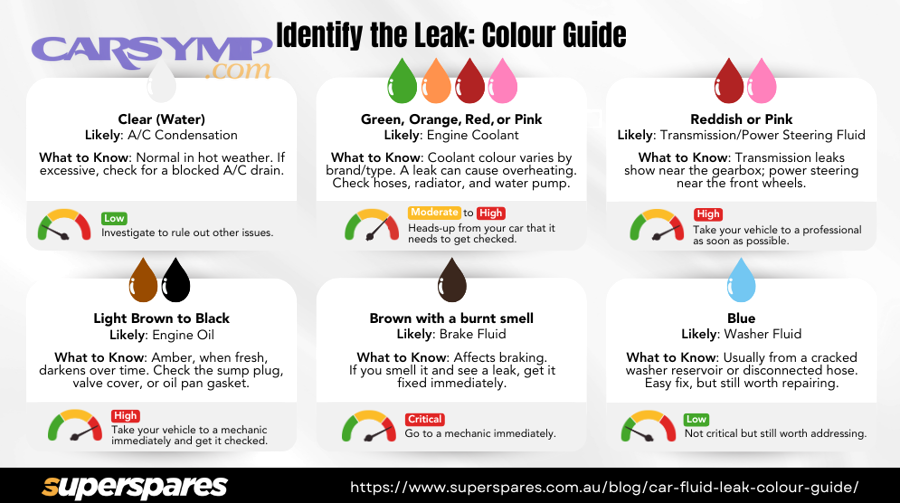
Step 1: Check levels correctly (cold vs warm matters)
Check engine oil with the car on level ground using the dipstick procedure recommended for your engine type. Check coolant only when the engine is cold, using the reservoir markings rather than opening a hot cap. Cụ thể, coolant expands when hot, so “hot checks” can mislead you.
Next, if either level is low, don’t just top off—look for the wet trail that caused the loss.
Step 2: Clean the suspected area and re-check after a drive
Cleaning makes small leaks visible. Use a safe degreaser on oil-grimy areas (avoid electrical connectors), then drive and re-inspect. Coolant leaks may show as fresh dampness near hose ends or as a new crust line after drying.
To link forward, re-check right after the drive and again after cooldown—different leaks reveal themselves at different temperature stages.
Step 3: Focus on high-probability leak points first
Oil often escapes from valve cover gaskets, oil filter housing seals, oil pan gaskets, front/rear main seals, turbo oil feed/return lines, and oil cooler seals. Coolant often escapes from radiator seams, hose connections, thermostat housing, water pump weep holes, heater hoses, and plastic fittings that age and crack.
Next, trace the wetness upward; gravity makes leaks look like they come from lower parts than they actually do.
Step 4: Use dye or powder only when needed
If the leak is elusive, UV dye kits exist for oil and for coolant, and leak-detection powder can reveal seep paths. Use the correct dye for the correct system and follow product instructions carefully.
Next, once you confirm which system is leaking, you can prioritize repairs by risk rather than by smell intensity.
Which common oil leak sources create the strongest odor?
The strongest oil odors usually come from leaks that land on the hottest parts—especially exhaust components—because oil vaporizes and burns, amplifying scent dramatically. The “smell-to-source” shortcut is to look for oil above the exhaust path.
After that, you can connect each likely source to a typical pattern of when the odor appears.
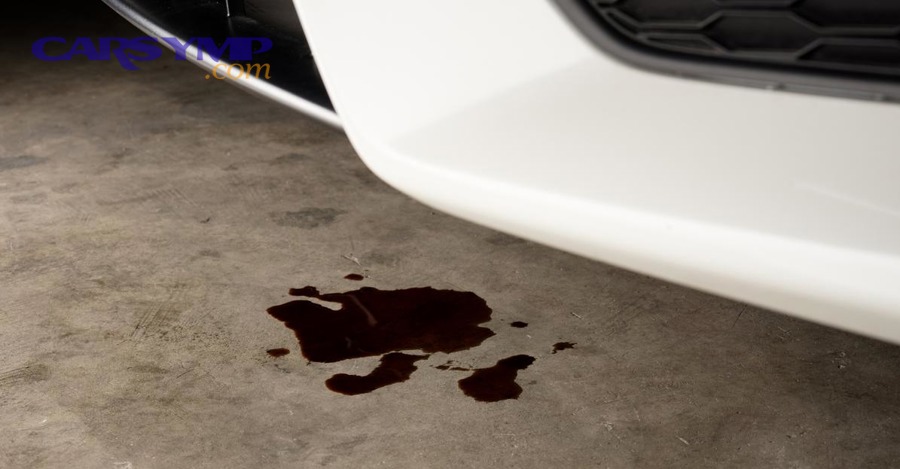
Valve cover gasket and cam area leaks
Oil from the top of the engine can run down onto exhaust manifolds or heat shields, producing odor mostly after the engine is hot. Cụ thể, you may see wetness along the valve cover edge and on nearby wiring loom coverings.
Next, check for oil in spark plug wells on some engines—this points strongly to valve cover sealing issues.
Oil filter, filter housing, and oil cooler seals
These leaks can spray or seep under pressure and can coat nearby hot parts quickly. Ví dụ, a loose filter or a double-gasketed filter can cause rapid oil loss and an immediate odor after startup.
To transition, check for fresh oil tracks below the filter area and for oil pooling on the splash shield.
Turbo oil feed/return lines and heat-adjacent leaks
On turbocharged engines, oil lines and seals live near extreme heat. A small seep can produce a strong smell with minimal visible dripping. Cụ thể hơn, odor may spike after boosting or a long climb due to increased exhaust temperatures.
Next, inspect for oily dampness around line fittings and for smoke that rises from behind the engine.
Oil on belts and pulleys: the hidden “odor multiplier”
Oil that reaches a belt can be flung across the engine bay, spreading smell and making the leak appear worse than it is. You might see oily speckles on the underside of the hood or across accessory brackets.
Next, prioritize belt inspection because oil-soaked belts can slip, squeal, or degrade prematurely.
Which common coolant leak sources create the most noticeable smell?
Coolant smell becomes most noticeable when a leak vents vapor under pressure or when coolant lands on hot parts and flashes into steam. Many coolant leaks are small but “loud” in odor because the vapor carries easily.
Next, map the smell to cooling-system pressure cycles—fans, warm-up, and shutdown often expose the leak.

Radiator seams, end tanks, and hose connections
Plastic end tanks and hose necks can develop hairline cracks with age. When the system pressurizes, coolant can mist outward and evaporate, creating a sweet odor. Cụ thể, look for dampness near clamp lines or a colored stain on the radiator core support.
Next, inspect with the engine warm but turned off, using a light—small seep lines often glisten.
Thermostat housing and plastic fittings
Thermostat housings (often plastic) can warp or crack, especially after repeated heat cycles. The leak may be slow but steady, leaving a crust ring. Ví dụ, odor might appear right after shutdown when hot coolant seeps and steams.
To connect forward, follow the hose to every junction—fittings are a frequent failure point.
Water pump weep hole and seal seepage
Many water pumps have a weep hole that can show early seal failure. A small leak here can produce smell and residue without a large puddle, especially if the serpentine belt disperses droplets.
Next, check below the pump area for colored crust and for dampness behind pulleys.
Heater core and cabin-side coolant leaks
If the odor is strongest inside the cabin and lingers, a heater core seep becomes more likely. You may also notice greasy-feeling film on the inside of windows or damp carpet. Cụ thể hơn, the smell may intensify when you turn the heater on.
Next, confirm by checking the coolant level trend and inspecting the firewall heater hose connections for seepage.
What should you do immediately when you notice a strong leak smell?
Your first move is to reduce risk: stop prolonged idling, avoid hard driving, and check for active dripping before it reaches hot exhaust or causes overheating. A short, careful inspection can prevent a small leak from becoming a breakdown.
Next, decide whether it’s safe to drive a short distance based on smoke/steam, temperature, and fluid levels.
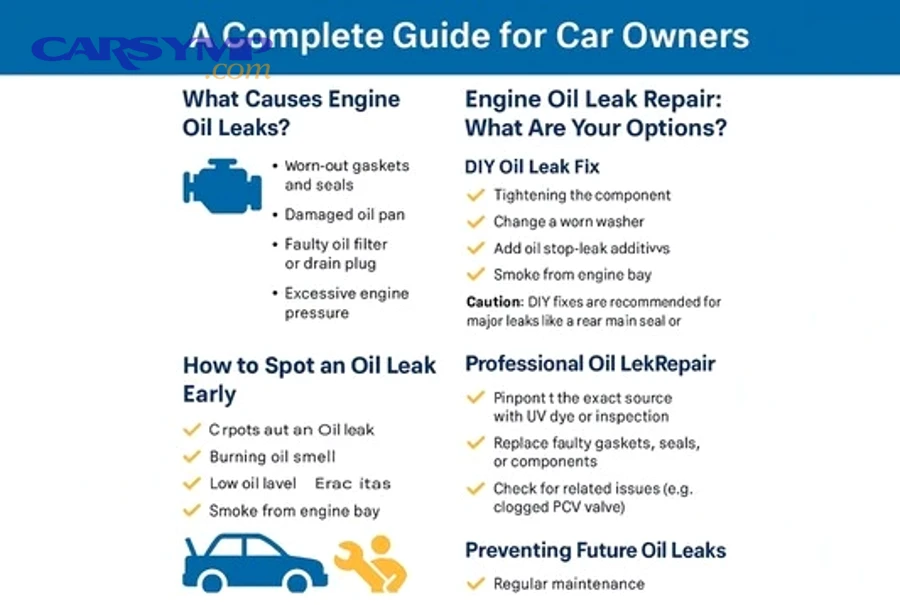
Quick safety check: smoke/steam, gauge, and puddles
If you see active smoke from the engine bay, pull over safely and shut the engine off. If you see steam and the temperature gauge is rising, treat it as a cooling-system risk. If fluid is dripping onto the exhaust, the odor can rapidly intensify.
Next, wait a few minutes for airflow to settle, then inspect from a safe angle—never reach into a running fan area.
Check levels before you “test drive” the problem
If oil is low, running the engine can cause engine damage. If coolant is low, driving can cause overheating and head gasket risk. Add the correct fluid only if you have it available and only to reach a safe location for repair.
To transition, if you must top off, re-check immediately after a short drive to see whether the leak rate is rapid.
Avoid these common mistakes that worsen leaks
- Opening a hot cooling system: hot coolant can spray and burn.
- Ignoring an oil-on-exhaust situation: it can create smoke and, in rare cases, ignite residue.
- Masking odor with cabin fresheners: it delays diagnosis and can hide escalating symptoms.
Next, if the smell returns quickly after cleanup, treat it as an active leak until proven otherwise.
How do driving conditions change the smell comparison?
Driving conditions act like a “magnifier” for leak odors: heat, airflow, and pressure vary by speed, load, and stop-and-go traffic. Oil odors often spike with heat soak, while coolant odors often spike with pressure cycles and fan operation.
After that, match your exact scenario—highway, traffic, cold start, or after shutdown—to the most likely leak type.
Cold start: brief smells that disappear
On a cold start, brief odors can come from residue left from prior drips, not necessarily an active leak. Coolant odors may appear as the system warms and pressurizes; oil odors may appear later when exhaust components become hot.
Next, note the timing: if the smell starts only after 10–15 minutes, heat-related oil burning becomes more likely.
Stop-and-go traffic: heat soak and reduced airflow
Traffic increases under-hood heat and reduces airflow, making oil-on-hot-metal smells stronger. Cooling fans cycling can also spread coolant vapor if there’s a small seep at the front of the engine bay.
Next, if the smell peaks at idle and fades at speed, consider heat soak and fan-driven vapor patterns.
Highway driving: sustained heat and pressure
Highway driving sustains high temperatures and can increase crankcase ventilation flow and coolant system pressure. A small oil seep may burn steadily, while a small coolant leak may vent intermittently and evaporate before dripping.
Next, inspect immediately after highway driving—fresh trails are easier to spot before they dry.
After shutdown: the “hot soak” reveal
Many leaks reveal themselves after shutdown because heat continues to rise locally even though the engine is off. Oil can drip onto hotter exhaust sections; coolant can seep from pressurized joints and steam off.
Next, look under the car after 5–15 minutes—this window often shows the first real drips.
How do you prioritize repairs when both oil and coolant odors appear?
If you suspect both odors, prioritize the system that can fail catastrophically sooner: overheating and rapid coolant loss are usually the most immediate risk, while rapid oil loss and low oil pressure are equally urgent. The key is to identify which level is dropping faster.
Next, treat “dual smell” as a clue that one leak is reaching a hot surface, not as proof of two separate leaks.
Rule 1: Rising temperature or low coolant level = urgent
If the temperature gauge rises, the heater stops blowing hot, or the coolant reservoir drops quickly, stop driving and address the cooling issue first. Overheating can escalate from mild to severe quickly.
Next, confirm the cooling fan operation and check for obvious hose or radiator leaks once the engine is cool.
Rule 2: Oil warning light, low oil level, or active oil dripping = urgent
If an oil pressure warning appears or the dipstick shows low oil, don’t “hope it’s fine.” A fast oil leak can starve bearings and cause major engine damage.
Next, if oil is dripping onto the exhaust, plan for immediate repair or towing to avoid smoke events and further spread.
Rule 3: Fix the leak origin, not just the mess
Degreasing the area can reduce odor temporarily but doesn’t solve the problem. Once you know which fluid is leaking, locate the highest wet point and address the seal, hose, clamp, or housing causing the leak.
Next, re-check after repair to confirm odor is gone and levels stabilize.
Rule 4: Don’t confuse spilled fluids with active leaks
Recent oil changes or coolant top-offs can leave residue that burns off and smells dramatic for a short time. If levels remain stable and no fresh wetness appears after cleaning, the smell may be leftover residue rather than an active leak.
Next, monitor for two or three heat cycles—true leaks usually return predictably.
Contextual Border: The sections above focus on the main comparison intent—smell signatures, locations, symptoms, confirmation steps, and repair priority. Below, we expand into rarer scenarios, edge-case clues, and higher-precision detection methods that can change the diagnosis.
Rare scenarios and precision clues that change the smell diagnosis
In edge cases, the “oil vs coolant” smell comparison shifts because airflow, cabin intake, additives, and component layout alter what you perceive. These precision clues help you resolve confusing cases when the odor doesn’t match the typical pattern.
Next, use these rare attributes only after you’ve done the basic level checks and a clean re-inspection.
When the odor is strongest only inside the cabin
If the smell is mainly inside and you notice humidity, window fogging, or damp carpet, cabin-side coolant becomes more likely. In that situation, a sweet chemical odor can persist even with the hood closed because the source is within the HVAC housing or near the firewall.
To deepen the check, inspect under the dashboard for dampness and look at the coolant level trend across multiple days.
When the odor appears after an oil change or maintenance
Fresh oil spilled onto engine covers or exhaust shields can produce a strong odor for several drives. In this scenario, you might notice a strong burning odor without a dropping oil level, and the smell gradually fades as residue burns off.
In that context, the phrase burning oil smell is often used by drivers to describe the odor, but the best test is still objective: confirm the dipstick level stays stable and no new wet trail appears after cleaning.
Next, if the smell remains beyond a few heat cycles, assume an active leak and re-check the valve cover area and filter housing region.
When you want to reduce the chance the odor returns later
Once the leak is repaired, odor can linger if residue remains on heat shields or undertrays. A thorough cleanup, replacing oil-soaked insulation, and ensuring proper crankcase ventilation can reduce recurrence. Drivers sometimes search for Preventing future oil smell issues after a repair because lingering residue feels like a “new leak.”
Next, focus on cleanup near the hottest metal and ensure splash shields are not retaining fluid that will re-burn later.
When you wonder if short-distance driving is acceptable
Sometimes the big question becomes “is it safe to drive to a shop?” The safest answer depends on smoke/steam, fluid level, and temperature stability. Many drivers phrase this as Can you drive with burning oil smell, but the practical rule is: if you see active smoke, rapid level drop, warning lights, or rising temperature, do not continue driving.
Next, if the situation is mild (no smoke/steam, stable temperature, stable levels), drive only a short distance with minimal load and re-check immediately on arrival.