


A fluorescent (UV) dye test is one of the most reliable DIY ways to trace an engine oil leak because it turns “mystery seepage” into a visible trail you can follow back to the true source. You add a small amount of dye to the engine oil, run the engine or drive briefly, then scan with a UV light to see where the dyed oil emerges.
Next, the method only works as well as your preparation and tools: the right dye for engine oil, a UV-A light that actually excites the dye, and a clean enough surface so old grime doesn’t create false trails. When those pieces are correct, you can pinpoint leaks that are otherwise invisible.
Then, timing and interpretation matter. You need enough run/drive time for dye to circulate, and you need a scanning strategy that distinguishes “where oil traveled” from “where oil started.” That’s how you avoid fixing the wrong part.
Introduce a new idea: once you’ve identified the source, you can decide whether it’s safe to keep driving short distances, plan the repair, and—just as importantly—set up habits for preventing the leak from returning.
What is a fluorescent (UV) dye test for engine oil leaks?
A fluorescent (UV) dye test for engine oil leaks is a diagnostic method where an oil-compatible dye is added to the crankcase so leaking oil glows under UV light, making the leak path easy to trace back to its origin.
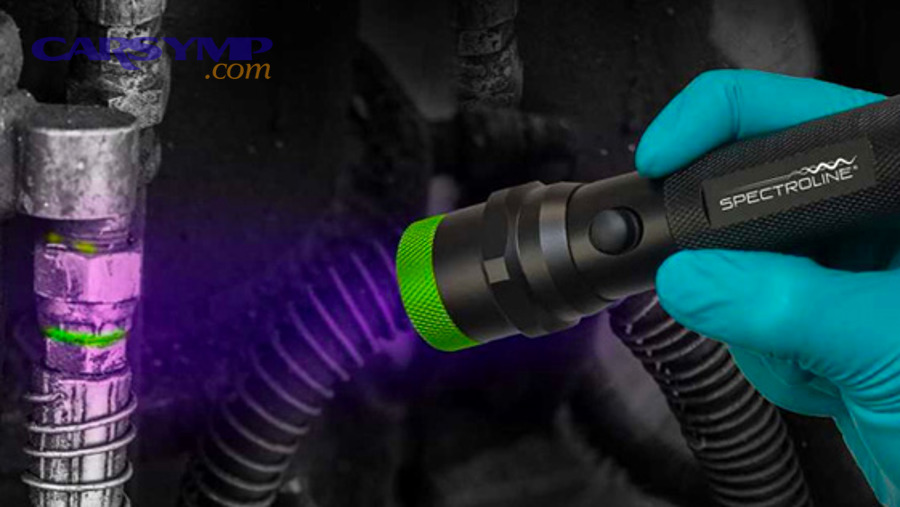
To better understand why this works, remember that most oil leaks don’t start as a dramatic drip—they start as a thin film that spreads along edges, bolts, and airflow paths. The dye makes that “first appearance” pop visually when you scan the engine with a UV flashlight.
What makes fluorescent dye “traceable” compared with normal oil?
Normal engine oil can look like “everything is wet” once dust sticks to it, especially on older engines. Fluorescent dye changes the game in three practical ways:
- Contrast: Under UV-A light, the dyed oil appears brighter than surrounding grime, so you can see thin seep lines and fresh droplets.
- Direction: A bright “source spot” stands out from a faint “travel path,” helping you follow the leak backward.
- Repeatability: After you wipe the area and recheck, only new dyed oil reappears, which is the fastest way to confirm the real leak point.
In real-world DIY terms, the dye test is less about seeing oil and more about seeing fresh oil movement.
Is a UV dye test different from other leak-finding methods?
Yes—its core advantage is that it can reveal leaks in tight crevices or behind covers where powder methods or plain visual inspection struggle. A mainstream auto-repair guide lists UV dye and UV light as a more “conclusive” approach for locating elusive leaks when other methods are inconclusive.
Is a UV dye test the right method for your oil leak?
Yes, a fluorescent (UV) dye test is the right method for many engine oil leaks because it (1) pinpoints slow leaks that don’t drip consistently, (2) reduces guesswork on dirty engines, and (3) helps confirm a leak after you clean or repair an area.
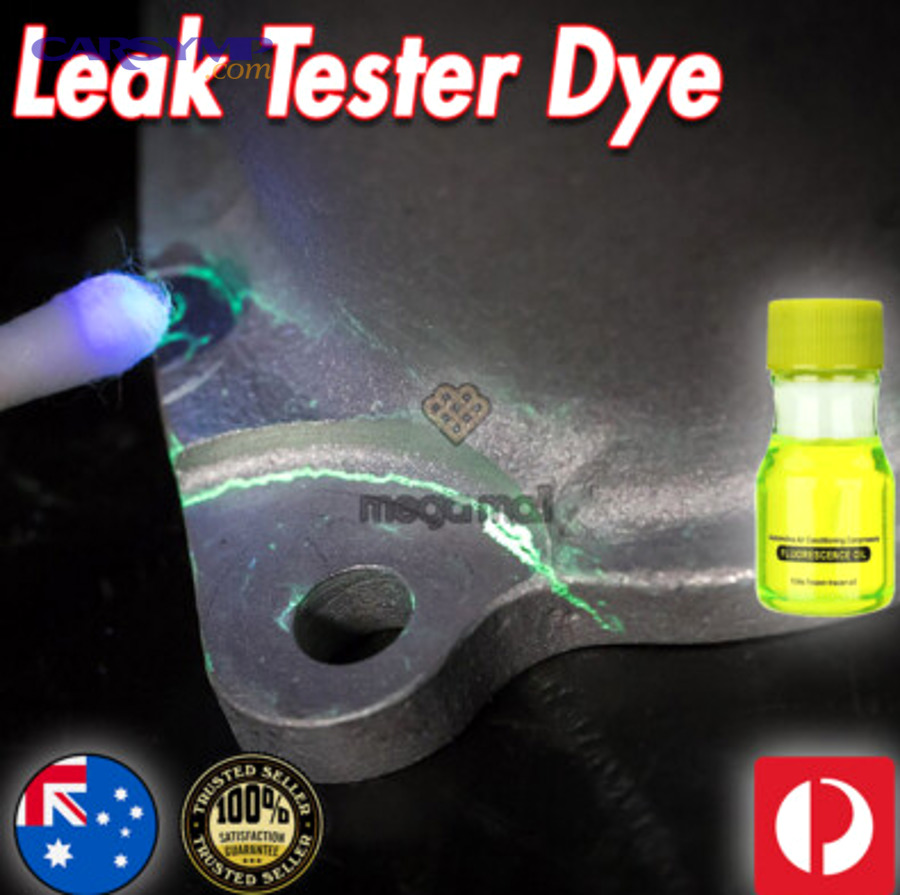
Next, the key decision is whether your situation benefits from “trace precision” or just needs a basic visual check. If you have a clear puddle every night in the same spot, you may not need dye to know it’s leaking—but you may still need dye to find which seal or gasket is responsible.
Can you do a UV dye test at home safely?
Yes, you can do a UV dye test at home safely because the process is low-pressure (you’re not disassembling anything), the dye dose is small, and the inspection is visual—as long as you follow three safety rules:
- Keep hands and tools away from moving parts (belts, fans, pulleys) while the engine is running.
- Avoid hot surfaces (exhaust manifold, turbo housing, downpipe). Scan after a short drive, then let heat soak settle before putting your hands near components.
- Lift the vehicle correctly if you need underside access—use jack stands on solid points, not a jack alone.
Because many leaks show up as an underside stain first, a careful lift matters—especially when you’re tracking an oil leak under car and need visibility around the oil pan, drain plug, and filter area.
Should you clean the engine first before adding dye?
Yes, you should clean the suspected areas first because (1) old oil film can glow and mislead you, (2) grime can “wick” dyed oil sideways, and (3) a clean surface makes the true origin point brighter and easier to confirm.
Then, cleaning doesn’t need to be perfect. Your goal is to remove thick buildup near likely sources so the dye’s first appearance is unambiguous. Focus on:
- Valve cover perimeter and corners
- Oil filter and oil filter housing area
- Front of engine around timing cover seams
- Bottom of engine around oil pan gasket seam and drain plug
- Any undertrays or skid plates that collect oil and spread it around
If the engine is extremely dirty, the dye can still work—but you’ll spend more time separating “old mess” from “new leak.”
What tools and supplies do you need for a UV dye oil leak test?
There are 6 main tools for a UV dye oil leak test: oil-compatible UV dye, UV-A flashlight, contrast (yellow) glasses, degreaser, wipe materials, and safe lift/support equipment—chosen based on whether you’re inspecting the top, underside, or both.
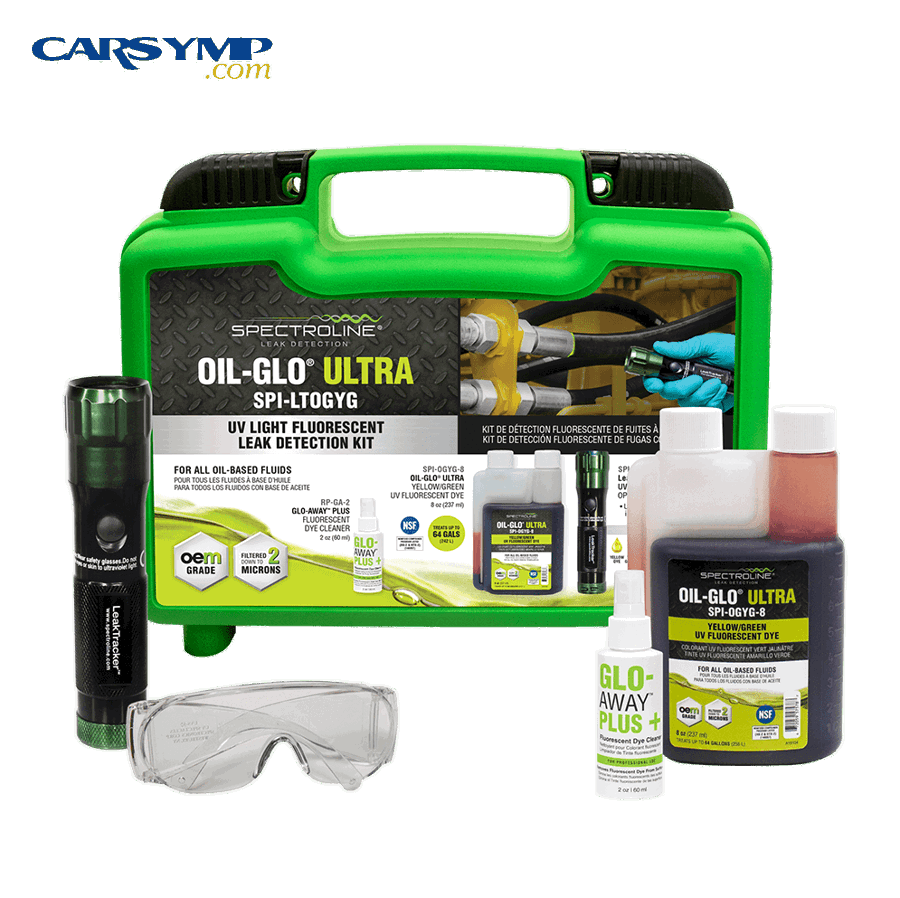
Next, treat this like a small diagnostic kit: the tools aren’t optional “extras”—they control how quickly you get a clear answer.
Here’s what each item does and why it matters:
- Engine-oil-compatible UV dye: Ensures the dye mixes and remains stable in the crankcase oil.
- UV-A flashlight (typically 365–395 nm range): Excites the dye so it fluoresces.
- Yellow contrast glasses: Improve visibility of fluorescence and reduce purple glare.
- Degreaser + soft brush: Removes old film so new dye trails stand out.
- Shop towels + nitrile gloves: Lets you wipe, recheck, and verify fresh leakage.
- Jack + jack stands (if needed): Gives safe access to the underside.
A widely used step-by-step automotive guide specifically lists UV dye and a UV flashlight among the required materials for this method.
What UV light and glasses work best for finding oil dye?
A UV-A leak-detection light wins for brightness and contrast, while the glasses are best for reducing glare and making fluorescence “pop,” especially in cramped engine bays.
However, not all “UV” flashlights perform the same. What matters in practice:
- Output strength: Brighter UV makes small seep lines easier to see without perfect darkness.
- Beam focus: A tighter, focused beam helps you inspect seams and bolts without flooding everything with purple light.
- Work distance: You often scan from 6–18 inches away—weak lights look fine on a wall but fail on an oily engine.
If your results look faint, don’t assume there’s no leak. Improve darkness (garage, shade), clean the area more, and shorten the time between driving and inspection so fresh oil hasn’t spread.
Which dye should you use for engine oil, and how much do you add?
Engine-oil dye should be an oil-compatible tracer, and you should add only the dose specified on the product instructions because over-dosing can create “everything glows” confusion and wastes time.
Next, keep your method consistent: add dye once, circulate it, and diagnose. Some kits provide explicit dosing guidance and note that effectiveness depends on leak size and normal vehicle use, which is exactly how DIY diagnostics plays out. (uvgear.co.uk)
A practical dosing approach that stays safe:
- Follow the dye instructions first (always).
- If you just changed oil, that’s ideal—fresh oil makes fluorescence clearer than dirty oil. (uvgear.co.uk)
- Mark your maintenance log (“UV dye added”) so you don’t forget later when scanning other fluids.
Evidence: According to a study by University of Bologna from the Department of Industrial Engineering, in 2022, researchers diluted mechanical oil with fluorescent dye (keeping dye below a specified maximum percentage) and used UV illumination to make oil leakage more clearly detectable for imaging-based detection. (pmc.ncbi.nlm.nih.gov)
How do you perform a UV dye test step-by-step to trace an oil leak?
Perform a fluorescent (UV) dye test in 7 steps—clean, add dye, circulate it, create inspection conditions, scan top-down, scan underside, and confirm by wipe-and-recheck—to trace the leak to its true origin.
Then, the “secret” is to treat this like a loop instead of a one-and-done event: if you don’t see a clear source after the first scan, you adjust run time, wipe, and recheck until the origin reveals itself.

What is the best step-by-step workflow from prep to inspection?
Here’s a DIY workflow that reliably produces a readable result:
- Verify oil level first. If oil is low, top up before testing so you don’t risk engine damage during the drive cycle.
- Clean the suspected areas. Focus on seams and junctions—where gaskets meet metal, where sensors thread in, where housings bolt together.
- Add the dye through the oil filler cap. Use a funnel if needed; don’t spill onto belts.
- Circulate the dye. Idle briefly, then take a short drive with normal acceleration and braking.
- Create inspection conditions. Park on a level surface, reduce ambient light if possible, and have your UV light and glasses ready.
- Scan top-down first. Start at the highest likely leak points; oil travels downward and backward with airflow.
- Scan the underside last. Look for the first bright origin point, not just the biggest drip.
A well-known automotive guide describes adding dye, then driving to allow it to mix, followed by inspection with the UV flashlight and following drips/stains back to the source.
How long should you run or drive before checking with UV light?
You should usually drive about 15–20 minutes before the first inspection, then extend to longer cycles only if the leak is very slow.
Next, treat “time” as a diagnostic variable. The right duration depends on leak behavior:
- Fast leaks (drips after parking): A short idle + short drive can be enough because dyed oil appears quickly.
- Slow seeps (no drips, just film): You may need multiple short drives over a day to get a clear source point.
- Leaks that only happen under load: A slightly longer drive with highway speeds may reveal what idling cannot.
One step-by-step guide explicitly suggests driving about 20 minutes (or per dye instructions) to allow mixing before inspection.
How do you read dye patterns to pinpoint the true leak source?
You read dye patterns by locating the brightest, highest “origin point” and tracing backward from trails, because the biggest glowing area is often where oil collected, not where oil started.
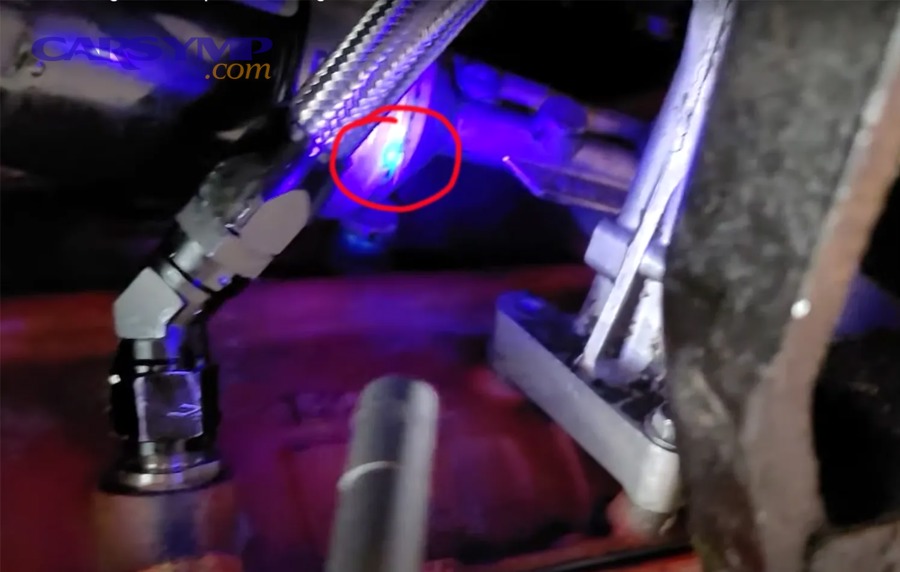
However, leaks behave like breadcrumbs in reverse. The dyed oil travels with gravity, vibration, and airflow—so your job is to identify the first upstream glow.
What does a UV “trail” vs a “bright source spot” mean?
A UV “trail” usually means oil traveled across a surface, while a bright source spot usually indicates where oil is actively emerging or pooling closest to the leak point.
Next, use a simple confirmation technique:
- Wipe the trail and source area clean.
- Run the engine for a few minutes (or drive a short loop).
- Recheck immediately with UV.
If the bright spot reappears first, you’ve found the origin. If the trail reappears first without a clear source, you likely need to scan higher up or remove an undertray that’s spreading oil.
Also watch for two common pattern traps:
- Belt sling: Oil from a front seal or housing can land on a pulley and spray in an arc. You’ll see speckled fluorescence in a circular pattern.
- Airflow drift: Under-car airflow pushes oil backward, so the drip you see near the rear of the engine may have started near the front.
Which common engine oil leak locations should you check first?
There are 7 common engine oil leak locations you should check first: valve cover gasket, oil filter and seal, oil filter housing gasket, oil pressure switch/sender, timing cover area, oil pan gasket seam, and drain plug/washer.
Then, prioritize by “height and likelihood”:
- Valve cover gasket: High on the engine; leaks run down the block.
- Oil filter / filter seal: Can drip quickly and create an obvious oil leak under car.
- Oil filter housing: Often leaks at the housing-to-block gasket.
- Oil pressure switch: A small part that can leak and spread widely.
- Timing cover / front seal area: Can contaminate belts and create spray.
- Oil pan gasket seam: Slow seep line along the pan edge.
- Drain plug / crush washer: Leaks after an oil change or from improper torque.
If your fluorescence is strongest along the pan seam, you’re likely looking at Oil pan gasket leak signs—a glowing line at the gasket edge, oil collecting on bolt heads, and a drip forming at the lowest point of the pan.
What should you do after you find the leak source?
After you find the leak source, you should (1) confirm it with a wipe-and-recheck, (2) decide if the leak is safe for short driving, and (3) plan the repair and prevention steps so the same leak doesn’t return.

In addition, treat the diagnosis as your leverage: once you know the exact part, you avoid unnecessary replacements and you can explain the issue clearly to a shop if you’re not DIYing the fix.
Should you keep driving once you’ve confirmed an oil leak?
Yes, you can sometimes keep driving short distances with a confirmed oil leak, but only if (1) the oil level stays safely within range, (2) there’s no oil pressure warning light or knocking, and (3) oil isn’t dripping onto hot exhaust parts that could smoke or pose a fire risk.
However, the question most drivers actually mean is: Can you drive with oil leaking under car without ruining the engine? The honest DIY answer is: it depends on leak rate and consequences.
Use this decision filter before any trip:
- Stop driving immediately if the oil pressure light comes on, the engine knocks/ticks loudly, or you smell burning oil with visible smoke.
- Drive only to a repair location if the leak is moderate (fresh drips, but oil level stays acceptable after topping up).
- Monitor and schedule repair soon if it’s a slow seep (light residue, minimal oil loss) and you confirm the level remains stable.
A repair guide emphasizes that engine oil protects against metal-on-metal contact and that substantial leaks should be addressed promptly to prevent damage.
How do you confirm the repair worked using the same UV method?
You confirm the repair worked by cleaning the area thoroughly, running a short drive cycle, and rescanning to ensure no fresh dyed oil reappears at the origin point.
To better understand this confirmation step, think of it as a before/after experiment:
- Degrease and dry the repaired area (the dye “memory” must be removed).
- Drive 10–20 minutes under conditions that previously showed leakage.
- Scan the exact seam, bolt line, or sensor base that previously glowed.
- Check nearby surfaces where oil used to travel (for false confidence).
If your dye is still in the oil from earlier, that’s fine—just remember the surface must be clean, or you’ll keep seeing old fluorescence.
What common mistakes and edge cases can make a UV dye oil leak test misleading?
There are 4 common ways a UV dye oil leak test becomes misleading: contamination from old residue, “everything glows” overdosing or dirty oil, airflow/belt sling patterns that relocate oil, and confusing engine oil with other fluids during under-car inspection.

More importantly, these are not rare—most DIY frustration comes from a small mistake early in the workflow.
Can a UV dye test confuse engine oil with transmission fluid or power steering fluid?
Yes, a dye test can confuse engine oil with other fluids if you add dye to the wrong system or if multiple fluids are leaking, because fluorescence alone doesn’t identify the fluid type—only that a dyed fluid is present.
However, you can prevent this confusion with three habits:
- Add dye to only one system at a time (engine oil first).
- Use smell/feel and location clues: engine oil is typically darker and may smell burnt; transmission fluid often has a distinct odor and different color when fresh; power steering fluid and ATF may overlap depending on the vehicle.
- Trace upward to the highest origin point: a rear-area drip does not automatically mean rear main seal—oil can travel.
This matters most when diagnosing an oil leak under car near the bellhousing area, where multiple fluids can appear in the same region.
Why might you see fluorescence everywhere—and how do you isolate the real source?
You might see fluorescence everywhere because old oil film was never removed, the underside shield is saturated, or dyed oil spread during driving—so you’re seeing the history of leaks, not the start of the leak.
Next, isolate the source using a controlled reset:
- Remove or open access to undertrays if possible (they trap oil and spread it).
- Degrease the suspicious region (seams, bolts, sensor bases).
- Wipe completely dry.
- Run a short drive cycle, then scan immediately.
If you need a visual anchor, look for the first reappearing bright point after wiping—that is far more diagnostic than the biggest glowing puddle.
What if the leak is near the turbo or a high-heat area and the dye seems to disappear?
Yes, dye can seem to “disappear” near high-heat areas because oil can burn off quickly or spread behind heat shields, reducing the visible trail.
Then, adjust your method instead of abandoning it:
- Inspect sooner: shorter drive, faster scan.
- Scan from multiple angles: mirrors help around heat shielding.
- Look for secondary clues: dye collecting at the lowest edge of a shield or bracket often points to the hidden origin above.
Is a dye test worth the cost compared with clean-and-recheck or shop smoke testing?
A dye test is worth the cost when you need pinpoint accuracy, while clean-and-recheck is best for obvious leaks, and shop diagnostics make sense when access is blocked or multiple fluids are involved.
To illustrate, use these decision rules:
- Choose dye test if you’ve cleaned before and the leak source still isn’t clear, or you suspect multiple possible leak points (common on older engines).
- Choose clean-and-recheck if the leak is heavy and the origin is visible quickly.
- Choose a shop if the leak is internal to a covered area, or if you need confirmation for a warranty claim.
And once you’ve fixed the issue, make Preventing future under-car oil leaks part of your maintenance rhythm: check oil level regularly, inspect after oil changes for drain plug and filter sealing, and address minor seepage early—because small leaks are easiest to diagnose before they coat the entire underside.
Evidence: According to a study by the University of Bologna from the Department of Industrial Engineering, in 2022, researchers used UV illumination with fluorescent-dye-enhanced oil to make leakage more clearly detectable during imaging-based detection. (pmc.ncbi.nlm.nih.gov)