


Engine mounts and transmission mounts are often the hidden cause of vibration, clunks, and harshness—especially when symptoms show up at idle, on takeoff, or during shifting. If you’re trying to confirm whether mount wear is behind what you feel, the most reliable path is a simple sequence: identify the symptom pattern, do a safe visual check, then run a couple of quick movement tests.
You’ll also want to connect which symptom happens when (idle vs acceleration vs shifting) to which mount is most likely involved. That matters because a failed engine mount tends to show up as engine rocking and contact noises, while a worn transmission mount often shows up as a thump during gear changes or a driveline “kick” on load reversal.
Next, you need a safety-first inspection approach. Mount checks can involve lifting the car, working near hot exhaust, and watching engine movement—so the best DIY method is controlled: quick checks first, deeper checks only if your setup is safe.
Introduce a new idea: once you learn the “mount signature” and compare it against common look-alikes (misfires, exhaust contact, suspension/driveline issues), you’ll know when DIY is enough and when a shop-level diagnosis is the smarter move.
What do engine mounts and transmission mounts do in the drivetrain?
Engine mounts and transmission mounts are vibration-isolating supports that secure the powertrain to the vehicle’s structure while controlling movement under torque, braking, and shifting—so the cabin stays smooth and hoses, wiring, and exhaust connections don’t get overstressed. (spectrum.library.concordia.ca)
Then, to understand why mount inspection matters, picture the powertrain as a heavy mass that’s constantly being “twisted” by combustion torque and gear changes: mounts are the controlled flexibility that prevents that mass from slamming into the chassis.

How are engine mounts and transmission mounts different from each other?
Engine mounts primarily control engine roll and pitch (especially on front-wheel-drive layouts) and isolate idle vibration; transmission mounts primarily stabilize the transmission tail / transaxle housing and reduce thumps during shifting and driveline load changes. In practice, they work as a system—one weak mount can overload the others.
A helpful mental model is meronymy (part–whole): mounts are “small parts” that protect a “whole set” of connected components. When mounts sag or separate, the powertrain’s movement transfers into parts that were never meant to carry that load.
Which parts do mounts protect when they fail?
Mounts protect the entire neighborhood around the powertrain, including:
- Exhaust flex joints, downpipes, and hangers (contact clunks, rattles, flex joint tearing)
- Coolant hoses and heater hoses (stretching, rubbing, seepage)
- Wiring looms and connectors (tugging, intermittent faults)
- Intake plumbing (misalignment, rub marks)
- CV joints/axles and driveline angles (added stress during engine/trans movement)
- Shifter linkage and cable routing (shift feel changes when the transmission is moving)
When those secondary parts start showing rub marks or repeated failures, it’s often not “bad luck”—it’s the mounts letting the drivetrain move too far.
Why can mount problems feel “random” at first?
Mount wear often starts as damping loss (more vibration) before it becomes structural separation (big movement and clunks). That’s why one day the car feels “a bit buzzier,” and weeks later you suddenly get a loud thud during a shift.
According to a study by Concordia University from the Department of Mechanical and Industrial Engineering, in 2005, an optimized engine-mounting system model reported a target reduction ratio decreasing by 91.1%, indicating major improvement in vibration isolation when mount system parameters and locations are optimized. (spectrum.library.concordia.ca)
Are your symptoms likely caused by a bad engine mount or transmission mount?
Yes—many common vibration and clunk complaints are consistent with mount wear because (1) symptoms change with torque direction (on/off throttle), (2) movement shows up most during gear engagement and shifting, and (3) idle vibration often increases when damping collapses or a mount sags.
However, to avoid replacing mounts unnecessarily, you need to match symptoms to the right “signature,” because other faults can mimic mounts.
What noises and vibrations point to mount wear under load changes?
Mount-related noises tend to be single-event and torque-triggered, like:
- Clunk when shifting from Park to Drive/Reverse (engine/trans loads suddenly change)
- Thump on the 1–2 shift or 2–3 shift (transmission mount and/or torque strut movement)
- Clunk when getting on/off throttle (load reversal: the drivetrain “rocks” forward/back)
- Bang when braking then accelerating (pitch change loads mounts in opposite direction)
- Idle vibration that reduces when you raise RPM slightly (mount damping no longer isolates at idle)
A key detail: mount noises often happen once per event (engage gear, apply torque), not continuously like a wheel bearing hum or a constant driveline vibration.
Which “Car Symp” patterns usually mean something else?
Some “Car Symp” patterns commonly point away from mounts:
- Steady misfire shake with flashing check engine light → ignition/fuel/air issues more likely than mounts
- Vibration that grows smoothly with speed (not torque) → tires/wheels/axles/driveshaft more likely
- Rattle only over bumps → heat shields, exhaust hangers, sway bar links, or interior trim more likely
- Grinding or clicking while turning → CV axle/joint issues more likely
This is why mount diagnosis is half “what you feel” and half “when it happens.”
Can a single failed mount change shifting feel?
Yes—especially in front-wheel-drive or transverse layouts—because excessive drivetrain movement can alter cable angles, linkage alignment, and the way the transmission housing settles under torque. A worn transmission mount can make shifts feel “looser,” “thumpier,” or delayed in engagement because the drivetrain is physically moving before torque transfers smoothly.
How can you visually inspect engine mounts and transmission mounts safely?
A safe visual inspection is a step-by-step method—prepare the vehicle, confirm access and stability, then check for cracks, collapse, loose hardware, and (on hydraulic mounts) fluid leakage—to identify obvious mount failure without putting yourself in a dangerous position.
Next, use the simplest checks first, because many mount failures are visible if you know what “bad” looks like.
What should you check first before lifting the vehicle?
Start with “no-lift” checks:
- Park on level ground, set the parking brake, and let the engine cool if you’ll be near the exhaust.
- Open the hood and look for unusual gaps: engine sitting low on one side, radiator fan shroud close to the fan, or the engine appearing tilted.
- Look for fresh contact marks: shiny metal rub marks, chipped paint near brackets, or exhaust components touching the subframe.
If you do need to lift the car, use jack stands on correct lift points and never rely on a jack alone.
What does a mount failure look like (cracks, collapse, leaks)?
A mount typically fails in visible ways:
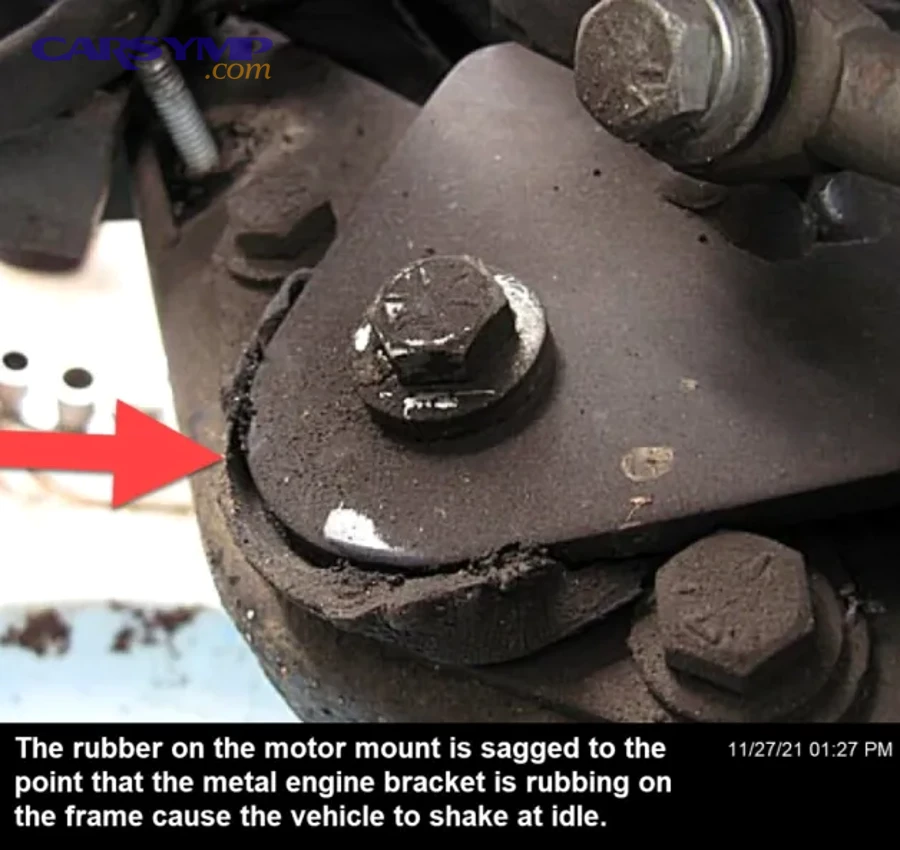
- Cracked or separated rubber (rubber split, torn, or delaminated from the metal)
- Collapsed “sag” (mount sits lower, rubber looks squashed)
- Loose or missing bolts (hardware backed out, shiny movement marks around bolt holes)
- Fluid leakage on hydraulic mounts (oily residue around the mount body)
One practical inspection guideline commonly noted for mounts is to look for cracked, loose, or broken brackets; loose/missing bolts; collapsed rubber; and fluid leaks on hydro-mounts. (brakeandfrontend.com)
How do you inspect a transmission mount and crossmember area?
Transmission mounts often sit on or near a crossmember. Look for:
- Rubber separation or crushed rubber in the mount
- Crossmember cracks or shifted alignment (elongated holes, shiny rub marks)
- Exhaust proximity (a sagging transmission mount can bring exhaust into contact under load)
- Drips from above (oil can soften rubber over time, accelerating failure)
If you can safely see the crossmember area, a visual reference helps you understand what you’re looking at:

What quick movement tests can confirm mount wear at home?
A quick confirmation approach combines 3 controlled tests—(1) a safe power-brake movement check, (2) a gentle load-reversal test, and (3) a careful pry-bar check—so you can observe excessive drivetrain movement and correlate it with your symptoms.

Then, treat movement tests as “observe and stop” procedures: you’re looking for excess motion, not trying to force the engine to jump.
How to do a safe power-brake movement check
This test is commonly discussed as a way to watch engine rock under controlled torque: with brakes firmly applied, you lightly load the drivetrain and observe how far the engine moves. If the engine rocks excessively, mounts deserve a closer inspection. (justanswer.com)
Do it safely:
- Use a flat surface, parking brake on, and keep bystanders away.
- Have a helper watch from the side with the hood open (never stand in front of the car).
- Apply the brake firmly, shift into Drive (or 1st gear in manual with clutch control), and lightly raise RPM just enough to load the drivetrain.
- Repeat briefly in Reverse.
What you’re looking for: a controlled, limited movement. Red flags: a sharp jump, a clunk, or the engine lifting/rolling dramatically to one side.
How to do a controlled “load reversal” test in a parking lot
This test mirrors real-world symptoms:
- In an empty lot, roll at low speed.
- Gently apply throttle, then gently lift off (no aggressive inputs).
- Listen for a single clunk and feel for a kick through the floor.
Mount issues often show up as a “one-time” thump exactly when torque changes direction. If the clunk is repeatable and tied to torque changes rather than bumps, mounts move up the suspect list.
How to use a pry-bar test without damaging components
If you can safely access the mount area (vehicle supported correctly), you can gently apply leverage to check for:
- Rubber separating from metal
- Excessive void movement
- Metal-to-metal contact points
Use minimal force. If you need to pry hard to see movement, stop—many mounts are designed to flex slightly, and you can damage surrounding parts if you treat the test like demolition.
How do you distinguish mount problems from other causes of vibration and clunks?
Mount problems win in torque-triggered clunks and engine rocking, engine misfire is best for irregular shaking tied to combustion events, and suspension/driveline faults are optimal for speed-related vibration or bump-related knocks—so the correct fix depends on when the symptom appears.

However, the fastest way to avoid misdiagnosis is to compare symptom timing and “feel” side by side.
Bad mount vs engine misfire
Mount vibration is usually:
- Strongest at idle in gear
- Changes when you blip the throttle
- Often paired with a thump on engagement
Misfire shake is often:
- Irregular (not a steady buzz)
- Worse under load and may trigger warning lights
- Felt more as “stumbling” than “thumping”
If you have a consistent rough idle plus a check engine light, investigate misfire causes first before blaming mounts.
Bad mount vs suspension/driveline clunks
Mount clunks are tied to torque direction (on/off throttle, shifting). Suspension clunks often tie to:
- Bumps and body roll
- Turning inputs
- Repeated rattles over rough surfaces
Driveline vibration (axles/driveshaft) usually scales with road speed, not just torque application. If the vibration ramps up smoothly at 40–70 mph, mounts may not be the primary driver.
Bad mount vs exhaust contact or heat shields
A sagging mount can cause exhaust contact, which is why these issues overlap. A quick way to separate them:
- If the noise is a tinny rattle at certain RPM ranges → heat shield/hanger more likely
- If the noise is a deep thud during gear engagement → mount movement more likely
When you see shiny rub marks where the exhaust passes the subframe, you may be looking at a mount problem and an exhaust problem—fixing the mount often prevents the exhaust contact from coming back.
When should you stop DIY and book a professional drivetrain inspection?
You should stop DIY and book a professional drivetrain inspection when (1) you hear loud bangs or feel the drivetrain shifting significantly, (2) you see a mount separated or leaking, (3) you can’t inspect safely, or (4) the symptom could involve safety-critical driveline or suspension components.

Next, think of this as escalation logic: DIY confirms “likely,” a shop confirms “which mount and why.”
What a drivetrain inspection includes
What a drivetrain inspection includes is typically more than just “looking at mounts.” A thorough shop process often includes:
- Visual inspection of engine mounts, transmission mount, torque struts
- Checking for fluid leaks (oil/coolant/PS fluid that can degrade rubber)
- Observing drivetrain movement under controlled load
- Inspecting related parts: exhaust clearance, axles/CVs, subframe bushings, crossmember integrity
- Road test to reproduce the symptom under the exact conditions you described
This is especially valuable when symptoms overlap with driveline vibration, suspension knocks, or exhaust contact.
Inspection cost and time expectations
Inspection cost and time expectations vary by vehicle layout and access, but most mount-related diagnostics depend on (a) whether the shop needs to lift the car, (b) whether undertrays/subframes block access, and (c) whether the symptom requires a road test plus a bay test.
A practical expectation is: basic checks can be quick, while hard-to-access mounts or symptoms requiring multiple tests can take longer. If a shop mentions diagnostic time, ask what tests they plan to perform and whether any of that time applies to repair if you proceed.
What information to bring to the shop for faster diagnosis
Bring specifics that reduce trial-and-error:
- Exact conditions: idle, in gear, cold vs hot, uphill takeoff, etc.
- A short video of engine movement during a safe test (from a distance)
- Notes on recent work: axle replacement, exhaust work, collision repair, subframe work
- Whether fluids have leaked onto mounts
The clearer you are about when it happens, the faster a technician can separate mounts from look-alike problems.
What special mount types and installation factors change the inspection approach?
There are 4 main special cases that change how you inspect mounts—hydraulic mounts, electronically controlled (active) mounts, torque strut “dogbone” mounts, and aftermarket polyurethane/solid mounts—because each type fails differently and produces different vibration signatures.

Then, instead of treating all mounts as identical rubber blocks, match the inspection method to the mount design.
How do hydraulic and active mounts change the inspection?
Hydraulic mounts can fail by leaking, even when the rubber looks “fine,” and that loss of fluid can reduce damping and increase vibration. This is why oily residue around a mount body is a big clue during inspection. (brakeandfrontend.com)
Active mounts (vacuum-controlled or electronically controlled) add another layer: the mount may look intact, but the control system or internal valve may fail. One diagnostic approach discussed for certain active mount designs is using a handheld vacuum pump to see whether the mount holds vacuum—if it doesn’t, it may be faulty. (tomorrowstechnician.com)
What about torque strut “dogbone” mounts and pendulum mounts?
Many front-wheel-drive cars use a torque strut (often called a “dogbone” or pendulum mount) to control drivetrain rocking. These commonly create:
- A clunk on quick throttle changes
- A fore-aft jerk sensation on takeoff
- A “tap” during shifts as the drivetrain loads/unloads
They’re also easier to misdiagnose because the symptom can feel like a transmission issue even when the transmission is fine.
Do polyurethane or solid mounts change symptoms?
Yes—stiffer mounts can increase noise and vibration even when they’re not “bad,” because they transmit more vibration into the cabin by design. So if you have aftermarket poly mounts, your baseline NVH may be higher, and “vibration at idle” is less diagnostic than it would be on factory hydraulic mounts.
The inspection focus shifts to:
- Loose hardware (poly mounts can stress fasteners)
- Bracket cracks
- Contact points created by reduced compliance
Evidence (if any)
According to a study by Concordia University from the Department of Mechanical and Industrial Engineering, in 2005, an optimized engine-mounting system model reported the reduction ratio of a target value decreasing by 91.1%, showing that mount system design and placement can dramatically improve vibration isolation performance. (spectrum.library.concordia.ca)