


If your car suddenly starts stalling, hesitating, losing power, or acting “possessed,” the most practical first step is to match what you’re feeling to ECU failure symptoms—because the ECU/ECM sits at the center of fuel, spark, and emissions control, so its problems can ripple across many systems.
Next, you need to know why ECU trouble is so often confused with “normal” faults like bad sensors, weak battery voltage, or wiring corrosion—because the symptoms overlap, and replacing parts blindly is how drivers get stuck in an expensive loop.
Then, you’ll want a clear path to confirm suspicion using scan results and real-world behavior patterns, so you can decide what to do safely and avoid chasing the wrong repair.
Introduce a new idea: the best way to approach ECU/ECM problems is to treat them like a pattern-recognition exercise—symptoms first, then comparisons, then diagnostics—so you can move from worry to evidence.
What does the ECU/ECM do, and why can its failure look like many other problems?
The ECU/ECM is the vehicle’s engine-control computer that interprets sensor inputs and commands fuel, ignition, idle, and emissions actions—so when it misreads inputs or misfires outputs, the car can behave like multiple parts failed at once.
Next, because so many drivability issues share the same symptoms, you’ll get better answers if you understand why ECU issues masquerade as “ordinary” faults.
At a basic level, the ECU/ECM is constantly doing three jobs:
- Reading inputs (airflow/pressure, throttle position, coolant temperature, crank/cam position, oxygen sensors, etc.).
- Making decisions .
- Driving outputs (injectors, coils, throttle actuator on drive-by-wire, idle control strategy, fan relays, purge valves, and more).
That’s why a failing ECU can create “big” symptoms—rough idle, stalling, or limp mode—without any single mechanical part being broken. The ECU might be fine mechanically, but its logic, internal circuits, or power/ground integrity may be unstable. In real life, that instability looks like randomness: the car runs fine, then suddenly doesn’t, and then “fixes itself.”
Can a failing ECU cause rough idle, stalling, and misfires even when parts are “new”?
Yes—ECU failure symptoms can include rough idle, stalling, and misfires even after new parts because (1) the ECU can miscalculate fueling or ignition timing, (2) it can drop or distort control signals to coils/injectors, and (3) it can glitch when voltage, heat, or vibration pushes a weak internal connection over the edge.
More specifically, “new parts” only help if the ECU is issuing correct commands and interpreting sensors correctly.
Here’s how that plays out in a common scenario:
- You replace plugs/coils to fix a misfire.
- The misfire improves… but comes back under the same condition (hot restart, heavy load, rain, bump in the road).
- The ECU may be intermittently failing to process crank/cam signals cleanly, or it may be producing unstable injector pulse control.
This is where drivers often describe bad ECU signs like “it’s worse when hot,” “it dies at stoplights,” or “it bucks only sometimes.” Those phrases are pattern clues. They don’t prove ECU failure—but they tell you where to look next.
What’s the simplest way to think about ECU failure vs “bad inputs” (sensors/wiring)?
ECU failure tends to look like a “brain problem” (wrong decisions or unstable outputs), while sensor/wiring faults tend to look like “bad information” (one input is clearly wrong or missing)—but both can trigger the same check engine light and drivability complaints.
However, you can separate them by asking one question: Is the problem isolated to one signal, or does it spread across multiple systems?
- More like a sensor/wiring issue: one system acts up consistently (e.g., MAF-related hesitation with predictable fuel trims; crank sensor causing repeatable no-start).
- More like an ECU issue: multiple unrelated symptoms appear, disappear, and return with temperature/voltage changes (or the scan tool shows odd communication behavior).
What are the 12 most common ECU failure symptoms drivers notice?
There are 12 main ECU failure symptoms drivers commonly notice—starting problems, stalling, rough idle, hesitation, surging, misfires, loss of power, limp mode, poor fuel economy, erratic throttle, repeated warning lights, and unusual scan/communication behavior—based on how the ECU controls engine outputs and self-checks.
Then, to make those symptoms actionable, you should link each one to what the car is doing and when it happens.
Below is a symptom-led checklist you can use like a “matching tool.” The goal is not to self-diagnose perfectly—it’s to recognize patterns strongly enough that your next diagnostic step is smarter.
The 12 symptoms:
- Hard starting (especially hot starts)
- No-start that’s intermittent
- Random stalling (often at idle or when coming to a stop)
- Rough idle that comes and goes
- Hesitation on acceleration
- Surging / hunting (RPM rises/falls without pedal change)
- Misfires that move around or don’t match typical ignition patterns
- Loss of power / limp mode
- Poor fuel economy without a clear mechanical cause
- Erratic throttle response (drive-by-wire weirdness)
- Multiple warning lights or repeated check engine light returns after clearing
- Scan tool oddities (communication dropouts, weird freeze-frame, multiple unrelated codes)
Which drivability symptoms are the biggest red flags for ECU trouble?
The biggest drivability red flags are intermittent hesitation, surging, bucking, and limp mode—especially when they appear across different driving conditions and don’t stay tied to one component.
To illustrate, drivability symptoms are the ECU “showing its work” in real time: it’s either commanding the wrong thing, or it’s reacting to data it thinks is real.
- Hesitation that changes with heat (fine cold, worse hot)
- Surging at steady cruise (like a rhythmic push-pull)
- Bucking under load that isn’t fixed by fuel/ignition basics
- Sudden limp mode with reduced throttle and limited RPM
- Unstable idle after electrical loads (A/C on, headlights on), suggesting voltage sensitivity
These are classic “system-level” complaints—often described as bad ECU signs—because they aren’t neatly explained by one worn part.
Which starting and stalling patterns suggest ECU issues (cold vs hot, intermittent vs constant)?
The most suggestive patterns are intermittent no-starts, hot-soak hard starts, and stalls that occur at idle or during deceleration, because they align with ECU signal processing, control stability, and temperature/voltage stress.
Moreover, the timing of a stall can tell you what kind of control is failing.
Common patterns to note in your symptom log:
- Hot restart no-start (starts fine cold; refuses after short stop)
- Starts, then dies immediately (idle control or control logic instability)
- Stalls when coming to a stop (ECU struggling to manage idle transition)
- Stalls over bumps (connector/ground sensitivity)
- Stalls after rain or car wash (moisture intrusion into connectors/harness/ECU housing)
If your engine quits and then restarts after cooling down, that’s a strong “intermittent under stress” clue—one of the most practical flags in real-world ECU symptom spotting.
Does a check engine light always appear with a failing ECU?
No—an ECU can fail without a check engine light because (1) some failures prevent proper self-reporting, (2) communication failures can stop codes from being stored or read, and (3) power/ground dropouts can reset the module before it logs a clean fault.
In addition, a check engine light can appear for anything, so its presence alone doesn’t prove ECU trouble.
What matters more than the light itself is:
- Whether codes are consistent and logical
- Whether freeze-frame data is plausible
- Whether the ECU stays communicative and stable during scans
How do you tell ECU failure symptoms apart from battery/alternator, sensors, or wiring problems?
ECU failure symptoms are most likely when the car shows multi-system instability, scan irregularities, and temperature/voltage sensitivity, while battery/alternator, sensor, or wiring faults usually create more predictable, single-path failures—so the most reliable approach is an ECU vs sensor/wiring fault diagnosis using patterns and basic electrical checks.
However, because voltage and wiring issues can imitate ECU problems, you should rule out the easiest look-alikes early.
A helpful way to think about this is “power first, signals second, module last.” A weak electrical foundation can make a healthy ECU behave badly.
Is it the ECU or the charging system (battery/alternator/voltage)?
The charging system is more likely than the ECU when symptoms worsen with electrical load, multiple modules throw warnings, or the car acts unstable right after startup—because low or fluctuating voltage can scramble electronics across the vehicle.
Besides that, voltage issues can create the illusion of an ECU that “forgot how to drive.”
Practical differences you can observe:
- More like battery/alternator: dim lights, slow crank, random warning lights, issues increase with A/C/headlights, problems across multiple systems (radio resets, gauges flicker).
- More like ECU: drivability issues dominate (fuel/spark control), behavior changes with temperature, and scan results show logic/communication anomalies specific to engine control.
What to do (high-level, safe checks):
- Confirm battery terminals are clean and tight.
- Note whether symptoms change when electrical loads are switched on/off.
- If you have a scan tool, note if codes are spread across many modules (voltage can cause that “code storm”).
Is it the ECU or a bad sensor (MAF/MAP/O2/crank/cam) creating bad data?
A single bad sensor usually creates a repeatable pattern tied to that sensor’s role, while ECU problems often create inconsistent or multi-symptom behavior—so you’re looking for whether the issue is “one input wrong” or “the whole strategy unstable.”
Meanwhile, scan data can help you test plausibility without guessing.
Examples of sensor-style patterns:
- MAF/MAP: hesitation, lean/rich codes, fuel trims strongly skewed
- Crank/cam: sudden stall/no-start, RPM signal drops out
- O2 sensors: fuel trim corrections and catalyst monitoring issues that follow warm-up cycles
Examples more suggestive of ECU involvement:
- Multiple sensor codes that don’t make sense together
- Impossible values that appear briefly and vanish
- Repeated “internal control module” codes (when present)
- The same symptom appears with different unrelated codes each time
This is where “replace-the-sensor” can become expensive. A better approach is: confirm wiring integrity and signal plausibility before replacing.
Is it the ECU or a wiring/ground issue?
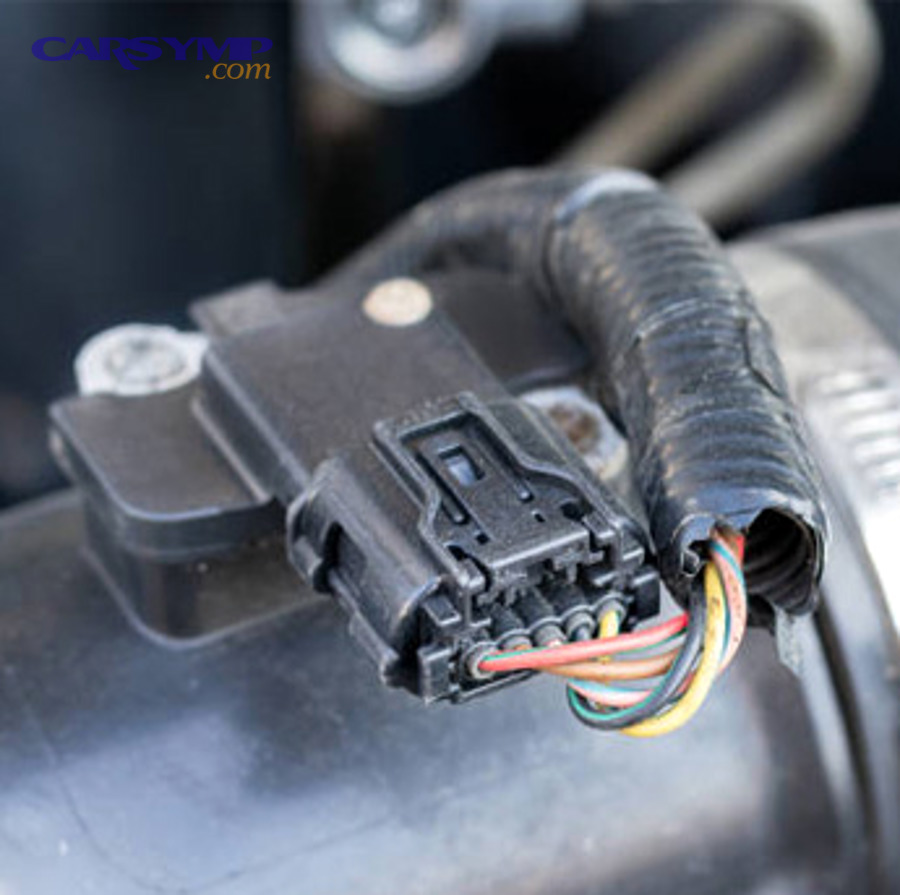
Wiring/ground faults can perfectly mimic ECU failure symptoms, especially when corrosion, pin fitment, or vibration causes intermittent contact—so you must treat wiring and grounds as a prime suspect before declaring the ECU bad.
More importantly, wiring problems often leave physical clues the ECU can’t hide.
Look for wiring/ground “tells”:
- Symptoms triggered by bumps, turning, or engine movement
- Visible corrosion or moisture in connectors
- Brittle wiring near heat sources
- Loose ground straps or ground points with rust/paint contamination
- Evidence of previous repairs (splices, electrical tape bundles)
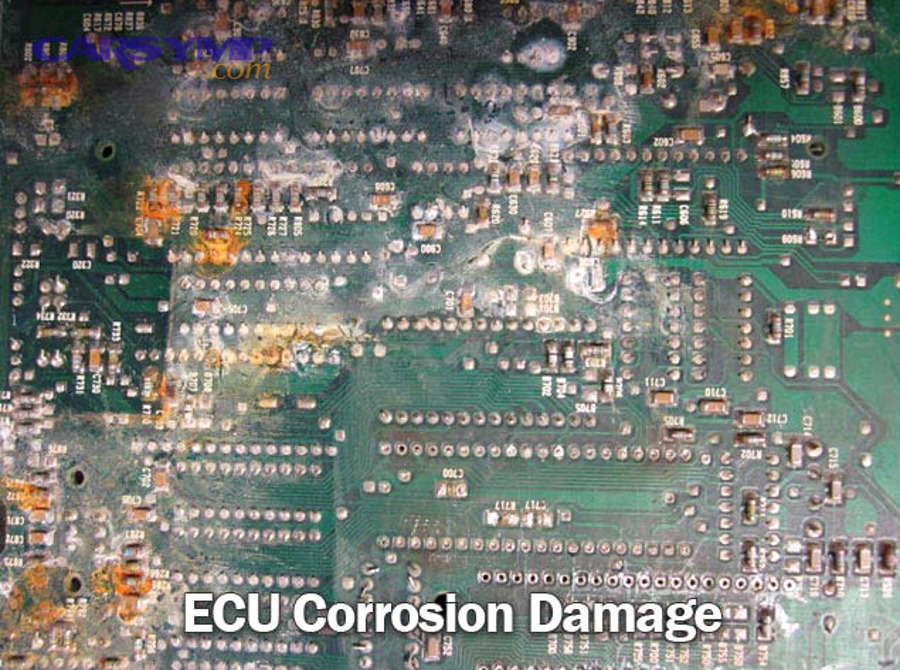
According to a study by Leibniz University Hannover from the Institute of Microelectronic Systems, in 2016, researchers noted that more than 20% of failures in microelectronic devices can be attributed to corrosion, highlighting why connector and ground corrosion can’t be ignored during diagnosis. (sustainability.uni-hannover.de)
What OBD-II clues and behaviors can support (or rule out) ECU failure?
OBD-II clues that support ECU suspicion include repeated communication issues, multiple unrelated codes, implausible live-data behavior, and patterns that return quickly after clearing—while clean, consistent data usually points away from ECU failure and toward sensors or wiring.
Specifically, ECU diagnosis becomes more reliable when you interpret codes as patterns instead of single answers.
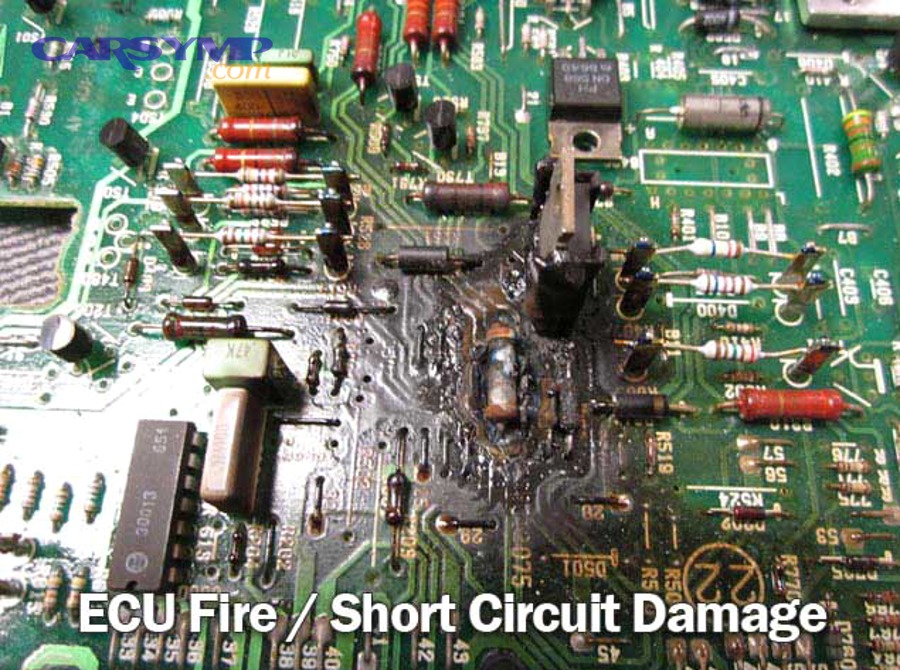
A quick warning: codes rarely say “replace ECU” in a straightforward way. More often, they say “I observed something I don’t like.” Your job is to decide whether the observation is coming from:
- a real mechanical issue,
- a bad sensor signal,
- a broken circuit, or
- an ECU that’s misprocessing or failing internally.
Which trouble code patterns point more toward ECU failure than toward a single component?
There are four code patterns that lean more toward ECU trouble: (1) multiple unrelated codes across different subsystems, (2) repeat internal module-related codes when present, (3) repeated code returns with no consistent root cause, and (4) communication-related codes mixed with drivability symptoms.
To better understand, think of these patterns as “ECU logic under stress.”
Examples of ECU-leaning patterns (conceptual, not vehicle-specific):
- Unrelated sensor faults appearing together without a shared cause
- Actuator control codes that don’t match the physical behavior
- Code storms after a stall/reset (possible module reset behavior)
- Repeated returns immediately after clearing without a change in conditions
A useful habit: write down the exact conditions of each event (hot/cold, wet/dry, idle/cruise, after refuel, after battery disconnect). ECU-related patterns often reveal themselves through repeat conditions.
What does “no communication with ECU” mean, and is it always a bad ECU?
“No communication with ECU” means the scan tool can’t establish data exchange with the engine control module, but it is not always a bad ECU because (1) the ECU may be unpowered, (2) CAN communication wiring may be disrupted, or (3) a network issue may be blocking messages.
However, a true ECU communication failure becomes more likely if power/grounds are confirmed and communication remains unstable.
Common causes to consider in order:
- Power/ground problem (blown fuse, bad relay, corroded ground)
- Network wiring problem (CAN high/low issues, connector damage)
- Module issue (internal failure preventing communication)
If communication drops out intermittently—connects, then fails—that often points to heat/voltage sensitivity or intermittent contact.
How can freeze-frame and live data expose an ECU that’s “thinking wrong”?
Freeze-frame and live data can expose ECU trouble when values become implausible (e.g., contradictory temperatures, unstable throttle commands, erratic RPM interpretation) because the ECU uses those numbers to make control decisions—so bad logic or internal instability can show up as “impossible” data behavior.
For example, live data is where you catch glitches that a stored code may miss.
Look for:
- Sensor readings that jump unrealistically
- Control outputs (like commanded throttle or fuel trims) that swing wildly without driver input
- Values that reset suddenly (suggesting ECU rebooting)
- Inconsistent data across related sensors (e.g., airflow vs throttle position vs load)
If you want one “next-best” tool step, it’s this: compare live data at idle and at a steady cruise—ECU oddities often become clearer under stable conditions.
What should you do next if you suspect ECU failure symptoms?
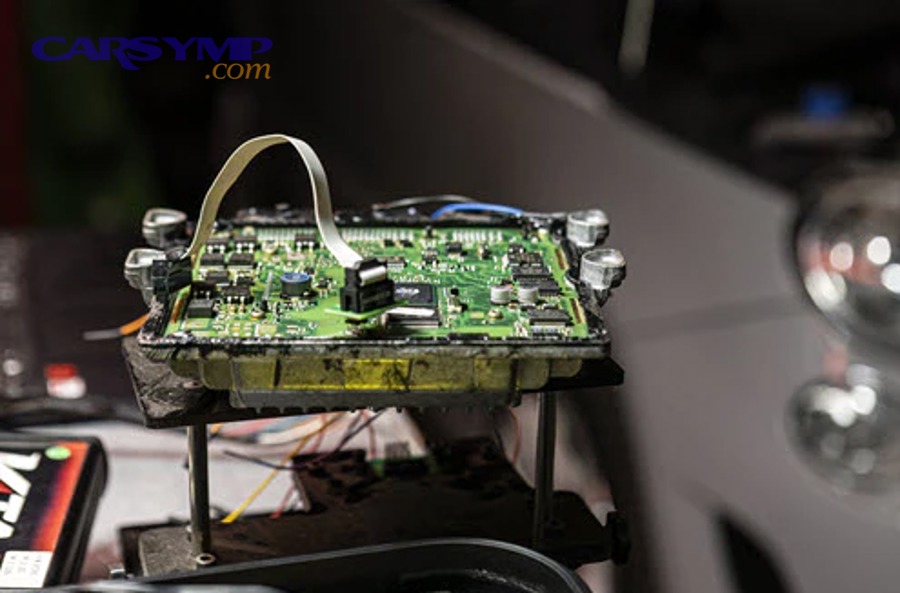
If you suspect ECU failure symptoms, the best next move is a structured path—stabilize the electrical foundation, document symptom conditions, scan for codes and live data patterns, and then choose professional testing before replacing the module—because ECU replacement is costly and misdiagnosis is common.
In addition, knowing what a shop actually does helps you evaluate quotes and avoid unnecessary parts.
This is the section where many articles get vague. Instead, think in terms of decisions you can actually make.
Should you keep driving with suspected ECU failure symptoms?
No—you should not keep driving with suspected ECU failure symptoms if stalling, limp mode, or sudden power loss is present because (1) the car can stall in traffic, (2) throttle/engine response can become unpredictable, and (3) repeated misfires or poor control can increase safety and mechanical risks.
Besides that, the driving decision should match the symptom severity, not your optimism.
A simple safety rule:
- Stop driving and tow if the engine dies unexpectedly, loses throttle control, or repeatedly enters limp mode.
- Drive cautiously to a shop only if symptoms are mild, consistent, and you can maintain safe speed without stalling.
This is not about fear—it’s about reducing the chance of the car failing at the worst possible time.
What information should you bring to a shop to speed up accurate diagnosis?
You should bring a short symptom log, scan results if available, and context about recent repairs because the fastest accurate diagnosis comes from patterns, not guesses—especially with intermittent electrical issues.
More specifically, you’re helping the technician avoid repeating the same dead ends.
Bring (or write down):
- When the symptom happens (cold start, hot restart, rain, idle, highway)
- What the car does (stall, surge, hesitate, no-start)
- Whether warning lights appear and which ones
- Any codes you pulled and the conditions when you pulled them
- Recent work (battery replacement, alternator, sensor replacements, engine work)
- Whether the problem changed after disconnecting the battery
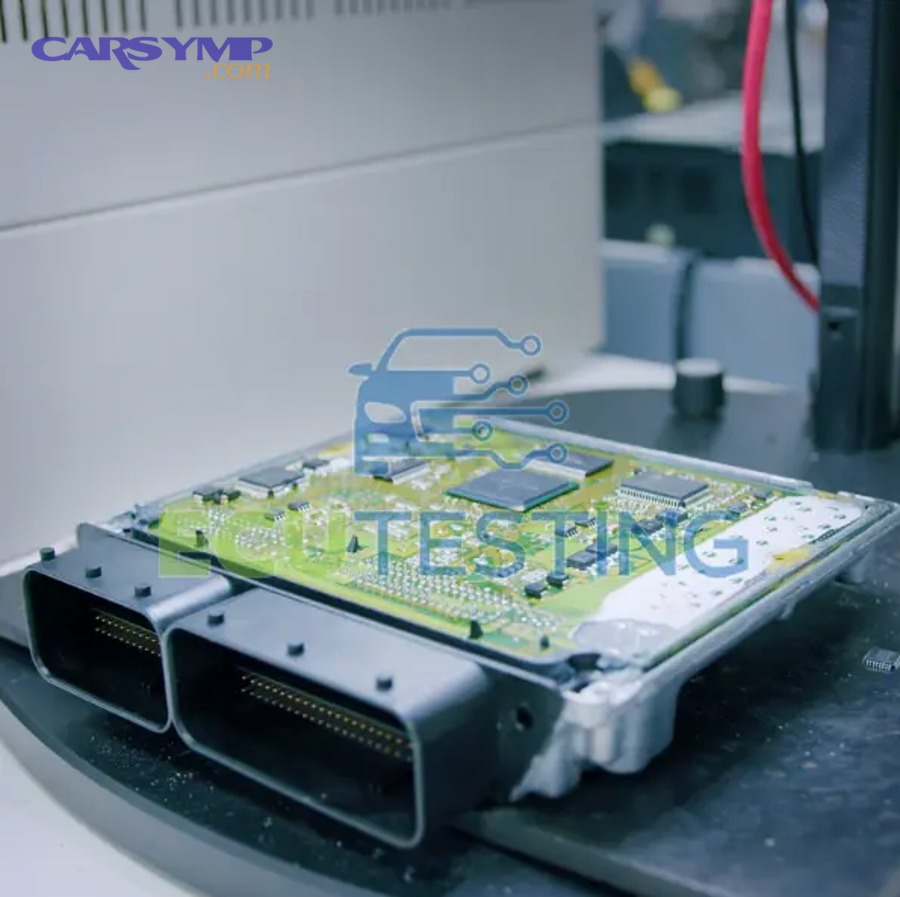
This is where the phrase ECU testing process at a shop matters in practice: the shop often needs your observations to recreate the failure, then confirm with scan data, power/ground checks, and communication checks before blaming the ECU.
Is ECU repair or replacement usually the better path for car owners?
Repair wins for cost and originality in many cases, replacement can be best for severe damage or unavailable repair options, and remanufactured modules often balance price and reliability—while used modules are the riskiest option for compatibility and unknown history.
However, the right choice depends on the failure type and the vehicle’s programming/immobilizer requirements.
Here’s how to think about it:
ECU repair (often best when):
- The issue is intermittent and traced to internal connections
- The module is known repairable for your model
- You want to keep original coding/vehicle configuration where possible
New/reman replacement (often best when):
- The ECU has severe internal damage or water intrusion
- The model has poor repair success rates
- You need warranty-backed reliability
When to consider a used ECU risks (and why people still do it):
- Used ECUs can be cheaper, but risk is high because of unknown prior stress (heat, water, electrical spikes), mismatch in calibration, immobilizer/key issues, and return hassles.
- If you go used, the decision should be based on verified part numbers, compatibility requirements, and a return policy—otherwise you can buy a second problem.
This is also where “bad ECU signs” can mislead: a used ECU from a salvage car may behave fine briefly, then fail under the same stress that killed it previously.
According to a study by Binghamton University from the electronic packaging reliability research community, in 2012, thermal cycling tests on solder interconnects quantified measurable changes in failure timing (including a reported 23% change in permanent failure time under preload), showing how heat and mechanical stress can materially affect electronic connection reliability over time. (ws.binghamton.edu)
Why do ECUs fail, and what rare symptom patterns should car owners know?
ECUs fail mainly from heat, moisture/corrosion, voltage stress, and vibration-driven connection fatigue, and rare patterns—like “fails hot, works cold” or post-rain randomness—often point to environmental or intermittent faults rather than a single bad sensor.
Next, these micro-level causes are useful because they explain why ECU failure symptoms can be intermittent and confusing.
What are the most common causes of ECU failure (heat, moisture, voltage spikes, corrosion)?
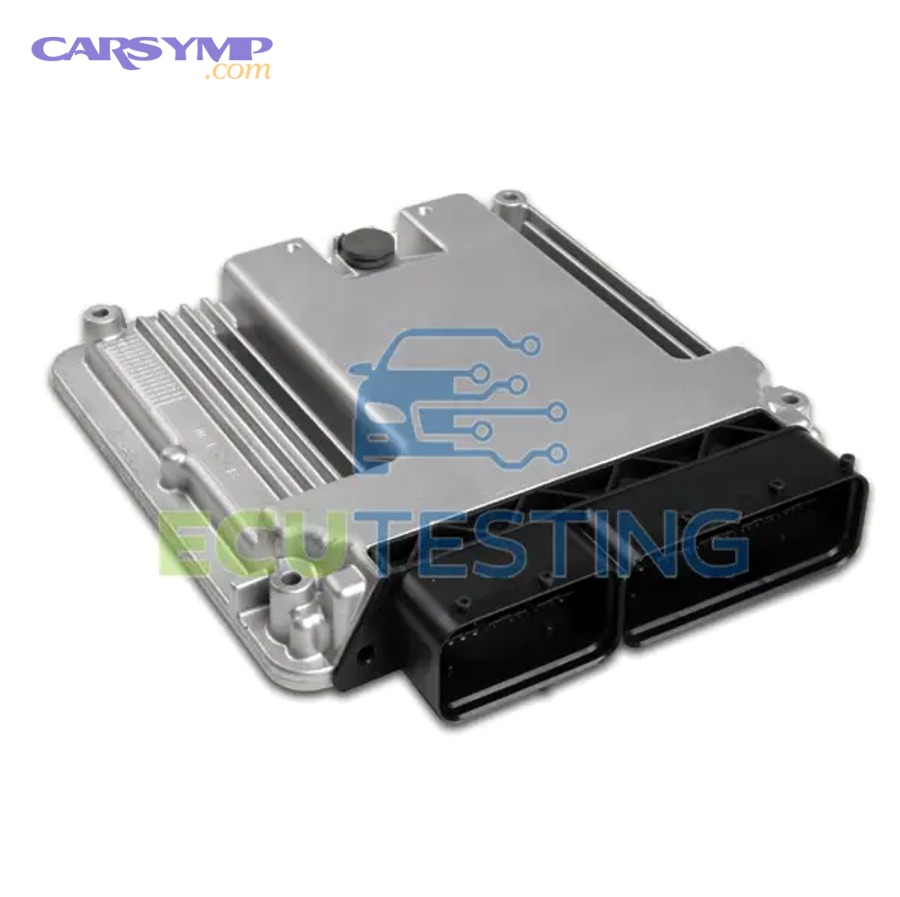
The most common causes are thermal stress, moisture ingress, voltage spikes/low voltage events, and corrosion at connectors or internal contacts because each one can degrade circuits and signal integrity until the ECU becomes unstable.
More importantly, these causes often leave repeatable “conditions” behind.
Cause-to-symptom connections:
- Heat stress: worsening when hot; limp mode after long drives; hot-start problems
- Moisture/corrosion: worse after rain; random faults; connector sensitivity
- Voltage spikes/low voltage: code storms; module resets; multi-warning behavior
- Vibration/fatigue: bumps trigger stalls; intermittent comm loss; harness movement sensitivity
The practical takeaway: preventing ECU failure isn’t only about the ECU—it’s about protecting the environment around it (drains, seals, grounds, charging system health).
Why do some ECU problems happen intermittently (works cold, fails hot)?
Intermittent ECU problems happen because heat expansion, changing resistance in weak solder joints, and marginal internal connections can cross a functional threshold only under certain temperatures or loads—so the ECU can behave normally until it’s stressed.
Then, once it cools, the connection “returns,” and the car seems fixed.
Common intermittent patterns to recognize:
- Runs fine for 10–20 minutes, then acts up
- No-start after a short stop, starts again later
- Symptoms return in the same temperature window repeatedly
This is why symptom logging is so powerful. Intermittent faults are easier to catch when you can reproduce them.
Can water intrusion or corrosion create “ghost symptoms” that mimic ECU failure?
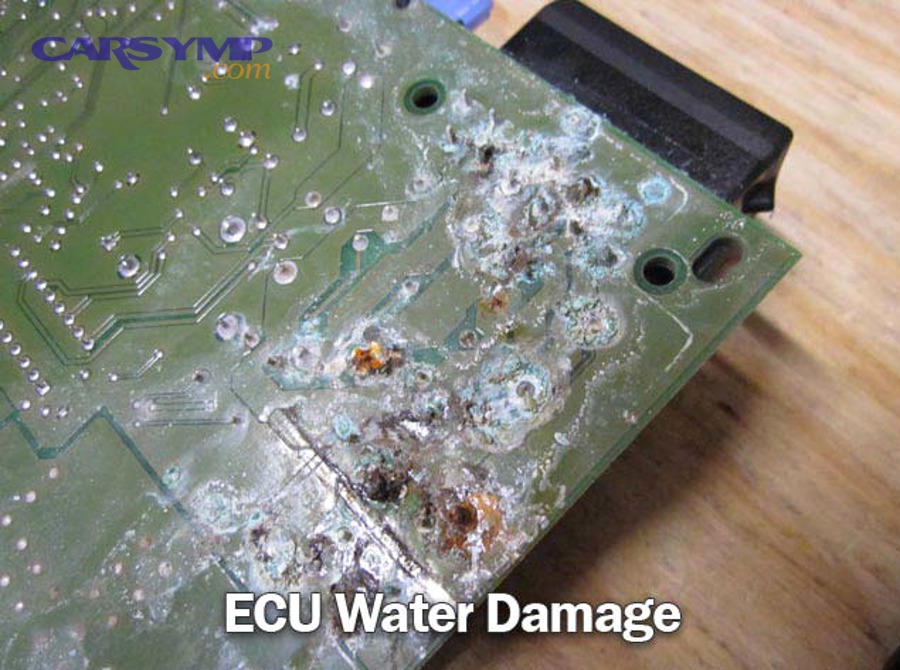
Yes—water intrusion and corrosion can create ghost symptoms that mimic ECU failure because (1) corrosion changes electrical resistance, (2) moisture creates unintended conductive paths, and (3) connectors can partially short or open intermittently, producing random-looking failures.
In addition, water-related faults often worsen after parking outside or after a wash, even if the ECU itself is okay.
Where water problems often start:
- Cowl drains and windshield leaks
- Flooded or damp carpet areas near module locations
- Engine bay connectors with compromised seals
- Poorly routed harnesses where water pools
If symptoms appear “the day after heavy rain,” don’t underestimate that clue—corrosion and moisture can lag behind the weather event.
How can CAN-bus or module communication faults change the symptom list?
CAN-bus and communication faults can expand the symptom list from engine-only issues to multi-module chaos because lost messages can trigger fail-safes, cause limp modes, and light up warning indicators across the dash—so the car looks like it has many unrelated problems at once.
However, communication faults can still originate from simple causes like power/ground issues or a damaged connector.
Communication-fault “tells”:
- Scan tool connects sometimes, not always
- Multiple U-codes (communication-related) appear with drivability issues
- Dash warnings multiply during or after a stall
- Symptoms worsen with vibration or wet conditions (connector/network sensitivity)
This is where professional ECU diagnosis adds value: a shop can test network integrity and module power/ground stability under load instead of swapping parts blindly.
Evidence (if any)
- According to a study by Leibniz University Hannover from the Institute of Microelectronic Systems, in 2016, researchers stated that more than 20% of failures in microelectronic devices can be attributed to corrosion, reinforcing the need to rule out wiring/connector corrosion before condemning an ECU. (sustainability.uni-hannover.de)
- According to a study by Binghamton University published in 2012, thermal cycling tests documented measurable shifts in solder-joint failure timing (including a reported 23% change in permanent failure time under preload), illustrating how heat/mechanical stress can contribute to intermittent electronic failures consistent with some ECU symptom patterns. (ws.binghamton.edu)