


A flat tire on the road becomes dangerous when panic replaces a plan—so the safest move is to keep control, slow down smoothly, and get your vehicle to the safest possible stopping point before you think about repairs. Your first goal is not to “fix” anything; it’s to protect your lane position, avoid sudden braking, and reduce speed until you can pull off safely. (nhtsa.gov)
Next, once you’re stopped, safety is still the priority because roadside risk comes from visibility, traffic speed, and where you stand. That’s why the right checklist focuses on making your car easy to see, securing it so it can’t roll, and choosing the safest place for passengers to wait—especially on high-speed roads. (cluballiance.aaa.com)
Then, the biggest decision is whether you should change the tire yourself or call for help. The “right” answer depends on shoulder width, lighting, weather, tools, and your confidence with jack points and lug nuts—not just whether you have a spare. This is where smart drivers avoid turning a simple flat into a roadside injury. (cluballiance.aaa.com)
Introduce a new idea: the same checklist can handle both a slow leak and a sudden blowout, but the control phase (what you do while still moving) matters more in a blowout—so let’s walk through the exact safety steps in the order they should happen. (nhtsa.gov)
What should you do immediately when a flat tire (or blowout) happens while driving?
Use this 6-step control method—steady steering, controlled throttle release, gentle deceleration, clear signaling, safe lane positioning, and a smart stop—to keep the vehicle stable and get off the road without escalating the risk. (nhtsa.gov)
To begin, the most important detail is that your tire problem is not yet a “stopped-car problem”—it’s a vehicle-control problem while you’re still rolling, and your inputs (hands and feet) decide what happens next.
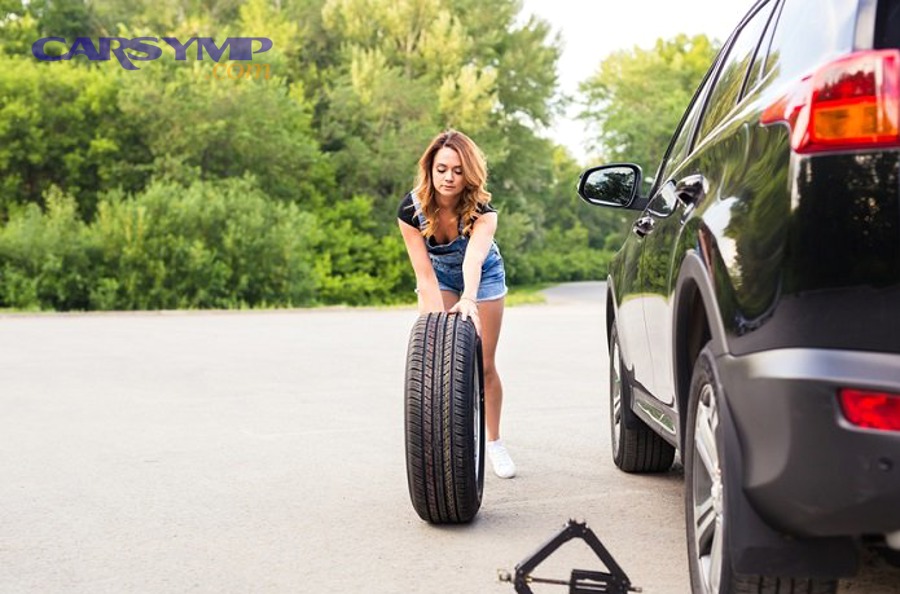
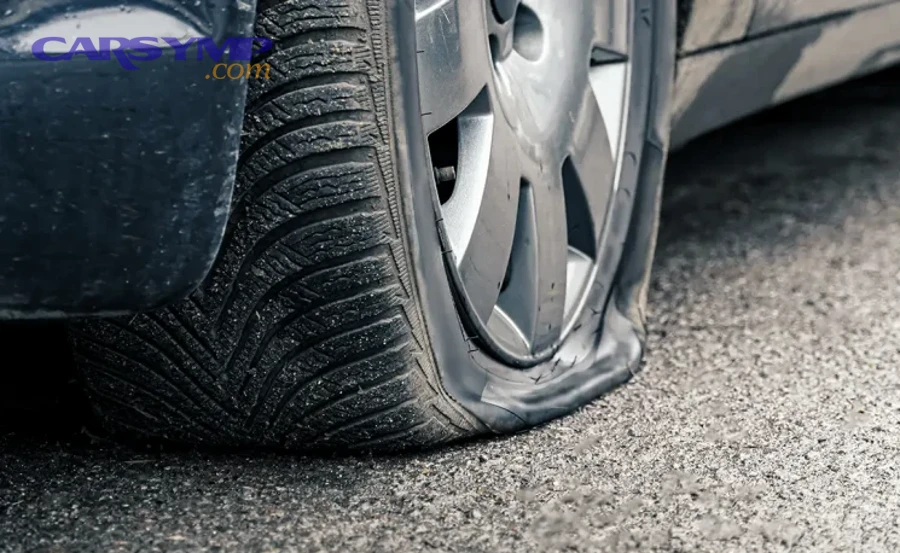
When the tire loses pressure, the car may drift, vibrate, or feel “heavy” in the steering. Many drivers describe early Car Symptoms like a thumping sound, a sudden pull to one side, or a steering wheel shimmy that gets worse as speed stays high. Those symptoms are your cue to switch from normal driving to stabilize-and-exit mode.
Here’s the practical 6-step sequence that works for a flat tire and scales up for a blowout:
- Grip the wheel with both hands and aim to keep the vehicle straight.
- Hold your lane—do not yank the wheel toward the shoulder.
- Gradually release the accelerator (don’t snap off the throttle).
- Signal early and scan for your safest stopping option.
- Move right smoothly when you have a safe gap, not at the first “panic moment.”
- Slow down gently and stop where you have maximum space and visibility.
This sequence matters because sudden braking or abrupt steering creates a weight shift that can worsen traction—exactly when one tire is already compromised.
Should you brake hard when you feel the tire go flat—Yes or No?
No—braking hard when you feel a flat tire is unsafe because it can (1) amplify loss of control by loading the front tires suddenly, (2) increase the pull toward the failed tire, and (3) reduce your ability to steer smoothly into a safe exit path. (nhtsa.gov)
However, “don’t brake hard” does not mean “don’t brake at all.” It means you brake after the vehicle is stable and you’ve started to slow naturally.
Why hard braking is risky (in plain terms):
- Uneven grip: The damaged tire may not share braking forces evenly, so the car can dart.
- Steering authority drops: Heavy braking asks the front tires to do two jobs (slow + steer) while you need steering most.
- Traffic behind you reacts late: A sudden speed drop can surprise drivers behind you.
A safer alternative is to ease off the gas first, let speed bleed off, then apply gentle braking once the car feels settled and you’re on a path to a safer spot.
How do you safely slow down and move off the road step-by-step?
You safely slow down and move off the road by stabilizing the car first, then reducing speed gradually, and only then changing lanes with a clear signal and smooth steering until you reach a wide shoulder, exit, or parking area. (nhtsa.gov)
Next, follow this step-by-step approach that matches how drivers actually succeed under stress:
- Step 1: “Steer first, speed second.” Keep your steering calm and your lane steady.
- Step 2: Gradual throttle release. Let the car slow naturally for a moment.
- Step 3: Signal and plan. Turn on your signal early; activate hazards once you’re clearly in trouble or slowing to stop.
- Step 4: Choose the safest stop you can reach. Favor exits, rest areas, or parking lots over narrow shoulders.
- Step 5: Move right smoothly. Make one clean lane change at a time; avoid last-second dives.
- Step 6: Gentle braking. Slow down and stop with maximum space to your right.
If you’re in heavy traffic, the “best” spot may be the next exit rather than the first sliver of shoulder. The goal is space—space to stop, space to stand, and space for other drivers to see you.
Where is the safest place to stop with a flat tire on the road?
There are 5 main safe stopping options for a flat tire—exit ramp/rest area, parking lot, wide shoulder, quiet side street, and the last-resort narrow shoulder—ranked by how much separation they give you from fast traffic.
Then, use this simple ranking to decide quickly:
- Exit ramp / rest area (best) — traffic is slowing and you gain space.
- Parking lot / gas station — controlled environment, level ground for repairs.
- Wide shoulder on straight roadway — workable if visibility is good and there’s room.
- Quiet side street — better than a highway shoulder if you can reach it safely.
- Narrow shoulder / bridge / curve (worst) — stop here only if the vehicle cannot continue safely.
Avoid stopping:
- On a blind curve or hill crest where drivers see you late.
- On bridges where there’s little escape space.
- Near intersections where traffic swirls unpredictably.
A smart “micro rule” is: If you can’t open your passenger door safely without stepping into traffic, the spot is not safe enough for a DIY tire change.
What changes if it’s a blowout instead of a slow leak?
A blowout demands more steering discipline and a longer stabilization phase, while a slow leak allows more time—but both require the same core steps: keep control, slow gradually, and pull off when it’s safe. (nhtsa.gov)
Especially at highway speed, a blowout can feel like a loud bang followed by a sudden pull. You may also see debris or smell hot rubber. This is where drivers overreact—slamming brakes or jerking to the shoulder—when the safer move is to keep the car balanced and controllable until you’re ready to stop. (nhtsa.gov)
A slow leak, by contrast, may present as:
- Persistent TPMS warning,
- Gradual pull,
- Tire noise that grows slowly,
- A “soft” feel in handling.
In both cases, remember the key safety concept: the road is the hazard, not the tire. You can replace a tire later; you can’t undo a loss-of-control moment.
What safety steps should you take after you’ve stopped to protect yourself and other drivers?
There are 5 main safety steps after stopping with a flat tire: visibility, vehicle securement, safe positioning, passenger protection, and help planning—and you should complete them before you touch a jack or lug wrench. (cluballiance.aaa.com)
Then, treat your stopped vehicle like a temporary hazard zone. Many roadside injuries happen not during the tire change itself, but while people walk around the car, stand too close to traffic, or forget the car can roll.
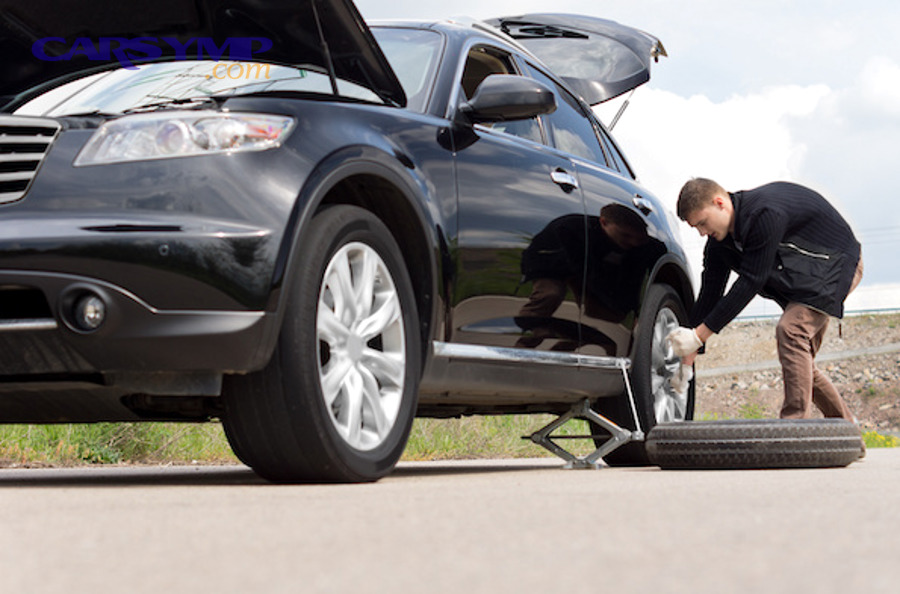
Should you turn on hazard lights and set a safety perimeter—Yes or No?
Yes—turning on hazard lights and creating a safety perimeter is essential because it (1) alerts approaching drivers early, (2) reduces rear-end and sideswipe risk, and (3) buys you time to make safer decisions like calling assistance or moving passengers. (cluballiance.aaa.com)
However, hazards are only one layer. The perimeter is created by distance and visibility, not just flashing lights.
Use this quick perimeter checklist:
- Hazards on immediately once you’re committed to stopping.
- Headlights on at night or in poor visibility (more conspicuous than hazards alone).
- Reflective triangle or flares if you have them and it’s legal/safe to deploy.
- Phone ready to call roadside help without wandering around the vehicle.
If conditions are dangerous (fast traffic, narrow shoulder), your “perimeter” may be as simple as staying buckled inside with hazards flashing while you call for help. (cluballiance.aaa.com)
How do you position the car and wheels to reduce risk of being hit?
You reduce the risk of being hit by maximizing separation from traffic, stabilizing the vehicle, and angling the front wheels away from the road so a secondary impact is less likely to push the car into traffic.
Next, lock down the vehicle in this order:
- Pull as far right as safely possible (aim for maximum shoulder width).
- Straighten the vehicle so it’s predictable and stable on the surface.
- Shift into Park (or in gear for manual transmissions).
- Set the parking brake firmly.
- Turn wheels away from traffic when safe to do so (reduces “into-traffic” roll risk).
- Place wheel chocks if you have them (especially on slopes).
If you are on a slope and you don’t have chocks, you can improvise cautiously with a stable object only if it’s safe to place—never step into traffic to do it.
Who should stay in the car vs get out, and where should everyone wait?
Staying inside the vehicle is often safer on busy roads, while moving behind a guardrail can be safer when you can exit away from traffic and reach a protected spot—so the best choice depends on traffic flow, shoulder width, and your ability to avoid stepping into danger. (cluballiance.aaa.com)
Then, decide using this comparison framework:
Stay in the car (usually best) when:
- Traffic is flowing close to your doors,
- You’re on a narrow shoulder,
- It’s dark or visibility is poor,
- You’re waiting for roadside assistance to arrive. (cluballiance.aaa.com)
Exit and wait away from the car (sometimes best) when:
- You can exit from the passenger side (away from traffic),
- You can get behind a guardrail or far off the road,
- You won’t be standing on a narrow shoulder.
If you have kids, older passengers, or pets, “moving around outside” often increases risk. Keep everyone calm, visible, and accounted for, and avoid the common mistake of standing near the traffic-facing side of the vehicle.
Can you safely change a tire on the roadside, and when should you NOT attempt it?
No—you cannot always safely change a tire on the roadside because (1) traffic proximity can be lethal, (2) unstable surfaces can collapse a jack, and (3) poor visibility or weather can turn a routine job into an emergency. (cluballiance.aaa.com)
However, “don’t change it” doesn’t mean “do nothing.” It means you choose the safer alternative: call for assistance, move to a safer location if possible, or use a temporary mobility option if your vehicle supports it.
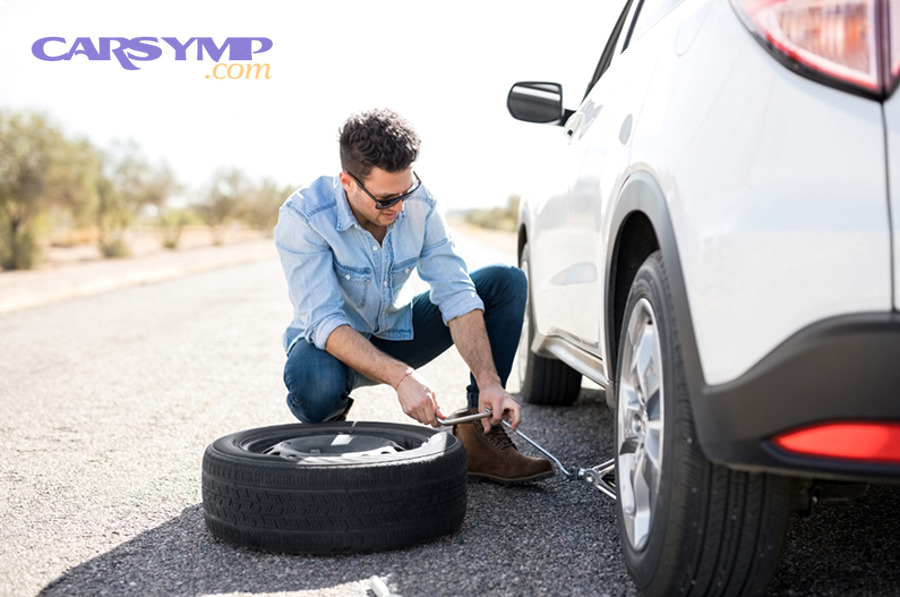
This is also where people misunderstand the phrase “fix flat tire.” Sometimes the safest way to fix flat tire is not with tools on the shoulder—it’s by getting to a safer environment first and doing the repair there.
Is it safe to change a tire on the highway shoulder—Yes or No?
No—changing a tire on a highway shoulder is often unsafe because (1) vehicles pass at high speed within a few feet, (2) shoulders can be uneven or soft and destabilize the jack, and (3) drivers approaching from behind may be distracted or unable to change lanes. (cluballiance.aaa.com)
On the other hand, there are exceptions—wide shoulders, straight sightlines, daylight, light traffic, and confident technique can make it feasible. The key is to apply a strict safety threshold:
If any of these are true, don’t DIY:
- Narrow shoulder, rumble strip with no extra space, or you must stand in the traffic lane.
- Blind curve, hill crest, bridge, or heavy rain/snow/fog.
- You lack the correct jack point knowledge or tools.
A blowout also increases the odds of Sidewall damage and blowout risks on the remaining tire carcass, which can leave shredded rubber and sharp debris around the wheel—another reason to avoid kneeling in a tight shoulder environment.
What situations mean you should call roadside assistance instead of DIY?
There are 7 common situations that should trigger a call for roadside assistance: unsafe location, poor visibility, severe weather, missing/incorrect tools, physical limitations, wheel/tire damage beyond a simple puncture, or uncertainty about jack points.
Next, use this decision list (it’s fast and practical):
- Unsafe shoulder (narrow, traffic close, blind spots).
- Night + poor lighting (drivers see you too late).
- Bad weather (rain, snow, high wind rocking the vehicle).
- No usable spare (flat spare, missing tools, key for locking lugs missing).
- Vehicle sits oddly (possible suspension damage or wheel wobble).
- Tire looks shredded (likely sidewall failure, not a simple puncture).
- You feel rushed or unsure (mistakes happen when you hurry).
If you suspect wheel damage or the tire came apart, you’re not dealing with a normal puncture—you’re dealing with a higher-risk incident that deserves professional help.
What’s the difference between using a donut spare, a full-size spare, and a tire repair kit?
A full-size spare wins for normal drivability, a donut spare is best for short-distance emergency mobility, and a tire repair kit is optimal only when the puncture is minor and located in the tread—not the sidewall.
Then, compare them using real-world criteria:
Full-size spare
- Closest to normal handling and braking
- Best for longer “get home / get to shop” distances
- Heavier and may not be included on many vehicles
Donut spare (temporary spare)
- Lightweight and easy to store
- Designed for short-term, reduced-speed use
- Can change handling and traction, especially in rain
Tire repair kit (sealant + inflator)
- Fast and requires less lifting work
- May fail on large punctures, tread tears, or sidewall damage
- Can complicate later repairs on some setups (check your vehicle guidance)
Important safety note: If the puncture is in the sidewall, do not rely on sealant—sidewalls flex heavily and failures can escalate quickly.
How do you change a tire safely step-by-step once you’re in a safe spot?
Change a tire safely using this 10-step method—secure, loosen, lift, remove, mount, hand-tighten, lower, tighten in pattern, verify pressure, and recheck—so the spare seats correctly and the vehicle stays stable during the swap.
Below, the key is sequence. Most mistakes come from doing steps out of order or skipping stability checks because you “just want it done.”
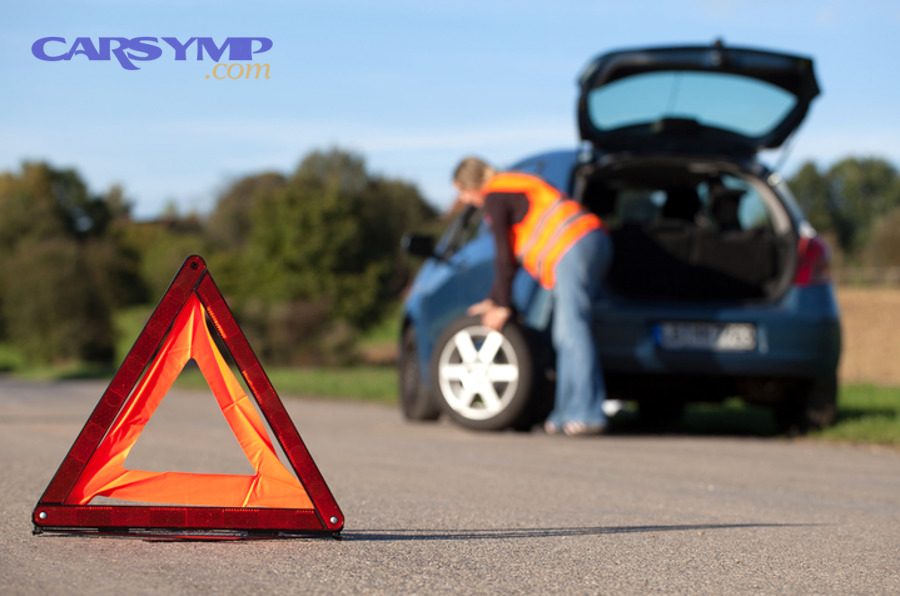
What tools and checks do you need before lifting the car?
There are 8 essentials before lifting the car: spare tire, jack, lug wrench, wheel chock, flashlight, gloves, a firm level surface, and the owner’s manual page showing jack points.
Then, do these checks before you lift:
- Ground check: Firm, flat, not soft gravel or sloped shoulder.
- Traffic check: You’re truly in a safe spot (not “technically off the road”).
- Jack point check: Confirm the correct lifting location for your vehicle.
- Spare check: Make sure the spare is inflated enough to use.
- Wheel chock check: Chock the opposite wheel if possible.
If your vehicle has locking lug nuts, locate the key before you loosen anything. If the key is missing, you’ve saved yourself from getting stuck mid-job.
What is the safest order for loosening lugs, jacking up, and tightening lugs?
The safest order is: loosen lugs slightly on the ground → jack up → remove lugs and wheel → mount spare → hand-tighten → lower → tighten in a star pattern → recheck after a short drive.
Next, here is that sequence with practical “do this, not that” clarity:
- Hazards on and parking brake set.
- Chock a wheel if available.
- Remove hubcap if needed to access lugs.
- Loosen lug nuts ¼–½ turn while the tire is still on the ground (prevents spinning).
- Place jack at the correct point and lift until the flat clears the ground.
- Remove lug nuts fully and pull the wheel straight off.
- Mount spare and start lug nuts by hand (prevents cross-threading).
- Snug lugs in a star pattern while the wheel is in the air.
- Lower the vehicle until the tire contacts the ground firmly.
- Tighten again in a star pattern with your wrench, then recheck soon after driving.
If you’re using a temporary spare, treat the vehicle as “in caution mode” immediately afterward—acceleration, braking, and cornering can feel different.
Should you crawl under the car while it’s on a jack—Yes or No?
No—never crawl under a car supported only by a jack because (1) jacks can shift on uneven surfaces, (2) sudden load changes can cause collapse, and (3) roadside ground conditions are rarely controlled or stable.
Instead, keep your body out from under the vehicle at all times. If you truly need under-car access (rare for a simple tire swap), you need jack stands on a solid surface—something most roadside situations can’t safely provide.
What should you do after the tire is changed (or help arrives) to stay safe and prevent follow-up damage?
There are 6 key steps after the tire is changed—clear the shoulder safely, drive cautiously, confirm pressure, watch for warning lights, plan a proper repair, and inspect for damage—so you avoid turning a “flat tire event” into wheel or tire failure later.
Then, focus on what many drivers skip: the “after-action” phase. This is where hidden damage, incorrect tightening, or driving too fast on a temporary spare can create a second incident.
Should you drive normally after installing a spare—Yes or No?
No—you should not drive normally after installing a spare because (1) temporary spares can reduce traction and stability, (2) incorrect lug torque can reveal itself under normal speeds, and (3) the original tire may have damage that needs professional evaluation.
Instead, drive smoothly, keep extra following distance, and head to a tire shop as soon as practical. If you used a donut spare, check your vehicle guidance for limits and treat it as a short-term bridge—not a “new normal.”
This is also where you should think about Sidewall damage and blowout risks: if the original tire ran underinflated, the sidewall may have overheated and weakened even if the puncture looks small.
What should you inspect for after a flat or blowout?
There are 7 post-flat checks that catch most problems early: tread/sidewall condition, wheel/rim damage, valve stem condition, unusual vibration, pulling or steering changes, repeated pressure loss, and warning-light behavior.
Next, use this simple inspection approach:
- Original tire inspection (before repair):
- Look for cuts, bulges, or shredded areas (bulges often mean the tire is done).
- Check whether the puncture is in the tread (often repairable) or sidewall (usually not).
- Wheel and mounting check:
- Look for rim bends, cracks, or scraping that could cause future leaks.
- Drive feel check:
- If the steering shakes, the wheel may not be seated correctly or the lugs may be uneven.
- Warning light check:
- If a TPMS light stays on after you’ve corrected pressure, you may need a procedure or a short drive cycle, depending on the vehicle. (nhtsa.gov)
If you’re trying to “fix flat tire” permanently, the safest mindset is: repair the cause, not just the symptom. A plug or patch is only correct when the tire’s structure is still healthy.
Finally, if your dashboard light is involved, drivers often ask about TPMS reset after fixing a flat. Some cars reset automatically after correct inflation and driving; others require a reset sequence through the vehicle menu or a button. Check your owner’s manual—and remember that the TPMS light typically turns off only when the system sees safe pressure again. (nhtsa.gov)
According to a study by the University of Michigan from the Transportation Research Institute (UMTRI), in 2000, a review of 129 police-reported tire defect cases (1995–1997) found that 52 cases (40.31%) involved a blowout, and among fatal truck crashes in that period, 52 of 14,768 trucks (0.35%) had a blowout noted as an event in the crash. (ntlrepository.blob.core.windows.net)
How can you prevent a flat tire—and what should you keep in your car for rare roadside scenarios?
There are 4 prevention-and-preparedness pillars—routine tire checks, smart driving habits, the right emergency gear, and scenario planning for bad conditions—so you reduce flat risk and handle rare roadside scenarios without improvising under stress. (nhtsa.gov)
In addition, prevention is the antonym of emergency response: you either spend a few minutes monthly reducing the chance of a flat, or you spend an hour on the shoulder dealing with one.
What maintenance habits reduce your risk of flats (prevention vs emergency response)?
Prevention wins when you consistently manage tire pressure, tread depth, and visible damage, while emergency response is what you rely on when those checks were skipped or a road hazard was unavoidable.
Next, keep prevention simple and repeatable:
- Check tire pressure monthly with an accurate gauge.
- Inspect tread and sidewalls for cuts, bulges, embedded objects, or cracking.
- Rotate tires on schedule to prevent uneven wear patterns.
- Address slow leaks early instead of topping off repeatedly.
- Replace aging tires when condition—not just tread—signals risk.
Underinflation matters because it increases sidewall flex and heat buildup, which can escalate into failure—especially at highway speeds. (crashstats.nhtsa.dot.gov)
What emergency gear should drivers carry beyond the spare and jack?
There are 10 high-value emergency items beyond the spare and jack: reflective triangles, headlamp, gloves, wheel chocks, portable inflator, tire gauge, rain gear, reflective vest, phone charger/power bank, and a basic first-aid kit. (cluballiance.aaa.com)
Then, build your kit around what actually goes wrong:
- You can’t see (headlamp).
- Other drivers can’t see you (triangles/reflective gear).
- The car moves unexpectedly (chocks).
- The spare is low (inflator + gauge).
- Your phone dies (charger + power bank).
If you travel with family, add water and a warm layer—waiting safely is often the best strategy on high-speed roads.
What should you do differently at night, in heavy rain, or in snow?
There are 3 major adjustments in low-visibility conditions: prioritize visibility, raise your “don’t DIY” threshold, and shorten your exposure time outside the vehicle.
Especially at night or in heavy rain:
- Stay buckled and visible while you assess options. (cluballiance.aaa.com)
- Use headlights to improve conspicuity.
- Call help sooner rather than attempting repairs in dangerous conditions.
In snow or on ice, even a stable jack job can turn unstable if the surface shifts. In those conditions, “wait safely” often beats “work quickly.”
Do run-flat tires or tire sealant change the safest next steps—Yes or No?
Yes—run-flat tires or sealant can change the safest next steps because they may (1) let you move to a safer location instead of stopping immediately, (2) reduce time spent exposed on the shoulder, and (3) provide a temporary mobility bridge until professional service is available.
However, the rule is still the same: safety first, repair second. If the tire is visibly shredded or the car is unstable, stop and call for help. If the tire is simply low and your system supports controlled mobility, use that advantage to reach a safer place—then do the proper repair.
And if your TPMS light is part of the story, treat it as guidance, not a guarantee: it warns you about pressure, but it doesn’t tell you whether the tire structure is safe after a severe low-pressure event. (nhtsa.gov)