


Oil pan (oil sump) gasket leak signs are usually identifiable if you follow one rule: trace the leak to the highest wet point on the engine, not the lowest drip on the floor. This article walks you through the exact symptoms that point to the oil pan gasket seam, plus simple checks to confirm it.
Many drivers notice a stain first—but an oil leak can travel. That’s why you’ll also learn how oil pan gasket symptoms differ from leaks higher up (like a valve cover gasket) and from nearby “false suspects” (like the drain plug or oil filter area).
Because a leak can be “just a seep” or a genuine risk, we’ll also cover what your symptoms mean for safety—how to judge urgency, what signs mean you should stop driving, and what to monitor if you must drive briefly.
Introduce a new idea: once you can identify and confirm the source, you’ll save time and money by choosing the right next step instead of guessing, tightening random bolts, or replacing the wrong seal.
What is an oil sump (oil pan) gasket leak?
An oil sump (oil pan) gasket leak is a loss of seal at the pan-to-engine mating surface that lets engine oil seep or drip from the pan rail, usually appearing as wetness around the pan seam and oil collecting on lower engine parts.
To better understand why this matters, start with what the gasket actually does and why “seep vs drip” changes your urgency.
What the oil pan gasket does (and why leaks start here)
The oil pan is the reservoir at the bottom of the engine. The gasket (or RTV sealant on some engines) is the barrier that keeps oil inside while the engine vibrates, heats up, cools down, and flexes slightly under load.
Over time, that seal can fail because of:
- Heat cycles: repeated expansion and contraction harden gasket material.
- Age and oil exposure: gaskets can lose elasticity and stop conforming to the metal surfaces.
- Impact or bending: a curb strike or road debris can slightly deform the pan lip.
- Improper sealing: wrong gasket, poor surface prep, or uneven torque can create gaps.
Seep vs leak: the quick definition that changes everything
- Seep: light wetness around the pan rail, oil film but no active dripping.
- Leak: active dripping, visible fresh oil trails, or repeated spots on the ground.
That difference matters because a seep is often a “monitor and plan” issue, while an active leak can become an “oil level drops fast” problem—especially on long drives.
What are the most common signs of an oil pan gasket leak?
There are 5 main signs of oil pan gasket leak symptoms—(1) oil spots under the engine, (2) a wet pan seam, (3) oily buildup on the undercarriage, (4) burning oil smell or light smoke, and (5) a dropping oil level—based on where oil shows up and how fast it accumulates.
Next, use the symptom order below to match what you’re seeing to what’s actually happening under the car.
Is oil on the driveway directly under the engine a clear sign of an oil pan gasket leak?
No—oil on the driveway is a useful clue, but it is not a clear confirmation of an oil pan gasket leak for three reasons: oil can run downward from higher gaskets, airflow can push oil rearward while driving, and lower components (like splash shields) can drip far from the source.
However, the spot location still helps when you treat it as a “starting point,” not a diagnosis.
How to use the driveway spot correctly
- Place clean cardboard under the engine overnight.
- Note whether the drip is center, front, or rear of the engine bay.
- Compare that with what’s wet above it the next morning.
If the cardboard spot is near the center of the engine bay and the pan rail is visibly wet all around, the oil pan gasket becomes more likely. If the spot is rearward near the bellhousing area, the rear main seal (or oil cooler/filter housing) becomes more likely.
What does an oil pan gasket leak look like on the pan seam and surrounding parts?
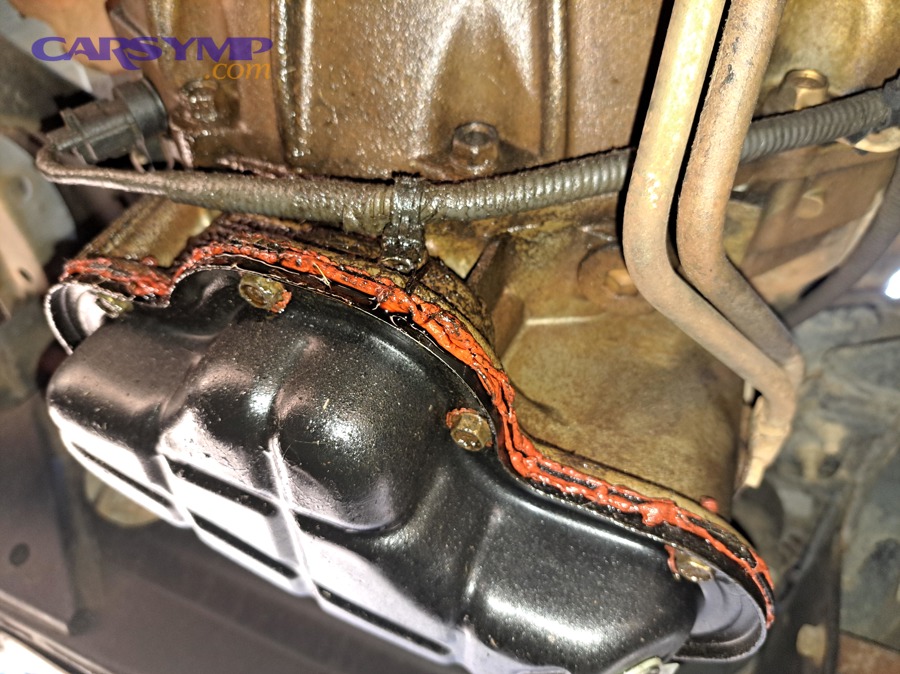
An oil pan gasket leak typically looks like a continuous wet line along the pan rail (the seam where the pan meets the engine), with fresh oil appearing as shiny wetness and older oil appearing as dark, sticky grime collecting around bolts and edges.
More specifically, your eyes should look for a “high-to-low trail” pattern.
Visual patterns that strongly suggest the pan gasket
- Wetness appears right at the pan-to-engine seam, not from above.
- Oil forms beads near pan bolts or along corners where the gasket changes direction.
- The side of the oil pan shows a clear boundary: dry above, wet below the seam.
Patterns that suggest it might not be the pan gasket
- The pan is wet, but the engine block above the pan rail is also wet.
- Oil appears on the side of the engine, higher than the pan seam.
- Oil is concentrated around the oil filter or cooler housing area.
Which warning signs suggest the leak is becoming urgent (not just a seep)?
The leak is becoming urgent if you have 3 escalating signs: oil level drops noticeably between checks, fresh oil drips appear after every drive, and oil contacts hot components (burning smell or smoke), based on leak rate and exposure risk.
Besides the mess, urgency is about whether the leak can cause low oil lubrication before you notice.
Urgency checklist
- You’re adding oil more than once between normal service intervals.
- You see fresh drips minutes after parking.
- You smell burning oil after a drive or see light smoke from the engine bay.
- The oil pressure warning light flickers (treat this as emergency-level).
If any of these are present, your next move is not “wait and see.” It’s to confirm the source and plan the repair quickly.
How can you confirm the leak is from the oil pan gasket and not higher up?
You can confirm an oil pan gasket leak using a clean-and-recheck method in 3 steps—clean the area, drive to create fresh oil movement, then inspect for the highest wet point—so you identify the true origin instead of the lowest drip.
Then, use one of the verification tools (visual inspection, cardboard test, or UV dye) depending on how slow the leak is.
Should you clean the engine first before diagnosing an oil leak?
Yes—you should clean first because oil residue can mislead you for at least three reasons: old oil spreads across surfaces, road dust turns residue into “fake trails,” and airflow while driving moves oil away from the source.
To begin, treat cleaning as part of diagnosis, not an extra chore.
Safe, practical cleaning approach
- Work on a cool engine.
- Use a degreaser on the lower engine and pan area.
- Rinse lightly (avoid blasting electrical connectors).
- Let it dry fully before rechecking.
Cleaning resets the evidence so that what you see next is real, fresh leak activity.
How do you do a simple “clean-and-recheck” test to pinpoint the oil pan gasket?
The clean-and-recheck test is: clean the suspected area, drive 10–20 minutes, park on a level surface, then inspect with a flashlight for the first fresh wetness at the highest point—that highest point is your likely leak source.
Specifically, follow this order so you don’t miss the seam.
Step-by-step inspection order
- Look above the oil pan: block edges, timing cover area, oil filter housing area.
- Move down to the pan rail: check the entire seam perimeter you can see.
- Check pan corners and bolt areas.
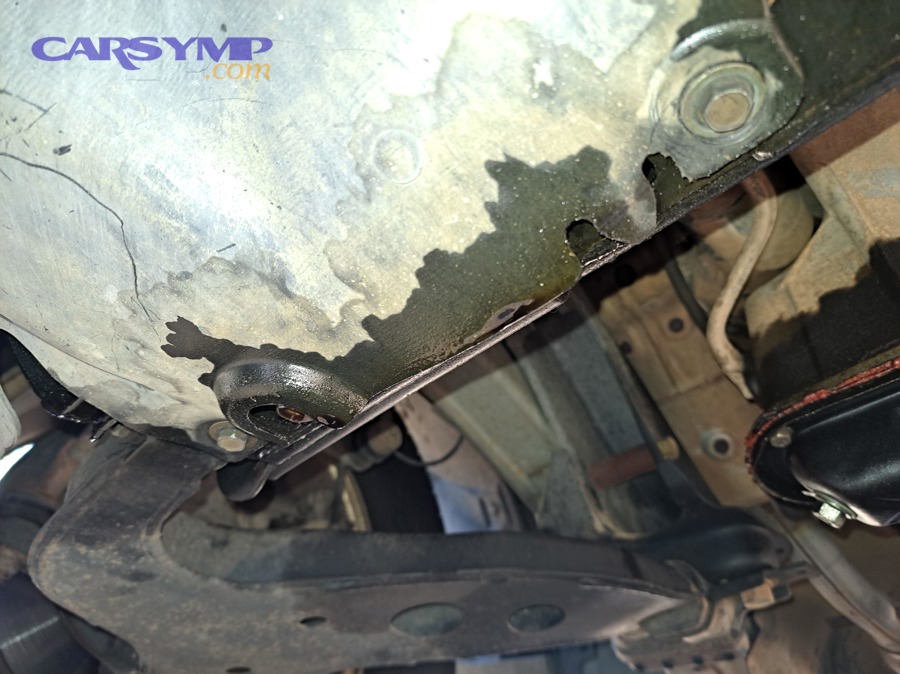
- Look at the undertray or splash shield: oil can pool there and drip later.
Tip that prevents the most common mistake
If the pan is wet but the block above it is also wet, don’t call it a pan gasket leak yet. Oil is gravity-driven; it rarely “climbs” upward. The highest wet point wins.
When is UV dye the best way to confirm an oil pan gasket leak?
UV dye is best when the leak is slow, intermittent, or masked by grime, because the dye highlights fresh oil flow and makes the origin visible under UV light more clearly than a standard flashlight inspection.
Meanwhile, it’s especially useful when the problem shows up as an “oil leak under car” only after driving—when airflow and heat make normal tracing difficult.
How UV dye confirmation works (in plain terms)
- Add dye compatible with engine oil.
- Drive long enough for oil circulation.
- Scan with UV light and glasses; look for the brightest fresh dye trail.
- Identify the first glowing point (the origin), not the glowing drip.
According to a study by Lund University from the Department of Physics (Combustion Physics), in 2017, researchers noted that certain fluorescent dyes commonly used in service and maintenance are designed to be excitable by handheld UV light sources, supporting dye-based tracing as a practical method for locating oil flow paths. (lup.lub.lu.se)
Oil pan gasket leak vs other oil leaks: how do you tell the difference?
Oil pan gasket leaks tend to originate at the pan rail seam, valve cover leaks originate high and run down, and rear main seal leaks often appear near the engine-to-transmission junction—so the best differentiator is where oil is first wet, not where it drips last.
However, because leaks can travel, you’ll get the fastest clarity by comparing leak patterns side-by-side.
Before the comparisons, here’s a quick “map.” This table summarizes Common leak spots by location under car and includes a Repair cost estimate by leak source so you understand what matters most during diagnosis (cost varies by vehicle access and labor time).
| Leak source (most common) | Where you see oil under the car | Typical visual clue | Repair cost estimate by leak source (relative) |
|---|---|---|---|
| Oil pan gasket (oil sump gasket) | Center-lower engine area | Wet pan rail seam; oil collects on pan lip | Medium |
| Valve cover gasket | Can drip down to lower engine and appear “everywhere” | Oil high on engine; sometimes oil on exhaust heat shields | Medium |
| Drain plug / crush washer | Near oil pan drain area | Fresh oil concentrated at drain bolt; often after service | Low |
| Oil filter / filter housing | Front/side of engine depending on layout | Wetness around filter or housing; spray pattern possible | Low–Medium |
| Rear main seal | Rear of engine at bellhousing | Drips at engine-trans junction; oily bellhousing area | High |
This table also sets up the exact decision you’re about to make: confirm source first, then choose the right fix rather than guessing.
Oil pan gasket leak vs valve cover gasket leak: which symptoms and leak paths differ?
Oil pan gasket leaks win for “lower seam wetness,” while valve cover gasket leaks win for “top-down oil trails,” because valve cover leaks start high and gravity carries oil down the engine block, often coating the oil pan and faking a pan gasket failure.
On the other hand, there are practical clues that separate them quickly.
Valve cover gasket clues
- Oil is visible high on the engine (near the valve cover perimeter).
- Burning smell occurs because oil hits hot exhaust components near the top/side.
- The oil pan is wet, but so is the engine block above the pan seam.
Oil pan gasket clues
- Engine block above pan rail is mostly dry.
- Wetness starts at the pan seam itself.
- Oil accumulates on crossmember or undertray directly below the pan.
If you’re stuck, return to the “highest wet point” rule—valve cover leaks almost always show that point clearly once cleaned.
Oil pan gasket leak vs oil drain plug/filter leak: what clues separate them?
Oil pan gasket leaks are best indicated by a wet pan rail seam, while drain plug or filter leaks are best indicated by fresh oil concentrated at one small point—plug threads, washer surface, filter gasket, or housing—so the “tight cluster vs long seam” pattern is your key differentiator.
More importantly, timing tells the truth.
Drain plug / filter leak clues
- Leak starts right after an oil change.
- Oil is localized around the plug or filter.
- Drips often appear immediately after parking.
Oil pan gasket leak clues
- Leak develops gradually over weeks/months.
- Oil appears along the seam line, not just one fastener.
This is where many people make the classic mistake: DIY tightening vs proper gasket fixes. A drain plug leak might be solved with the right washer and torque; an oil pan gasket leak usually is not solved by “just crank it tighter.”
Oil pan gasket leak vs rear main seal leak: how does leak location change?
Oil pan gasket leaks usually show wetness around the pan perimeter, while rear main seal leaks usually show wetness at the rear engine area near the bellhousing—so rear main seal leaks are more “rear junction” and pan gasket leaks are more “pan seam.”
However, the two can be confused because oil can travel backward with airflow.
Rear main seal clues
- Oil is concentrated where engine meets transmission.
- Oil may drip from a bellhousing inspection opening.
- The pan rail may be less uniformly wet.
Oil pan gasket clues
- Wetness is distributed along the pan seam and corners.
- Oil pools on the pan lip and lower edges.
When in doubt, dye testing is especially helpful for rear leaks because that junction area collects grime quickly.
Can you drive with an oil pan gasket leak?
Yes, you can sometimes drive with an oil pan gasket leak, but only if (1) the leak is a slow seep, (2) the oil level stays stable with frequent checks, and (3) there is no burning smell, smoke, or oil pressure warning light—otherwise, you should not drive because the risk escalates fast.
Next, use the “drive vs don’t drive” rules below to decide based on symptoms, not hope.
Is it safe to drive if the leak is only a slow seep?
Yes, it can be safe short-term if you meet three conditions: you can confirm it’s only a seep (no active drips), you can maintain oil level with frequent checks, and oil is not contacting hot components (no smoke or strong burning smell).
However, “safe” here means “safe enough to get it repaired,” not “ignore it.”
Safe-short-term rules
- Check oil level every time you refuel (or daily).
- Park over cardboard to track whether seep becomes drip.
- Avoid long highway drives if you’re uncertain about leak rate.
If the leak rate changes suddenly, treat it as a new problem and reassess.
What symptoms mean you should stop driving immediately?
You should stop driving immediately if you have 3 danger signs: an oil pressure warning (or low-oil-pressure symptom), heavy burning smell/smoke, or rapid oil loss (fresh puddles or repeated drips), because these indicate lubrication risk or fire risk.
More specifically, here are the red flags.
Stop-now symptoms
- Oil pressure light comes on or flickers.
- Loud new ticking/knocking appears (possible lubrication loss).
- Visible smoke from underhood after stopping.
- Oil level drops noticeably in a very short time.
According to a study by Harbin Engineering University from the College of Power and Energy Engineering, in 2025, researchers demonstrated that starved lubrication conditions can drive severe wear transitions and scuffing behavior in cylinder liner and piston ring interfaces—reinforcing why driving with low oil supply risk is not “just a leak,” but a potential wear and failure pathway. (eprints.whiterose.ac.uk)
What should you do next after you identify oil pan gasket leak signs?
There are 4 smart next steps after identifying oil pan gasket leak signs: document the leak rate, confirm the source with a repeatable test, choose the correct repair path, and prevent recurrence by addressing related factors—based on severity and vehicle access.
Below is the practical decision ladder that keeps you from wasting time (and from replacing the wrong seal).
What checks should you do before booking a repair?
Before booking a repair, do three checks: verify the highest wet point, measure oil level change over a few days, and note when the leak appears (cold start, hot idle, after highway driving), because these details help a shop (or you) confirm the right fix faster.
Specifically, create a simple record:
- Date/time + mileage
- Oil level (dipstick mark)
- Where the drip lands (center/front/rear)
- Smell/smoke present or not
This also helps you avoid the trap of “replace pan gasket, leak still present” because the original source was higher.
Does tightening oil pan bolts stop an oil pan gasket leak?
No, tightening oil pan bolts usually does not stop an oil pan gasket leak for three reasons: the gasket material is already compressed or hardened, uneven tightening can create new gaps, and over-tightening can distort the pan rail or strip threads—making the repair worse.
Instead, use the right logic: tighten only if you have evidence that a fastener is loose and you know the correct torque spec and tightening sequence.
What “proper” looks like
- Confirm the leak is at the seam (not above).
- If bolts are accessible, verify they are snug—not cranked.
- Plan the real fix: gasket replacement or reseal with the correct procedure.
If you want a quick reference on symptom patterns while you’re troubleshooting, a site like carsymp.com may help you cross-check general symptom descriptions—but always trust your own “highest wet point” inspection over generic lists.
How much does it cost to fix an oil pan gasket leak and how can you prevent it coming back?
Oil pan gasket repair cost and prevention come down to access and root cause: some cars allow a straightforward gasket swap, while others require subframe or exhaust removal; preventing recurrence depends on correct sealing, correct torque, and avoiding pressure/impact issues that stress the seal.
In addition, prevention is easier when you treat oil leaks as a system problem—seal condition, crankcase pressure, and undercarriage impacts—not just one gasket.
What factors make oil pan gasket replacement expensive on some cars?
Oil pan gasket replacement becomes expensive when labor access is difficult, especially if the pan is blocked by the subframe, steering components, exhaust, or an AWD drivetrain layout, because labor time (not parts price) dominates the final bill.
Key cost drivers include:
- Subframe lowering or removal
- Exhaust removal
- Rusted fasteners and broken bolts
- One-piece RTV sealing designs that require careful prep and curing time
- Tight packaging in transverse-engine vehicles
A practical takeaway: diagnosis matters because replacing the wrong seal wastes the labor you’re paying for.
Should you use stop-leak additives for an oil pan gasket leak?
No, stop-leak additives are usually not a reliable solution for an oil pan gasket leak for three reasons: they can’t restore a physically damaged sealing surface, results are inconsistent on pan rail leaks, and they can create side effects (swelling seals you didn’t intend to swell or contaminating oil).
If you need a short-term strategy, the safer approach is:
- Monitor oil level closely
- Fix the leak properly
- Avoid long drives until repaired
Stop-leak is best viewed as “last resort to limp,” not a repair.
What rare issues can mimic a gasket leak (airflow trails, wicking, warped pan)?
Three rare issues can mimic an oil pan gasket leak: airflow trails pushing oil backward while driving, wicking along bolts and seams creating false origins, and a warped or dented pan rail that leaks like a gasket failure even with a new gasket.
To illustrate how they fool people:
- Airflow can coat the rear of the pan even if the leak started higher.
- Wicking can make a bolt look like the source when it’s just carrying oil.
- A slightly bent pan lip can leak at one corner no matter how many times you reseal it—until the pan is repaired or replaced.
When your leak “won’t go away” after a reseal, these rare causes are worth considering.
How can you prevent future under-car oil leaks after the repair?
You can prevent future under-car oil leaks by doing four things: protect the undercarriage from impacts, use correct torque and sealing procedures, keep crankcase ventilation healthy, and recheck for seepage after the first heat cycles—because most repeat leaks come from pressure, distortion, or poor sealing prep.
Prevention habits that actually work:
- Use the correct gasket/RTV for your engine design.
- Clean mating surfaces thoroughly before sealing.
- Follow the correct tightening sequence and torque spec.
- Reinspect after a week: look for early wetness before it becomes a drip.
If you do those, you dramatically reduce the chance that a repaired pan gasket becomes “another oil leak under car” mystery a month later.