


Where a nail lands on your tire matters far more than most drivers realize. Tire puncture location rules establish a clear boundary: only punctures within the central 75% of the tread width — a zone known as the “minor repair area” or crown — qualify for a safe, industry-approved repair. Any damage outside this zone, regardless of how small, moves the tire into mandatory replacement territory. Understanding these boundaries is not guesswork; it is governed by precise standards from the U.S. Tire Manufacturers Association (USTMA), the Tire Industry Association (TIA), and the National Highway Traffic Safety Administration (NHTSA).
The distinction between tread vs sidewall is the single most important factor in any repair decision. The tread center is reinforced with steel belts that can support a plug-patch combination repair. The sidewall, by contrast, flexes continuously with every rotation of the wheel and contains no steel reinforcement capable of holding a repair unit under real-world stress. Even a pinhole in the sidewall is classified as non-repairable under every major industry standard currently in effect.
Beyond zone location, puncture size and tread depth independently determine whether a tire in the repairable zone can actually be fixed. A puncture must measure no larger than ¼ inch (6mm) in diameter, and the remaining tread depth must exceed 2/32 of an inch. If either condition fails, the tire must be replaced even when the puncture sits squarely in the center of the tread.
These rules exist because improper tire repairs are a documented safety hazard — not an inconvenience. Tread separation caused by a failed plug, or a sudden blowout from a sidewall patch that gave way at highway speed, are preventable outcomes when location-based repair rules are followed correctly. Next, this article walks through every zone, every official standard, and every edge case so that drivers and technicians can make the right call every time.
What Is the “Puncture Repair Zone” on a Tire?
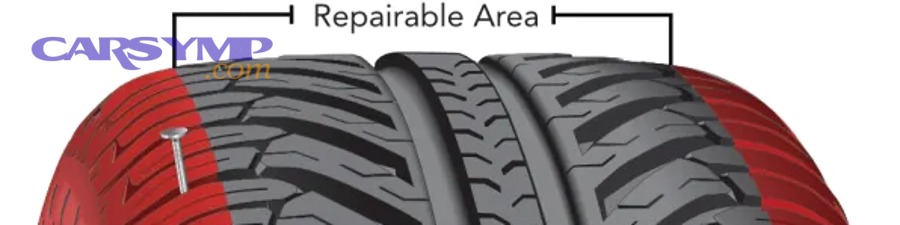
The puncture repair zone is a defined structural region — specifically, the central three-quarters of the tread width — where the tire’s steel belt reinforcement makes a permanent, safe repair mechanically possible.
To better understand why this zone exists, it helps to see the tire not as a single surface but as a set of distinct structural regions, each with different engineering properties.
How Wide Exactly Is the Safe Repair Zone?
The safe repair zone spans approximately the central 75% of the total tread width, measured on a dismounted and fully deflated tire. In practical terms, this translates to roughly 1 to 1.5 inches inward from the beginning of each shoulder edge, depending on the tire’s overall width.
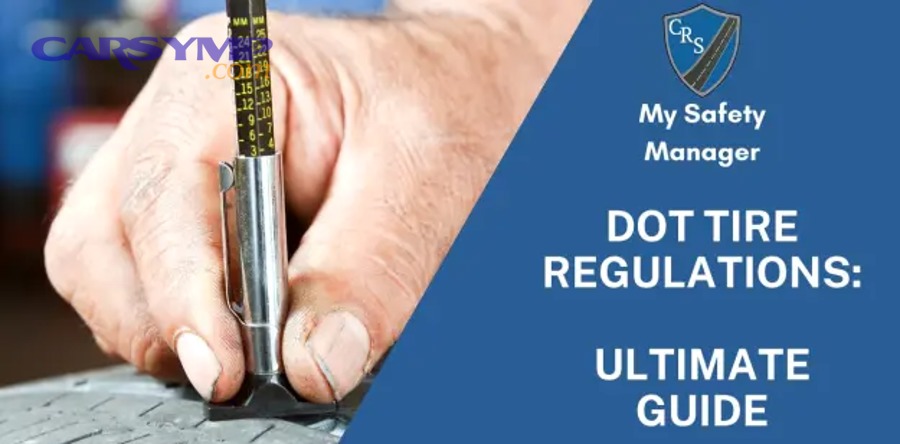
The USTMA sets a minimum clearance of ½ inch from the point where the flat tread surface begins to curve into the shoulder. This measurement is not approximate — technicians are expected to use a measuring tool to confirm puncture placement before proceeding with any repair. The key details that define this zone are:
- Boundary: Central 75% of tread width, measured on a deflated, dismounted tire
- Shoulder clearance: Minimum ½ inch from the shoulder transition point
- Why dismounted: Measuring on an inflated, mounted tire distorts the tread geometry and produces inaccurate zone readings
- Overlap rule: A new puncture must sit at least 1 inch away from any prior repair; punctures directly across from each other on opposite tread faces disqualify the tire entirely
What Does the “Crown” or “Tread Center” Mean in Tire Repair?
The crown refers to the flat, road-contacting surface of the tire that runs across the top of the tire’s arc. It is the only portion of the tire structure that is reinforced on both sides by overlapping steel belts, which are the same belts that give a radial tire its rigidity and load-bearing strength.
This reinforcement is precisely what makes repair viable in the crown area. When a plug-patch combination unit is installed correctly, the steel belts on either side of the puncture channel hold the repair unit stable under inflation pressure, braking forces, and cornering loads. Specifically, the crown differs from the shoulder in one critical way: the shoulder begins where the tread starts to curve downward toward the sidewall, and that curvature introduces flex patterns the crown does not experience. A repair unit placed at or near that curve cannot achieve the same mechanical stability as one placed flat across the crown.
Which Tire Zones Are Repairable and Which Are Not?
There are three main tire zones classified by repairability: the tread center (repairable under conditions), the shoulder (non-repairable), and the sidewall (always non-repairable) — based on structural reinforcement and flex behavior.
Specifically, each zone behaves differently under the stresses of driving, and those differences directly determine whether a repair unit can hold. The table below summarizes the classification before the detailed breakdown.
| Zone | Repairable? | Governing Rule | Key Reason |
|---|---|---|---|
| Tread Center (Crown) | Yes — conditionally | USTMA, TIA, NHTSA | Steel belt reinforcement supports repair unit |
| Shoulder | No | USTMA, TIA, Goodyear | High-flex transition zone; repair cannot hold |
| Sidewall | Never | All major standards | No steel reinforcement; continuous flex causes failure |
Is a Puncture in the Tread Area Always Repairable?
No — a tread-area puncture is not automatically repairable. It must simultaneously meet all of the following conditions to qualify for a proper tire puncture repair:
- Location: Within the central 75% of tread width, ≥ ½ inch from the shoulder start
- Size: ≤ ¼ inch (6mm) in diameter
- Tread depth: Remaining depth must be ≥ 2/32 inch across all areas
- No overlap: The repair must not overlap any previous repair
- No opposing injuries: Two punctures directly across from each other disqualify the tire
- No structural compromise: No evidence of run-flat damage, underinflation damage, or prior improper repair
- Internal inspection passed: The tire must be dismounted and internally inspected — a nail visible in the tread can mask hidden sidewall damage invisible from the outside
If any single condition above fails, the tire must be replaced, regardless of how centered or small the puncture appears from the outside.
Can a Shoulder Puncture Ever Be Repaired?
No — a shoulder puncture cannot be safely repaired under any current industry standard. The USTMA, TIA, and Goodyear’s own published guidelines all classify the shoulder and belt-edge area as a no-repair zone without exception.
The reason is structural. The shoulder is the transition region where the flat tread surface curves into the sidewall, and this curvature subjects the area to cyclical compression and expansion with every wheel rotation. A repair unit installed in this zone cannot maintain an airtight seal under those repeated flex cycles, regardless of how well the installation is performed.
A common source of confusion is the phrase “near the shoulder.” A puncture that appears to be just inside the tread but sits within ½ inch of the shoulder boundary already fails the clearance requirement and is treated the same as a shoulder puncture. The ½-inch minimum clearance rule from the USTMA exists precisely to prevent borderline cases from being misclassified as repairable.
Why Is a Sidewall Puncture Never Repairable?
A sidewall puncture is never repairable because the sidewall contains no steel belt reinforcement and undergoes continuous, high-amplitude flexing that no repair unit is engineered to withstand.
Unlike the crown, the sidewall’s entire function is to flex — absorbing road shocks and supporting the vehicle’s load by deforming and recovering with every revolution. This flexing generates heat and physical stress that would cause any patch or plug to delaminate, lose adhesion, or rupture under normal highway conditions.
Moreover, sidewall damage frequently extends beyond what is visible externally. A bulge or bubble in the sidewall — typically caused by hitting a curb or pothole — indicates that the internal cord structure has already failed. That failure is structurally irreversible, and no repair process addresses it. Any tire presenting a sidewall bulge must be taken out of service immediately and replaced. Attempting a sidewall repair does not just risk repair failure — it risks catastrophic blowout.
What Are the Official Rules for Tire Puncture Repair by Location?
There are three primary regulatory frameworks governing tire puncture repair by location: USTMA guidelines, TIA Recommended Practice, and NHTSA regulations — all of which converge on the same zone-based repair boundaries.

These standards are not interchangeable brand preferences — they are the binding technical documents that professional tire technicians are trained and certified to follow. Together, they define what constitutes a legal, safe, and warranty-compliant tire puncture repair.
What Do USTMA Guidelines Say About Puncture Location?
The USTMA requires that all repairs be confined to the central tread area, performed only on punctures measuring ≤ ¼ inch (6mm) in diameter, and executed using a combination plug-patch repair unit — not a plug alone or a patch alone.
The USTMA’s position on repair method is unambiguous: plug-only repairs and patch-only repairs are both classified as improper repairs, regardless of where on the tread the puncture is located. A plug fills the puncture channel but does not seal the inner liner. A patch seals the liner but does not fill the channel. Only a combination unit — which fills the channel from the inside out and seals the liner simultaneously — creates the airtight, structurally sound repair that the USTMA recognizes as valid.
Additional USTMA conditions that directly affect location-based decisions include:
- Tires damaged by underinflation, overloading, or previous improper (non-USTMA) repairs must be scrapped, not repaired
- Repair units must not overlap one another
- If sealant from an emergency inflator is found inside the tire, specific additional inspection steps apply before any repair can proceed
What Does the TIA Recommend for Repairable vs. Non-Repairable Zones?
The TIA limits all puncture repairs strictly to the crown and center tread area, explicitly prohibiting any repair to the shoulder or sidewall, and requires that the tire be fully dismounted from the rim before any repair decision is made.
The TIA’s Recommended Practice (RP-02-21) establishes that a tire worn to its treadwear indicators — or to 2/32 inch of remaining tread depth in any part of the tread — must not be repaired regardless of puncture location. This tread-depth rule adds a second independent variable beyond zone placement: even a perfectly centered puncture in a tire with insufficient tread depth is non-repairable under TIA standards.
The TIA also emphasizes the internal inspection requirement as a mandatory step, not an optional one. A nail visible in the tread from the outside can create a diagonal penetration path that pierces the sidewall internally — damage that is entirely invisible without dismounting the tire and examining the inner liner. Skipping this step is one of the most common causes of improper repair and subsequent tire failure.
What Are the NHTSA Rules on Tire Repair Zone Placement?
The NHTSA stipulates that repairable punctures must be located in the tread area, must not exceed ¼ inch in depth, and that all patch and plug placements must maintain a minimum distance of 1 inch from any prior repair and 2 inches from the sidewall.
The NHTSA’s framework also specifies a mandatory replacement list — conditions under which no repair is permitted regardless of puncture size or location:
- Structural damage of any kind
- Punctures in the sidewall or shoulder
- Temporary spare tires (not designed for full repair)
- Run-flat tires that have been driven on while fully deflated beyond the manufacturer’s rated distance
- Tires with bulging or visible deformation
- Tires with significant gashes or tread separation
From a legal liability standpoint, the NHTSA’s guidelines carry enforcement weight under the National Traffic and Motor Vehicle Safety Act. All tires sold in the U.S. carry a DOT-certified serial number, and repairs performed outside NHTSA-compliant standards can constitute negligence in the event of an accident — a point that carries direct relevance for both repair shops and vehicle owners who choose to self-repair.
According to the Tire Industry Association’s published consumer education materials, when a puncture is within the industry-established limits and properly repaired, a driver can expect thousands of additional miles of safe, reliable performance from that tire.
How Does Puncture Location Determine Repair vs. Replacement?
Puncture location determines the repair-vs.-replacement outcome as follows: tread center wins for repair eligibility, shoulder is best replaced immediately, and sidewall is always replaced — based on structural reinforcement, flex load, and official standards.
However, location alone is never the only variable. The decision is a matrix, and every axis of that matrix must clear its threshold before a repair is authorized.
Repair vs. Replace: How to Decide Based on Where the Puncture Is
The correct decision framework combines zone, size, tread depth, and internal condition into a single pass/fail checklist. The following table captures the full decision matrix that technicians and informed drivers should apply.
| Factor | Repair Allowed | Replacement Required |
|---|---|---|
| Zone | Central 75% of tread | Shoulder, sidewall, or belt-edge area |
| Puncture size | ≤ ¼ inch (6mm) | > ¼ inch (6mm) |
| Tread depth | ≥ 2/32 inch | < 2/32 inch |
| Prior repairs | No overlap, not directly opposing | Overlapping or directly opposing |
| Internal condition | Inner liner intact, no hidden damage | Cord damage, sidewall breach, separation |
| Run-flat status | Met all standard criteria, not over-driven flat | Driven flat beyond rated distance |
The most practically important point in this matrix is the internal inspection step. Tire puncture repair cost estimates for a proper plug-patch performed by a trained technician typically range from $15 to $45 depending on region and shop — a cost that also covers the mandatory internal inspection. Skipping that inspection to save time or money by using a roadside plug kit is precisely the scenario that leads to tread separation at highway speed.
Preventing future punctures starts with recognizing that the tread center is the zone that determines long-term tire health. Maintaining proper inflation pressure reduces the tread’s vulnerability to road debris penetration, and rotating tires on schedule ensures even wear that keeps the tread depth above repair-eligible thresholds for as long as possible.
What Happens If You Repair a Tire Outside the Approved Zone?
Repairing a tire outside the approved zone creates two categories of risk: immediate mechanical failure and long-term structural degradation — both of which can result in loss of vehicle control.
More specifically, a plug inserted into the sidewall may appear to hold pressure initially. However, the continuous flexing of the sidewall works against the plug’s seal with every wheel rotation. Over time — sometimes within miles, sometimes within weeks — the plug loosens, air migrates between tread layers, and the tread begins to separate from the carcass. This process is often silent until the separation becomes catastrophic.
The consequences extend beyond safety. Tire manufacturers universally void the warranty on any tire repaired outside USTMA/TIA-approved zone boundaries. Insurance claims related to accidents caused by failed out-of-zone repairs may be denied. And in commercial or fleet contexts, operating a vehicle on a non-compliant tire repair can trigger regulatory penalties.
TPMS considerations after puncture repair also deserve attention here. A Tire Pressure Monitoring System sensor is often mounted near the valve stem inside the wheel, and an improper repair — especially one involving a sidewall or shoulder — can dislodge or damage the TPMS sensor during the failed repair attempt. After any legitimate in-zone repair, the TPMS system should be reset and verified to confirm it is reading correctly before the vehicle returns to service.
Special Cases: When Standard Puncture Location Rules Don’t Fully Apply
Standard puncture location rules do not fully apply to run-flat tires, high-speed-rated tires, and bias-ply tires, each of which carries manufacturer-specific or construction-specific repair restrictions that go beyond the standard tread-zone criteria.
In addition, the angle of puncture penetration introduces a repair-method variable that applies even within the standard repairable zone — making it a factor that neither the zone check nor the size check alone can capture.
Can Run-Flat Tires Be Repaired Based on Puncture Location?
Run-flat tire repair eligibility depends on both puncture location and whether the tire was driven while flat — and some manufacturers prohibit repair entirely regardless of where the damage occurred.
Run-flat tires are constructed with reinforced sidewalls designed to support the vehicle’s weight for a limited distance (typically 50 miles at up to 50 mph) after a complete loss of inflation pressure. However, that reinforced sidewall undergoes significant internal stress when driven flat, and that stress may not be externally visible. Key run-flat repair considerations include:
- Standard zone criteria still apply: The puncture must be in the central tread area, ≤ ¼ inch, and the inner liner must be intact
- Distance-driven-flat limit: If the tire was driven beyond the manufacturer’s rated distance while deflated, internal damage to the reinforced sidewall is assumed, and the tire must be scrapped
- Manufacturer prohibition: Several European tire manufacturers (notably some BMW-approved run-flat suppliers) recommend replacement regardless of zone and size, citing the difficulty of reliably inspecting internal reinforcement integrity post-deflation
- Technician expertise: Run-flat tire repairs should only be performed by technicians with specific run-flat training; general tire repair training does not cover the full inspection protocol
Do Speed-Rated Tires Have Stricter Puncture Location Rules?
Yes — speed-rated tires, specifically those rated H and above, are subject to additional repair restrictions even when the puncture falls within the standard repairable zone.
Goodyear’s published repair guidelines specify that for H-rated and above speed-rated tires, only one properly performed puncture repair is permitted over the life of the tire for the tire’s full speed rating to be maintained. A second repair — even a textbook-perfect one in the center of the tread — means the tire can no longer be certified to perform at its original speed rating. For performance vehicle owners, this is a direct safety implication:
- A Z-rated tire repaired twice may handle normally at moderate speeds but fail structurally under the sustained high-heat loads generated at rated speed
- The repair itself does not degrade speed performance — the cumulative effect of multiple penetrations into the belt structure does
- Owners of sports cars, high-performance sedans, and vehicles with factory-fitted V or W speed-rated tires should confirm with their tire manufacturer whether a single repair is permitted before proceeding
How Does the Angle of Puncture Affect Repairability, Regardless of Location?
A puncture whose angle of penetration exceeds 25 degrees from vertical requires a two-piece repair system — even when the puncture sits squarely within the standard repairable tread zone.
This is one of the most frequently overlooked variables in tire puncture repair, even among experienced technicians. When a nail or screw enters the tire at a steep diagonal angle, the penetration channel runs through more of the belt structure than a straight-down puncture does. A standard one-piece combination unit is not geometrically capable of sealing that channel effectively. The repair sequence for an angled penetration follows these steps:
- Remove the puncturing object and note the angle of entry
- Probe the injury channel with a blunt awl to confirm the exact direction and depth
- If the angle exceeds 25°, select a two-piece repair system (separate inner patch + fill stem)
- Clean and buff the inner liner to the full size required by the two-piece unit’s patch body
- Install and stitch the patch first, then fill the channel with the stem from inside out
Most roadside plug kits and many quick-service shops do not account for penetration angle at all. This is a significant reason why USTMA and TIA standards mandate that repairs be performed only by trained tire service technicians who have been specifically trained in damage assessment — not just plug-patch installation.
What Are the Tire Repair Zone Rules for Bias-Ply vs. Radial Tires?
Bias-ply tires and radial tires differ in carcass construction in ways that affect how the repairable zone behaves under stress, though the zone boundaries themselves are defined by the same standards.
In a radial tire, the body plies run perpendicular to the direction of travel, and the steel belt package above them stabilizes the tread zone. This construction makes the radial tire’s tread center relatively rigid and well-suited to supporting a repair unit. In a bias-ply tire, the body plies run diagonally across the tire at alternating angles, which means the entire carcass — including the tread area — undergoes more distributed flexing. This greater tread-area distortion means that:
- Bias-ply tires experience a faster wear rate, which reduces the window of tread-depth eligibility for repair sooner than a comparable radial
- The repairable zone boundaries (central 75% of tread) remain the same, but the mechanical stability of a repair unit may be lower in a heavily loaded bias-ply tire
- Bias-ply construction is no longer standard in passenger vehicles but remains common in agricultural tires, trailer tires, vintage vehicles, and some off-road equipment — contexts where USTMA/TIA radial-centric repair protocols may not directly apply
In short, drivers operating specialty or vintage vehicles with bias-ply tires should consult the tire manufacturer’s specific repair guidelines rather than assuming standard passenger-tire repair protocols fully translate.
According to NHTSA safety documentation, improper tire repairs — including repairs performed in non-approved zones — are a contributing factor in tire-related vehicle crashes, underscoring why location-based compliance is not optional for any tire placed back into service.