


If you want cold air again without risking injury or damaging expensive components, the safest approach is to recharge your car A/C only after you’ve confirmed the correct refrigerant, verified basic system health, and followed a controlled, step-by-step process.
For DIY AC recharge, the biggest win comes from safety discipline: eye/skin protection, stable engine-bay workflow, and “stop points” where you re-check pressures and vent temperature before adding more.
You’ll also avoid the most common mistakes—mixing refrigerants, overfilling, or masking a leak—by learning what “normal” looks like for your vehicle’s label, your ambient temperature, and your gauge behavior.
Giới thiệu ý mới: below is a practical, driver-friendly method that prioritizes safety, legality, and repeatable results—so you can decide whether to proceed yourself or switch to a repair-first plan.
Is it safe to recharge your car A/C yourself?
Yes—recharging can be safe if you use the correct refrigerant, follow protective handling rules, and stop immediately when readings or symptoms suggest a leak, overpressure, or component failure. To begin, treat this as a controlled procedure, not a quick “pour-and-go.”
Next, you’ll reduce risk by understanding what can go wrong and why the safest path starts with verification rather than guessing.
What makes DIY recharging risky?
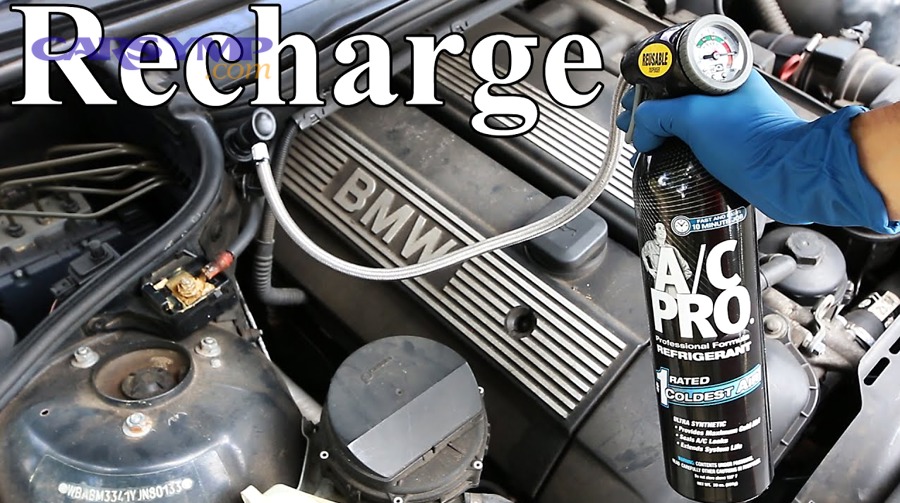
The risk isn’t just the refrigerant can—it’s the system state you can’t see. A/C systems run at high pressure, and refrigerant can cause frostbite on contact, eye injury, or respiratory irritation in poorly ventilated spaces. More importantly, wrong refrigerant or overfilling can spike head pressure, stress hoses and seals, and in severe cases contribute to compressor damage.
After that, you also need to consider vehicle-specific differences (especially newer refrigerants) before you even connect a gauge.
When should you stop and choose repair-first?
Stop and choose repair-first when you see oily residue around A/C fittings, hear loud compressor grinding, smell a sharp chemical odor in the cabin, or find that the clutch cycles rapidly with no cooling improvement. Those signs can indicate leaks, internal contamination, or airflow/heat-exchange problems that adding refrigerant won’t fix.
To continue safely, you’ll next confirm the correct refrigerant type from the vehicle label—because that one detail controls nearly everything else.
What refrigerant does your car actually use?
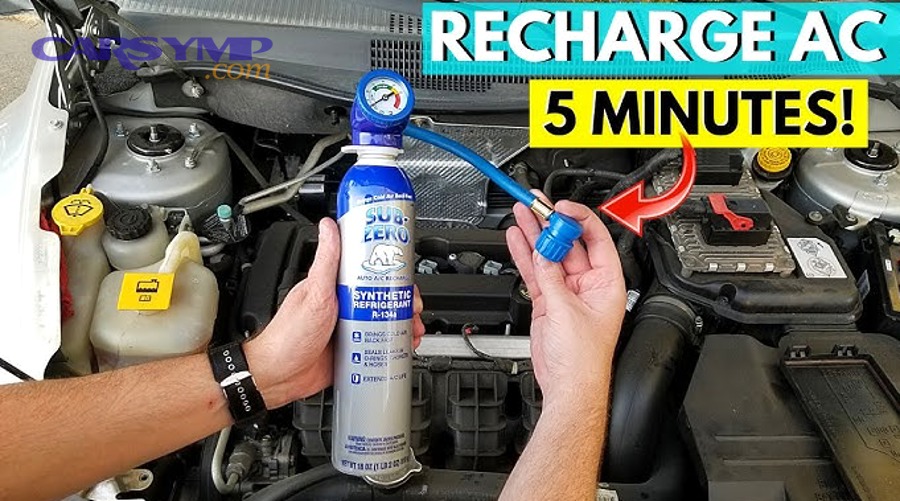
Your car’s A/C is safest to service only with the refrigerant listed on the under-hood label, because each type has different properties, service fittings, and safety requirements. To start, find the label on the radiator support, underside of the hood, or near the condenser area.
Then, once you know the refrigerant type, you can choose tools and procedures that match the system instead of forcing a universal approach.
Why the label matters more than internet advice
Vehicle A/C systems are designed around specific pressure-temperature behavior and oil compatibility. Using the wrong refrigerant—or mixing types—can create unreliable gauge readings, reduce cooling performance, and complicate professional recovery later. In some cases, it can also be illegal to use an “unacceptable” substitute in motor vehicle A/C applications.
To make this more concrete, the next step is to identify whether you’re dealing with a common older type (like HFC-134a) or a newer, lower-GWP type (like HFO-1234yf), because the service tools and safety expectations differ.
A quick climate and safety reality check
Some refrigerants have dramatically different climate impact, which is one reason regulations and industry practices have evolved. Theo nghiên cứu của U.S. Environmental Protection Agency (EPA) từ mục “Acceptable Refrigerants and their Impacts”, vào 08/2015, HFC-134a có GWP khoảng 1,430 trong khi HFO-1234yf khoảng 4.
With that context, you’re ready to inspect for “recharge-worthy” conditions—so you don’t add refrigerant into a system that’s failing for another reason.
What should you check before you connect any can or gauge?
Before you add anything, do a quick system health check: airflow, condenser condition, fan operation, and obvious leak indicators. To begin, verify that the cabin blower works strongly and the A/C button command actually engages the system.
Next, these checks help you avoid the classic mistake of treating a mechanical or airflow problem like a low-charge problem.
Airflow and heat rejection checks
Cooling depends on moving heat out of the condenser. If the condenser is packed with debris or the condenser fan doesn’t run, pressures can rise while vent temperature stays warm—making recharging unsafe and ineffective. Look for bent fins, blocked airflow, and verify the fan comes on when A/C is commanded (some vehicles stage fan speed).
After that, confirm the cabin-side airflow isn’t choking the system: a dirty cabin air filter or a weak blower can mimic “low charge” by reducing evaporator heat transfer.
Leak clues you can spot without special tools
Refrigerant leaks often leave oily dirt around service ports, hose crimps, compressor front seals, or the condenser. A musty or chemical odor can sometimes show up if the evaporator area is contaminated. If you see obvious oil wetness, treat it as a leak-first case—because adding refrigerant is temporary at best.
Next, you’ll set up the right tools and protective gear so you can take readings without rushing or improvising.
What tools and safety gear do you need for the safest DIY approach?
The safest DIY setup includes proper eye protection, gloves, a reliable pressure-reading method, and a way to measure vent temperature—so you can stop before you overfill. To begin, gather your gear and plan a stable workflow with the engine running in a well-ventilated area.
Then, use the checklist below to avoid unsafe shortcuts.
This table lists essential items and what each one helps you do safely during a vehicle A/C service attempt.
| Item | Why it matters for safety |
|---|---|
| Safety glasses / face shield | Protects eyes from refrigerant spray and debris near rotating parts. |
| Nitrile or insulated gloves | Reduces frostbite risk if refrigerant contacts skin. |
| Vent thermometer | Prevents “chasing pressure” by confirming actual cooling outcome. |
| Pressure gauge method | Lets you monitor low-side behavior and stop before unsafe conditions. |
| Work-light and inspection mirror | Helps spot oil residue and damaged fittings before you connect. |
Why a thermometer is a safety tool, not just a comfort tool
Vent temperature is your reality check. Pressure alone can mislead you if airflow is poor, ambient temperature is extreme, or the system is cycling due to sensors. Measuring vent temperature helps you confirm whether the system is improving in a stable, repeatable way—without pushing charge beyond safe limits.
Next, you’ll connect only to the correct service port and learn the “slow-add, re-check, stabilize” rhythm that keeps the process controlled.
How to set up your work area to avoid accidents
Park on level ground, set the parking brake, and keep clothing and tools away from belts and fans. Work outdoors or with strong ventilation; never recharge in a closed garage. Keep the can away from heat sources, and never invert a can unless the product and procedure explicitly require it (liquid slugging can be dangerous for compressors).
With safety and tools prepared, you’re ready to read pressures in a way that actually guides safe decisions.
How do you read pressures safely without guessing?
You read pressures safely by stabilizing operating conditions—engine at idle, A/C on max cool, doors open, blower high—and watching for consistent, reasonable gauge behavior. To begin, let the system run several minutes before judging anything.
Then, interpret readings as “clues,” not a single verdict, because ambient temperature and airflow strongly affect what you see.
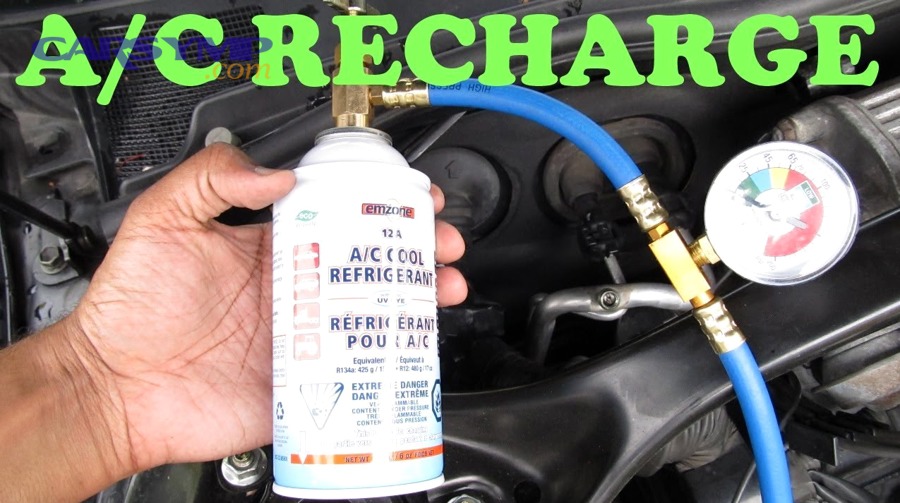
What low-side readings can and cannot tell you
Low-side pressure can suggest low charge if it’s consistently low while the compressor is engaged and airflow/heat rejection are normal. But low-side pressure alone cannot confirm the correct charge amount, reveal contamination, or guarantee the compressor is healthy. If the system short-cycles, the low-side may bounce in ways that tempt you to overfill.
After that, your safest move is to combine pressure behavior with vent temperature and compressor cycling patterns instead of chasing a single number.
How to avoid the “overfill spiral”
The overfill spiral happens when you add refrigerant, don’t wait for stabilization, and add more because the air still isn’t cold. In reality, temperature response lags, and many problems aren’t charge-related. The safe method is to add in small increments, pause, re-check vent temperature, and stop early if pressures climb abnormally or cooling doesn’t improve.
Next, you’ll use a step-by-step procedure that emphasizes controlled increments and safe stopping points.
How do you recharge the A/C step by step without overcharging?
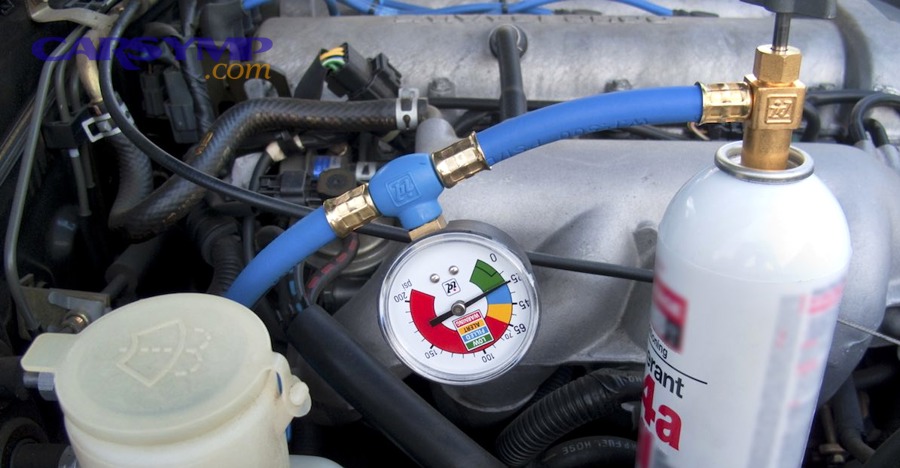
The safest method is a slow, staged process: confirm refrigerant type, connect to the low-side port only, add small amounts, and re-check stabilization after each addition until cooling improves within normal range. To begin, read your under-hood label and your tool instructions carefully.
Next, follow the steps below in order, because sequence control is what prevents accidental overcharging.
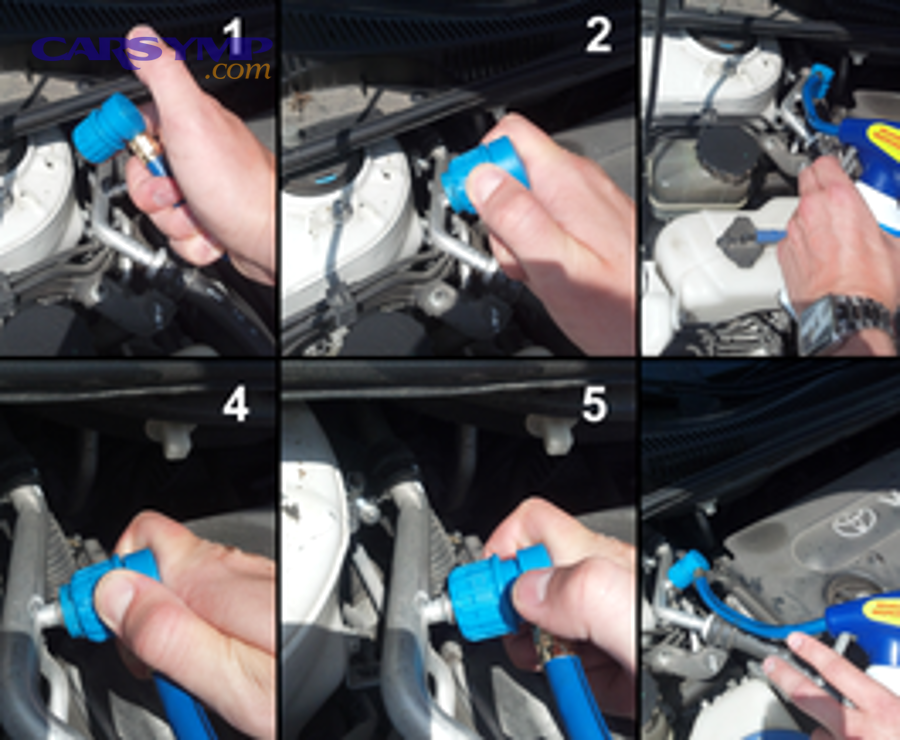
Step 1: Identify the low-side service port and connect correctly
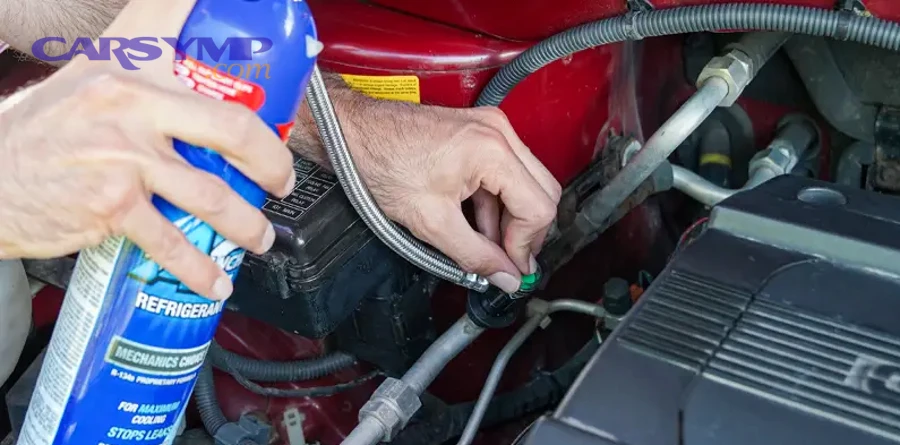
The low-side port is typically on the larger-diameter line and uses a different fitting than the high-side port. Only connect to the low side for consumer recharge procedures. Ensure the coupler snaps securely and does not leak; if it hisses continuously, stop and reseat—spraying refrigerant is unsafe and wasteful.
After that, start the engine, set max A/C, and allow the system to stabilize for a few minutes before you add anything.
Step 2: Add in short bursts and wait for stabilization
Add refrigerant in short bursts (a few seconds), then wait 30–90 seconds to let pressures and evaporator temperature stabilize. Monitor vent temperature with your thermometer and watch for smooth, predictable compressor cycling. If vent temperature improves steadily, you’re moving in the right direction; if it doesn’t, stop early and reassess.
To make this practical, think in “micro-cycles”: add a little, wait, measure, decide—rather than one continuous fill.
Step 3: Stop at the first sign of abnormal pressure or no cooling gain
Stop immediately if the system shows signs of overpressure (rapid cycling with rising pressure, harsh compressor noise, or sudden loss of cooling), or if vent temperature fails to improve after multiple small additions. This is where many DIY attempts go wrong: continuing to add refrigerant turns a diagnosis problem into a damage problem.
Next, you’ll need to address the question everyone asks—how to know the right amount—without relying on guesswork.
How do you know the right charge amount without gambling?
The safest “right amount” is the amount that matches your vehicle’s specified charge and produces stable cooling under normal conditions, not the maximum your gauge suggests. To begin, use the under-hood label as your authority and treat pressure charts as secondary clues.
Then, you can make safer decisions by combining label data, vent temperature, and system behavior rather than filling until a needle lands in a colored zone.
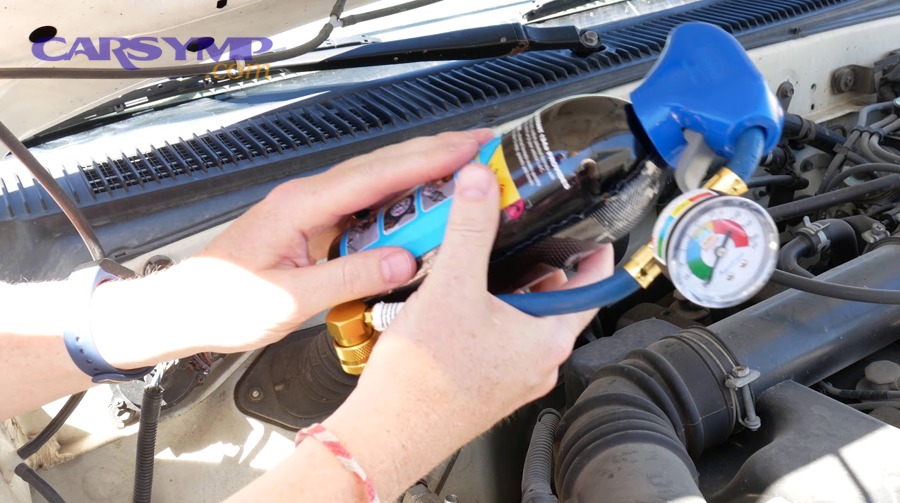
Use the factory specification as the primary target
Most vehicles specify charge in ounces or grams. That specification assumes the system was evacuated properly and filled by weight—this is the most accurate method. DIY “top-up” methods are inherently less precise, which is why your safe approach is conservative: add only enough to restore reasonable performance, and stop before chasing perfection.
After that, remember that a system low enough to need frequent recharging likely has a leak; treat repeated topping as a diagnostic red flag.
Vent temperature targets that keep you honest
While exact numbers vary by humidity and vehicle design, you should see a meaningful drop in vent temperature compared to ambient when the system is healthy. If pressures creep up but vent temperature doesn’t drop, your limiting factor may be airflow, condenser efficiency, blend door issues, or compressor performance—none of which are solved by adding more refrigerant.
Next, you’ll learn the warning signs of overcharging and how to recover safely from mistakes.
What are overcharge warning signs and how do you stay safe if you suspect it?
Overcharge warning signs include reduced cooling despite higher pressure, frequent compressor cycling, unusual noise, and high heat load symptoms near the condenser area. To begin, stop adding refrigerant the moment performance stops improving.
Then, if you suspect overcharge, prioritize safety and professional recovery rather than trying to “bleed off” refrigerant irresponsibly.
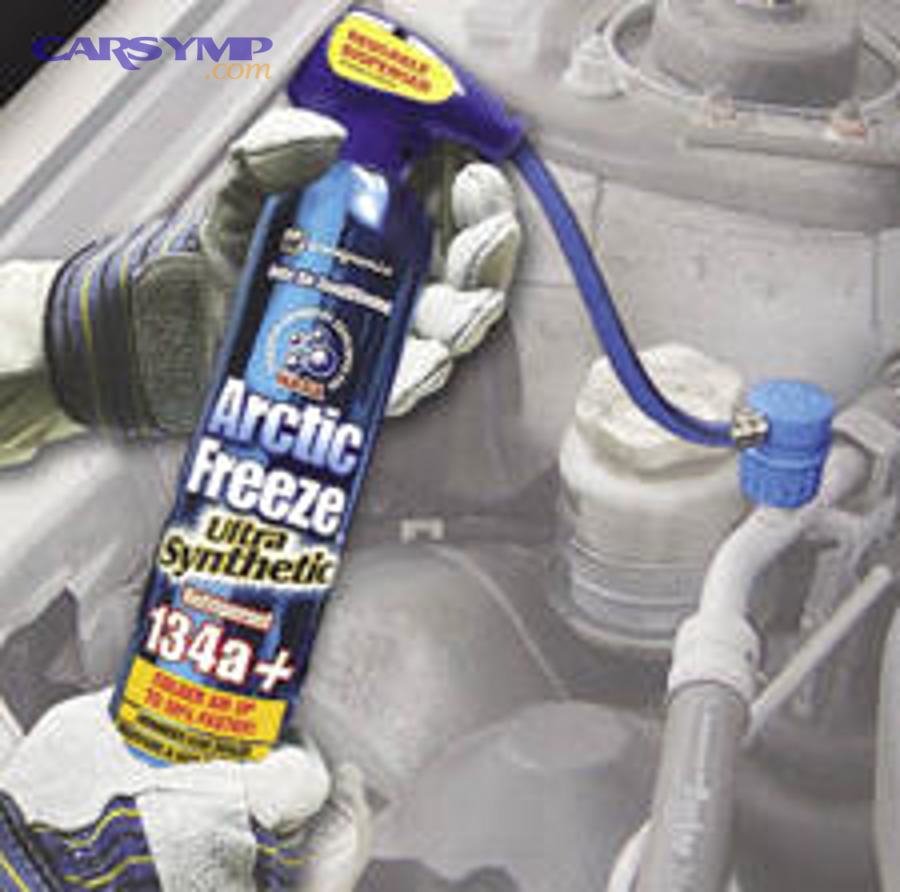
Why venting refrigerant is a bad idea
Releasing refrigerant into the air is unsafe and often illegal, and it can expose you to cold burns or inhalation risk. It also creates environmental harm; some refrigerants have very high global warming potential compared to CO2. Theo nghiên cứu của U.S. Environmental Protection Agency (EPA) từ chương trình MVAC, vào 08/2015, việc chọn đúng môi chất và xử lý đúng cách giúp giảm phát thải các khí có tác động khí hậu cao.
After that, the correct response is to stop, seal the can, and schedule a shop visit for recovery and proper charge by weight.
How to recognize when the problem isn’t charge-related
If the compressor clutch doesn’t engage reliably, the condenser fan doesn’t run, or airflow through the condenser is blocked, adding refrigerant won’t restore safe operation. Similarly, if you hear grinding or metal-on-metal sounds, the compressor may be failing internally, and continued operation can spread debris through the system.
Next, you’ll compare the “quick add” approach to the more complete evacuation-and-fill approach so you understand what you’re gaining and what you’re skipping.
How do you confirm success after recharging?
You confirm success by verifying stable vent temperature improvement, predictable compressor cycling, and consistent pressure behavior over a short test drive—not by emptying a can. To begin, let the system run at idle, then test it at moderate road speed where condenser airflow is stronger.
Next, record a simple before/after snapshot so you can detect slow leaks or performance drift later.
Do a simple performance check at idle and at speed
At idle, vent temperature may not be as low as it gets at cruising speed, especially in hot weather. A stable improvement at both idle and speed suggests the system is operating normally. If it only cools at speed, investigate condenser airflow, fan operation, and heat exchanger cleanliness rather than adding more refrigerant.
After that, listen for consistent compressor engagement: rapid clicking on and off can indicate pressure switches reacting to abnormal conditions.
Watch for signs of a slow leak in the days that follow
If cooling fades again within days or weeks, you likely have a leak. This is where an AC recharge (as a phrase used by shops and DIYers alike) becomes a temporary symptom-management step rather than a solution. In that case, the safer plan is leak detection and repair, followed by proper evacuation and charging.
Now that you can confirm results, you’re ready to cross the contextual border into advanced topics: environmental rules, full-service evacuation, and when to choose a shop.
Contextual border: Up to this point, you’ve learned how to perform a conservative, safety-first recharge attempt. Next, we expand into advanced safeguards and decision-making—where legality, equipment differences, and service quality matter most.
Advanced safeguards, environmental rules, and pro-level checks
Advanced safe practice means understanding legal handling rules, recognizing when a full evacuation is required, and choosing between DIY tools and professional service based on risk and accuracy. To begin, treat refrigerant as a regulated chemical—because in many places, it is.
Then, use the sections below to decide whether your situation is still DIY-appropriate or should move to a shop workflow.
Legal and environmental handling basics you should follow
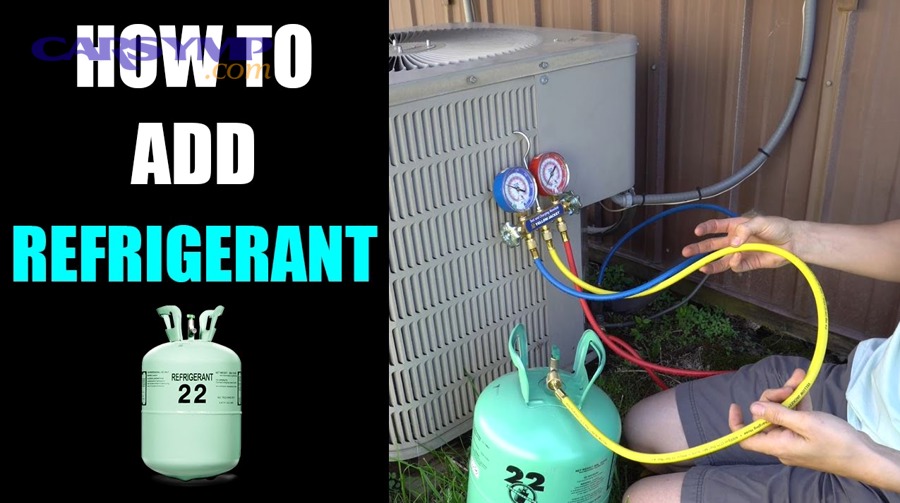
Many regions restrict venting refrigerant and regulate which substitutes are acceptable in motor vehicle A/C systems. Even if you’re only doing light DIY work, the safest mindset is: don’t release refrigerant intentionally, don’t mix unknown blends, and don’t use flammable substitutes not approved for your application. This protects you, the next technician, and the environment.
After that, keep documentation: refrigerant type used, date, and observed symptoms. This helps later diagnosis if cooling fades again.
What a full evacuation adds that topping cannot
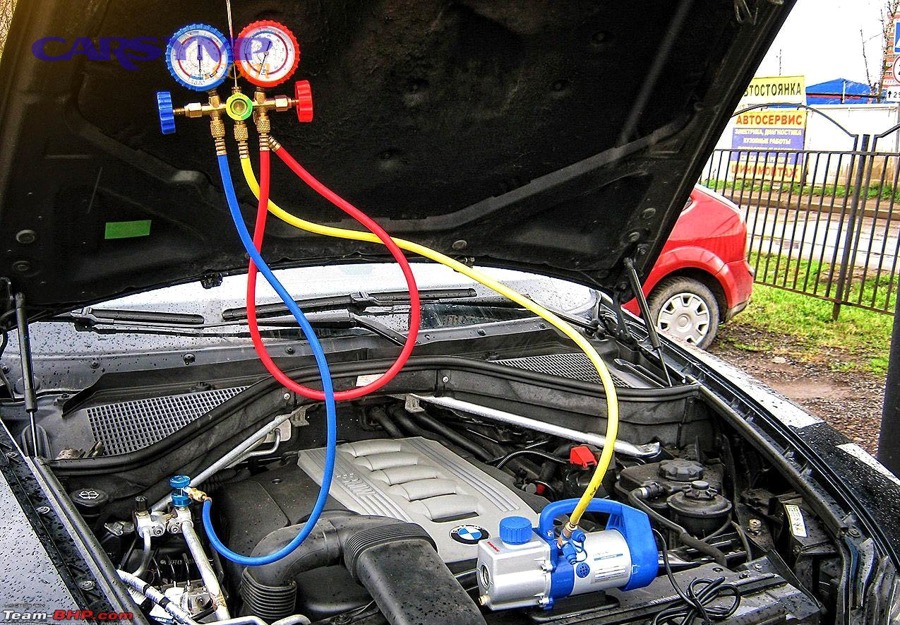
A professional evacuation removes air and moisture, which can otherwise reduce cooling, promote corrosion, and destabilize pressure readings. This is where the “Vacuum pump vs “top-off” difference” matters: evacuation is about system integrity and dryness, while topping is only about adding refrigerant when the system is otherwise healthy. If your system was opened to the atmosphere (hose replacement, condenser replacement), evacuation is the safer and more correct path than topping.
To go one step further, a proper service also charges by weight, which is the most accurate way to hit the factory spec.
Choosing between DIY tools and a shop based on risk
The “AC recharge kit vs shop service comparison” comes down to precision and recovery capability. DIY tools can help in a mild low-charge scenario, but shops can recover refrigerant, test for leaks, evacuate moisture, and refill by weight. If your system has repeated loss of cooling, abnormal cycling, or uncertain refrigerant history, shop service is usually the safer choice—even if the initial cost is higher.
In practical terms, if you’re asking yourself “How much refrigerant to add” because you’re unsure, that uncertainty is often the signal to stop and choose a weighed charge and leak test.
FAQ: common safety questions drivers ask
Q: Can I recharge if the system is completely empty?
A: It’s risky. A completely empty system often has a significant leak, and running the compressor can be unsafe. A shop leak test and proper evacuation is the safer route.
Q: Should I recharge in very hot weather?
A: You can, but readings become more sensitive to airflow and heat load. Work in shade, ensure condenser airflow is strong, and be extra conservative with small additions and stabilization time.
Q: Can sealants make DIY safer by stopping leaks?
A: Often no. Sealants can contaminate service equipment and complicate repairs. If you suspect a leak, leak detection and repair is the safer long-term fix.
Q: How do I know if my “recharge” worked well enough?
A: You want stable vent temperature improvement, predictable cycling, and cooling that persists over days. If cooling fades quickly, prioritize leak diagnosis rather than repeated refills.