


When you have no heat in your car, the fastest way to fix it is to treat it like a diagnosis—not a guessing game: confirm the engine reaches normal temperature, confirm coolant is full and circulating, then confirm the heater core and HVAC air-mix system can actually deliver that heat into the cabin.
Next, you’ll follow a causes checklist that starts with the highest-probability, lowest-effort checks (coolant level, warm-up behavior, heater hose temperature) and only then moves toward deeper HVAC faults like actuator problems behind the dash.
Then, you’ll learn how to match specific symptom patterns—like heat only while driving, weak airflow, or one side hot/one side cold—to the most likely failure point so you stop replacing parts that aren’t broken.
Introduce a new idea: once you finish the core checklist and pinpoint the likely cause, you’ll also know what’s urgent (defrost/visibility and overheating risk) and what can wait, plus what to do if the basics check out but the heat is still missing.
Is it safe to drive when your car has no heat and poor defrost?
No—driving with no heat in your car can be unsafe because you may lose windshield defrosting, you may be missing an early warning of coolant problems, and you may not be able to maintain visibility in wet/cold conditions.
Next, the safest approach is to do a quick “safety triage” before you troubleshoot deeper.
Should you stop driving immediately if you smell coolant or see foggy windows?
Yes—if you smell coolant or your windows fog with a sweet odor, you should stop driving because it can indicate a coolant leak in the cabin area, it can rapidly destroy defrost visibility, and it can lead to dangerous coolant loss.
Then, treat this as a priority leak check—not a comfort problem.
A sweet smell plus persistent fogging often points to a heater core leak, because warm coolant vapor can film the inside of the glass and keep returning even after you wipe it. If you also notice damp carpet (especially front passenger footwell), the odds increase that the leak is inside the HVAC case rather than an external hose drip.
What to do right away:
- Turn off the HVAC heat and set the system to fresh air (not recirculation) if it helps reduce fog.
- Check coolant level only when the engine is cool enough to do so safely.
- Watch the temperature gauge closely on the way to a safe stop.
- If fogging prevents visibility, do not continue driving—poor visibility is an immediate safety hazard.
Evidence: According to a study by The University of Michigan Transportation Research Institute, in May 1999, researchers measured driver reaction time and visibility-related ratings under defogger/defroster line conditions, reinforcing how visibility constraints can affect driver performance in real viewing tasks.
Can “no heat” indicate an overheating risk even if the temperature gauge looks normal?
Yes—no heat can signal an overheating risk because low coolant can leave the heater core dry, air pockets can cause false-stable gauge readings, and some sensor locations don’t reflect localized hot spots.
Next, focus on “heat as a coolant-flow indicator,” not just cabin comfort.
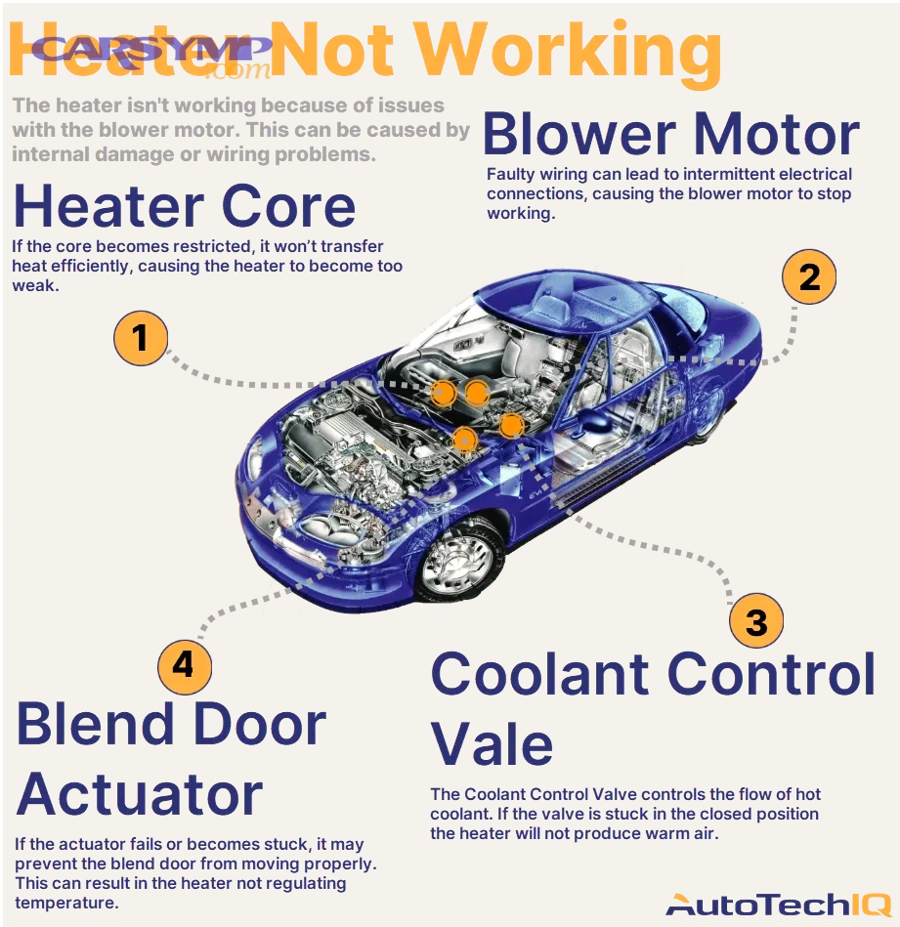
Here’s the key logic: cabin heat depends on hot coolant flowing through the heater core. If the engine is truly warm but the heater core isn’t getting hot coolant, something is interrupting the flow—low coolant, air trapped, a blockage, or a control valve (on some vehicles).
Red flags that raise urgency:
- Coolant warning light, low coolant message, or repeated need to top off
- Temperature gauge rising above normal or fluctuating
- Gurgling behind the dash (air in the system)
- Heater output that changes abruptly when you rev the engine
If any of these appear, your “no heat” situation is no longer a simple heater not working complaint—it’s potentially a cooling-system reliability problem that can cascade into overheating.
What does “no heat in car” mean in HVAC terms?
“No heat in car” is a cabin-heating failure where the engine’s heat is not transferred through the heater core and then delivered by airflow into the cabin, usually due to coolant-flow limits, heat-exchanger restriction, or air-mix/control faults.
To better understand why it happens, it helps to visualize the heat path from engine to vents.

A modern vehicle’s cabin heat is basically a controlled heat-transfer chain:
- Engine warms coolant
- Thermostat manages warm-up and temperature stability
- Hot coolant flows through heater core (a small radiator)
- Blower pushes air across heater core fins
- Blend door routes air through/around heater core to achieve your temperature setting
- Ducting delivers air to vents/defrosters
Break any link, and you get “no heat,” weak heat, or inconsistent heat.
What’s the difference between “no airflow” and “airflow but cold”?
“No airflow” is usually an air-delivery fault (blower, power, resistor, filter, duct), while “airflow but cold” is usually a heat-source or heat-transfer fault (coolant temperature, coolant flow, heater core, or blend door position).
However, you should separate the two early because they lead you to completely different checks.
Practical interpretation:
- No airflow (or extremely weak airflow): you likely won’t get heat or A/C performance because the air isn’t moving. Think blower motor, blower resistor/module, fuse/relay, or a severely clogged cabin air filter.
- Strong airflow but cold: air is moving fine, so now you ask, “Is that air being heated?” That points you to coolant temp (thermostat), heater core flow, or blend door routing.
This split prevents the most common mistake: replacing cooling parts when the real issue is that the HVAC box never routed air through the heater core.
What are the most common symptom patterns to note before diagnosing?
There are 6 main symptom patterns to note before diagnosing no heat: no airflow, strong cold airflow, heat only while driving, heat at idle but cold at speed, one-side hot/one-side cold, and intermittent heat with gurgling—because each pattern points to a different failure class.
Next, you’ll use these patterns to choose the right checklist path.
Here’s what each pattern often suggests:
- No airflow: blower circuit, resistor/module, fuse/relay, cabin filter, mode door stuck
- Strong airflow but cold: thermostat/coolant temp, low coolant, air pockets, heater core restriction, blend door stuck cold
- Heat only while driving: low coolant, air in system, marginal heater core flow, water pump circulation issues
- Heat at idle but cold at speed: Thermostat stuck open symptoms (engine cools off under airflow load), or blend door/control issues
- One-side hot/one-side cold: dual-zone actuator, blend door actuator, HVAC calibration issue
- Intermittent heat + gurgling: air pockets, low coolant, improper bleed
Capture these observations first; they become your “input data” for the checklist.
What is the fastest “no heat” diagnostic checklist you can follow at home?
There are 7 main steps in the fastest no-heat checklist: confirm airflow, confirm engine warm-up, verify coolant level/condition, check heater hose temperatures, test temperature control/blend door behavior, look for leaks/air pockets, then decide flush vs repair.
Below, the goal is to isolate the fault with minimal tools and minimal part swapping.
Checklist table context: This table summarizes a home-diagnosis flow for “no heat in car” and helps you interpret each check before moving to the next.
| Step | Quick check | What “normal” looks like | What “not normal” suggests |
|---|---|---|---|
| 1 | Airflow from vents | Strong airflow on higher fan speeds | Blower/fuse/resistor/cabin filter restriction |
| 2 | Warm-up behavior | Gauge reaches normal and stays stable | Engine temperature not reaching normal causes such as thermostat stuck open, sensor issue, or cooling system fault |
| 3 | Coolant level (cold engine) | Level at correct mark, no repeated loss | Leak, air ingestion, heater core leak risk |
| 4 | Heater hose temp feel/test | Both hoses warm/hot after warm-up | One hot/one cool = heater core restriction or valve issue |
| 5 | Temp control response | Vent temp changes when you move temp knob | Blend door actuator no-heat issues or control problem |
| 6 | Leak signs inside/outside | Dry carpet, no sweet smell, no residue | Heater core leak, hose leak, radiator leak |
| 7 | Decision | Root cause confirmed | Flush/bleed/repair based on evidence |
Do you have normal engine operating temperature?
No—if your engine temperature does not reach normal, you won’t get consistent cabin heat because the coolant never gets hot enough, the heater core can’t transfer sufficient heat, and the HVAC system will only blow lukewarm air at best.
Then, you should treat warm-up behavior as your first “heat supply” test.
This is where the phrase Engine temperature not reaching normal causes matters. Common reasons include:
- Thermostat stuck open symptoms (most common): slow warm-up, gauge runs low, heat weak at idle and improves slightly when driving but never truly hot
- Cooling fan running too much (fan relay issue or fan commanded on due to sensor fault)
- Coolant mixture too concentrated or too diluted (extremes can affect heat transfer)
- Faulty temperature sensor or gauge behavior (less common, but possible)
Simple warm-up validation:
- Start cold, idle for a short period, then drive gently.
- Most cars should reach normal operating temperature within a reasonable drive (varies by vehicle and weather).
- If the gauge never reaches normal or drops at highway speed, you’re likely dealing with thermostat regulation problems.
Is coolant low, contaminated, or aerated?
Yes—low, contaminated, or aerated coolant can cause no heat because the heater core may not be full of hot coolant, air pockets can block flow, and sludge can restrict the heater core’s tiny passages.
Next, treat coolant condition as both a heating and reliability check.
How to check safely:
- Only open the coolant reservoir (and radiator cap if applicable) when the system is cool enough to avoid pressure burns.
- Look for repeated low level over days—repeat loss is a leak clue, not “normal evaporation.”
What “contaminated” can look like:
- Rusty/brown discoloration (corrosion products)
- Oily film (can indicate oil contamination; requires caution and further diagnosis)
- Debris/sediment (can accumulate in heater core)
Aeration clues:
- Gurgling behind dash
- Heat comes and goes with RPM changes
- Coolant level fluctuates oddly after a drive
If the coolant is low, fix the leak first—or your future repairs won’t hold.
Which cooling-system problems most often cause no cabin heat?
There are 5 main cooling-system problems that most often cause no cabin heat: low coolant, thermostat faults, trapped air, restricted heater-core flow, and circulation issues (pump/valves)—because all five reduce hot-coolant delivery to the heater core.
Next, you’ll narrow them down using symptom logic and a couple of simple tests.
Is a stuck-open thermostat causing lukewarm air and slow warm-up?
Yes—a stuck-open thermostat can cause no heat or weak heat because the engine warms up too slowly, coolant temperature stays too low, and highway airflow can keep the coolant below the range needed for strong heater output.
However, you should confirm it with warm-up behavior before blaming the heater core.
This is the classic profile:
- Long warm-up time
- Temperature gauge stays low or fluctuates downward at speed
- Heat improves slightly with revs but never gets truly hot
- Fuel economy may drop because the engine runs cooler than intended
In content terms, this is the cleanest “No Heat vs Hot Air” contrast: when the thermostat regulates correctly, you can get hot air quickly; when it’s stuck open, you get persistent lukewarm air.
Evidence: According to a study by University of Eastern Finland (with Tampere University) reported in 2023, engine coolant needed nearly the entire drive (~19 minutes over 13.8 km) to reach an optimal operating temperature after a cold start in subfreezing conditions, highlighting how temperature management strongly affects comfort and warm-up outcomes.
Can air pockets after coolant service cause intermittent heat?
Yes—air pockets are trapped gas volumes in the cooling system that block coolant flow through the heater core and create inconsistent heat, often after coolant service or a slow leak that lets air enter.
Then, you fix the root cause (leak or improper bleed) before you chase HVAC parts.
Why air pockets kill heat:
- The heater core sits high in many vehicles, so air naturally migrates there.
- Air compresses and moves, so heat output can swing with engine RPM and vehicle angle.
- Some vehicles need specific bleed procedures, bleed screws, or vacuum fill tools to purge air effectively.
Practical signs:
- Gurgling or “waterfall” sound behind dash
- Heat comes back when you rev the engine
- Temperature gauge can spike briefly then settle
If you just did a coolant change and heat disappeared, suspect trapped air early.
Is your heater core clogged or leaking?
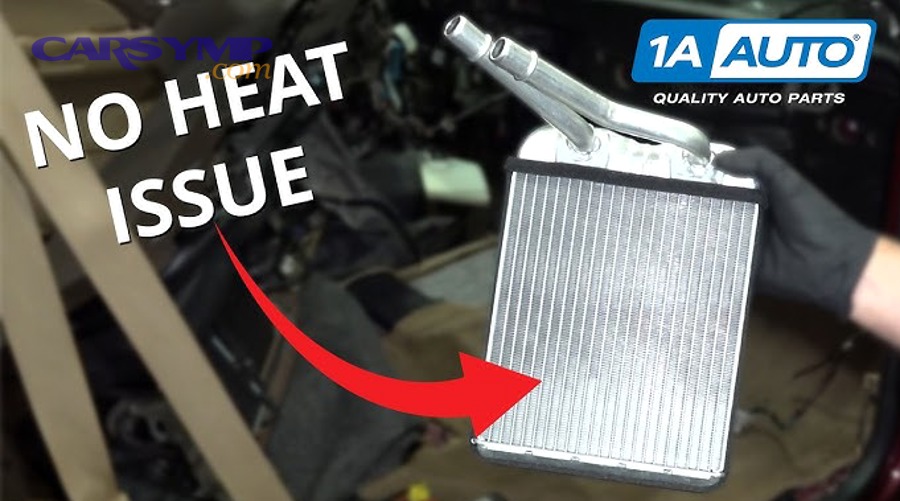
A clogged heater core is most likely when one heater hose is hot and the other is much cooler, while a leaking heater core is most likely when you get sweet smell, foggy windows, and damp carpet—because restriction changes temperature delta and leaks add vapor/liquid into the cabin.
Next, you’ll do a quick heater-hose temperature test and a cabin leak check.

How do you do a quick heater-hose temperature test to spot a clogged heater core?
A heater-hose temperature test is a simple check where you compare the inlet and outlet heater hoses after warm-up to infer coolant flow through the heater core; a big temperature difference usually indicates restriction.
Then, you interpret what you feel (or measure) with a clear rule.
How to do it (basic, low-tool version):
- Warm the engine to normal operating temp.
- Set heat to max, fan medium, and let it run a minute.
- Locate the two heater hoses at the firewall.
- Carefully feel both hoses (avoid burns—use caution).
Interpretation:
- Both hoses hot and similar: coolant is flowing through heater core; heat problem is more likely blend door/air-mix, airflow, or control logic.
- Inlet hose hot, outlet noticeably cooler: restriction in heater core or a heater control valve not opening fully.
- Both hoses only warm/lukewarm: coolant isn’t hot enough (thermostat/warm-up issue) or coolant is low/air is present.
If you have an infrared thermometer, you can quantify the delta, but the “one clearly cooler” pattern is often enough to proceed.
What symptoms point to a heater core leak (sweet smell, foggy windows, damp carpet)?
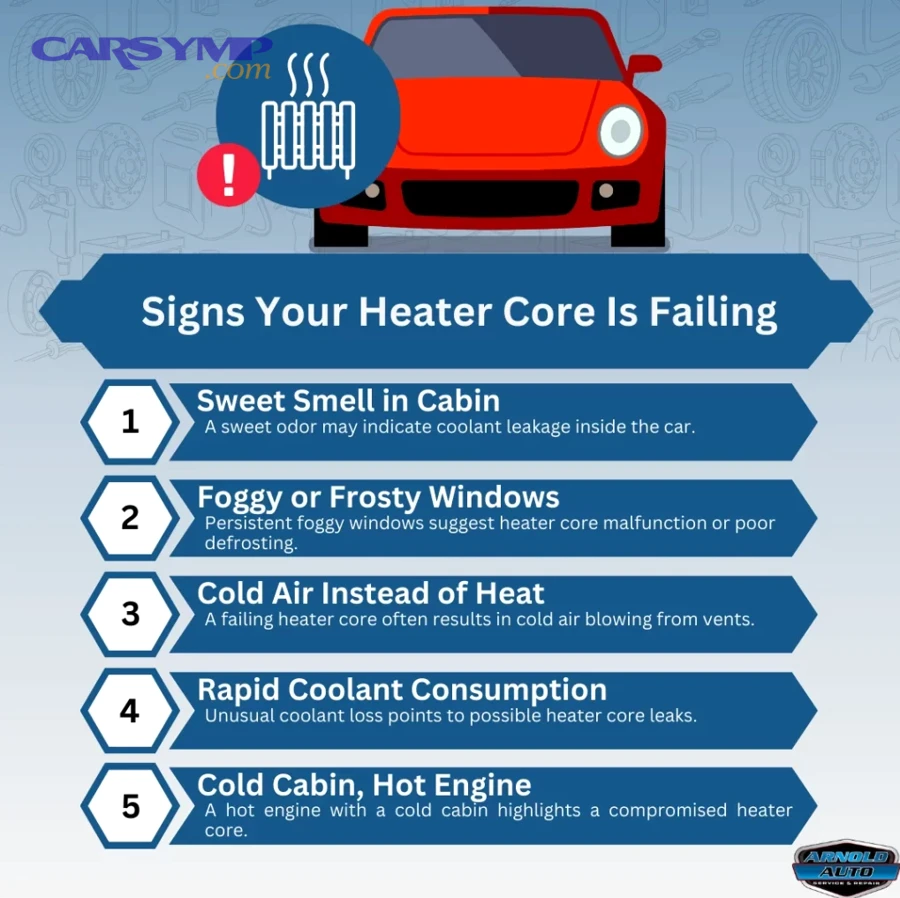
There are 4 main heater core leak symptom groups: cabin odor/fog, wet flooring, coolant loss, and film residue—because leaking coolant vaporizes in the HVAC case and spreads through vents and insulation.
Next, you’ll use these to separate “clogged vs leaking” quickly.
1) Cabin odor/fog
- Sweet smell (coolant-like)
- Windows fog quickly when heat is on
- Oily film on inside of windshield
2) Wet flooring
- Damp carpet (often passenger side)
- Sticky residue under floor mat
- Persistent moisture even in dry weather
3) Coolant loss
- Repeated low reservoir level
- Need to top up without external puddles
4) Heating behavior
- Heat may still be hot (leaks don’t always reduce heat immediately)
- Fogging can be worse at idle when airflow is slower
This is where the phrase Cabin damp carpet diagnosis becomes practical: damp carpet + sweet smell is not a “normal condensation” explanation—it’s a leak hypothesis until proven otherwise.
Could it be airflow or temperature-control hardware instead of the cooling system?
If the engine warms normally and heater hoses are hot but the cabin stays cold, the HVAC air-delivery system (blower/filter/ducts) or the temperature-control system (blend door/actuator) is more likely than the coolant system.
Moreover, this is where many “no heat” cases actually live—behind the dash.
If airflow is weak, is the cabin air filter or blower motor the likely cause?
Cabin air filter restriction wins when airflow is weak but fan sounds normal, while blower motor or blower module wins when airflow is weak and fan speed behavior is abnormal—because filters limit volume and blower faults limit drive power.
Next, you test airflow the same way you would test water flow: by checking for restrictions first.
Fast differentiation:
- If fan speed 1–4 all feel nearly the same (or dead on some speeds), suspect a blower resistor/module or control issue.
- If airflow is weak across all speeds but improves slightly on max, and you hear the blower working, check the cabin air filter.
A clogged cabin filter can make heat feel broken because warm air never reaches the cabin in volume—especially at idle when airflow is already lower.
If airflow is strong but stays cold, is the blend door actuator stuck?
Yes—a stuck blend door actuator can cause no heat because it can keep the air-mix door in the “cold” position, it can ignore your temperature knob inputs, and it can trap airflow away from the heater core even when coolant flow is normal.
Then, you verify it with behavior tests before replacing parts.
This is where Blend door actuator no-heat issues become a primary suspect. Common signs:
- Clicking/ticking behind the dash when you change temperature
- Temperature stays cold even though heater hoses are hot
- One side hot and the other cold on dual-zone systems
- Temperature changes briefly then returns to cold
Quick behavior tests:
- Move temperature from full cold to full hot and listen for actuator movement.
- Switch modes (defrost/floor/vent) and watch if airflow direction changes normally.
- If you have dual-zone, compare driver vs passenger output.
Evidence: According to a guide written by an ASE-certified automotive technician and published by CarParts.com (updated May 2025), abnormal noises and incorrect outlet temperature are common symptoms of a failing blend door actuator and can lead to stuck hot/cold output.
What are the most common fixes, and when should you choose flushing vs replacing the heater core?
Flushing wins when restriction is mild-to-moderate and there’s no leak, replacing wins when the heater core leaks or repeatedly clogs, and repairing controls (actuator/blower) wins when coolant flow is normal but cabin temperature control fails.
Next, you’ll choose the fix based on your diagnostic results—not on guesswork.
When does a heater core flush work, and when is replacement the smarter option?
A heater core flush works best for partial clogs with clear “inlet hot/outlet cool” evidence, while heater core replacement is smarter for leaks, heavy sludge, or repeat restriction—because flushing restores flow only when the core structure is still intact.
However, you should define “success” before you flush so you know whether to escalate.
Flush is reasonable when:
- Coolant is generally clean (not thick rust sludge)
- No sweet smell, no damp carpet, no fog residue
- Heat is weak and hose delta suggests restriction
- The vehicle hasn’t had repeated stop-leak use
Replacement is smarter when:
- Leak symptoms are present (odor, fogging, damp carpet)
- Core clogs repeatedly after flush
- Coolant contamination is severe (heavy rust scale)
- The core’s internal passages are likely compromised
If you’re deciding based on cost alone, remember: a flush is lower cost and lower intrusion; replacement can be labor-heavy because the heater core often sits deep behind the dash.
After a repair, how do you confirm the fix and avoid air pockets?
Confirming a no-heat repair means verifying stable engine temperature, stable coolant level, and repeatable hot vent output under the same conditions—while avoiding air pockets requires proper bleeding so coolant fully fills the heater core.
Then, you validate the result with a simple repeat test.
Post-repair confirmation checklist:
- Engine reaches normal temperature and stays stable
- Coolant level holds steady over several heat cycles
- Both heater hoses are hot after warm-up
- Vent temperature increases when set to hot
- Defrost performs consistently (no sudden fog return)
Air-pocket prevention habits:
- Use the manufacturer-recommended bleed method (some vehicles require specific steps)
- Run the heater during bleeding so the heater core is in-circuit
- Recheck coolant level the next day after a full cool-down
If heat is back but becomes intermittent again, suspect remaining air or an unresolved leak that is pulling air into the system.
What rare or vehicle-specific issues can cause no heat even after you’ve checked coolant, thermostat, and heater core?
Rare no-heat causes usually involve vehicle-specific HVAC logic or hardware—like dual-zone actuator failures, calibration problems, heater control valves, or supplemental heaters—because the basics can be “fine” while the air-mix system still blocks heat delivery.
Next, you’ll use a targeted approach: confirm what’s unique about your system before you disassemble anything.
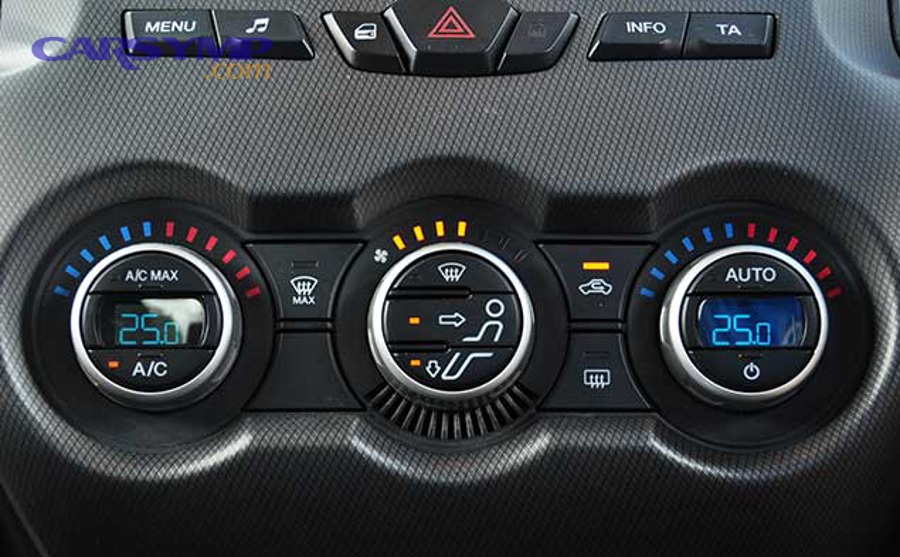
These “edge case” categories matter most when:
- Heater hoses are hot
- Engine reaches normal temperature
- Coolant level is stable
- Yet cabin heat is still missing or inconsistent
Common vehicle-specific culprits:
- Dual-zone systems with multiple actuators (one fails, one works)
- HVAC control module requiring a relearn/calibration after battery disconnect
- Heater control valve stuck closed (present on some models)
- EV/diesel supplemental heaters that can fail independently from coolant heat
If you’ve reached this point, your next best step is to consult a model-specific service procedure or scan HVAC data for actuator position and commanded temperature—because the failure may be control-side rather than coolant-side.
Evidence: According to a study by The University of Michigan Transportation Research Institute, in May 1999, researchers found that subjective ease-of-seeing ratings were significantly affected by defroster/defogger line characteristics, underscoring how HVAC/defog performance and visibility-related design factors influence driver perception even when task performance remains measurable.