


A UV (fluorescent) dye test is the fastest DIY way to pinpoint where an engine oil leak actually starts: you add an oil-safe fluorescent dye, let the oil circulate, then scan with a UV light to see a bright trail that leads back to the source—not just the drip spot.
Next, you’ll need the right setup to get a clean result: the correct dye for engine oil, a UV flashlight that makes the dye pop, and a simple prep routine that removes old grime so you don’t “follow yesterday’s mess” instead of today’s leak.
Then, the real value comes from interpreting what you see: dye patterns can spread with airflow, wick along bolts, and pool on edges, so you’ll learn how to read “thin trails” versus “glowing pools,” and how to confirm the leak with wipe-and-recheck.
Introduce a new idea: once you can reliably locate the leak source, you can decide whether the fix is a quick tighten-and-monitor move, a planned engine oil leak repair, or a “stop driving and get help” situation—without guessing.
What is a UV (fluorescent) dye test for engine oil leaks?
A UV (fluorescent) dye test for engine oil leaks is a diagnostic method that mixes an oil-compatible fluorescent dye into engine oil so the leak fluoresces under UV light, making the leak path and origin easy to track even in tight, dirty engine bays.
To better understand why this works so well, it helps to separate the “glow” from the “guess” and focus on what the dye reveals that normal light cannot.
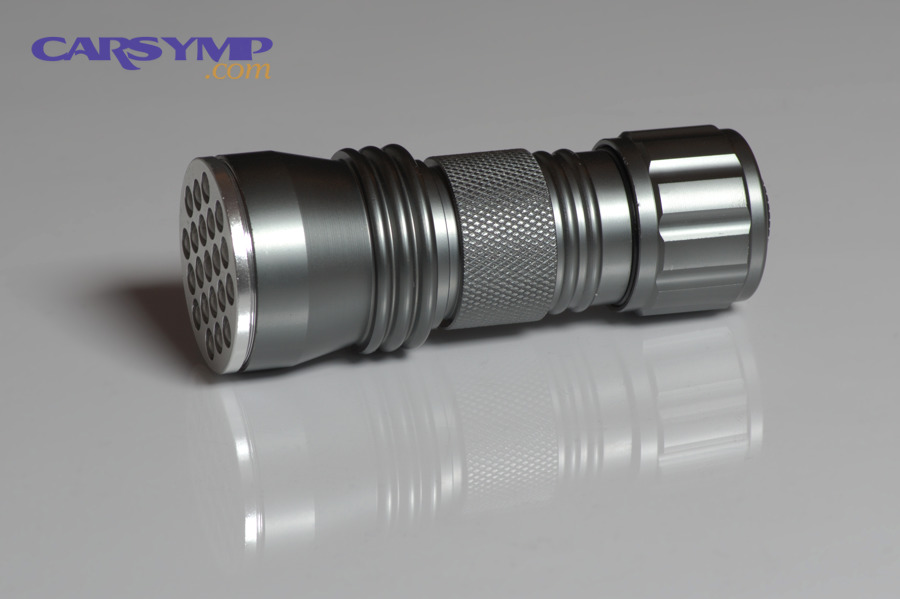
How does fluorescent dye make an oil leak easier to trace than fresh oil alone?
Fluorescent dye makes an oil leak easier to trace because it creates a high-contrast, bright marker inside the oil that stands out under UV light, so you can see the direction of travel and the highest wet point instead of just a shiny smear.
Specifically, a typical oil leak has three visual problems in normal lighting:
- Oil spreads before it drips. Oil often runs along castings, brackets, and bolt heads, then drips from the lowest edge. The drip point is rarely the source.
- Old grime masks new oil. A slightly wet area can look identical to a fresh leak when there’s baked-on residue.
- Airflow relocates evidence. Driving pushes oil rearward and sideways, creating a “false map” unless you can see a distinct trace line.
The dye solves these by making fresh leakage unmistakable. When you scan with UV, the newest oil-dye mixture usually looks brighter and more defined than older residue, so you can work backward with confidence. Many dye systems are designed to be compatible with engine oil and visible as a bright yellow-green under UV/blue light. (spectronicsmedia.com)
What parts of the engine can a dye test help diagnose most accurately?
A dye test can help diagnose oil leaks most accurately in areas where oil hides, spreads, or collects—especially around seals, gaskets, and pressurized oil passages that are hard to see in normal light.
These are the most common “high-value” diagnostic targets a UV dye test clarifies:
- Upper engine seepage: valve cover gasket perimeter, spark plug tube seals, cam cap corners
- Filter and housing areas: oil filter base, oil cooler gasket areas, oil pressure switch/sender threads
- Front-of-engine wet zones: timing cover seams, crankshaft front seal area, VVT solenoids (if equipped)
- Lower engine edges: oil pan gasket rails, drain plug sealing surface, pan corners
- Rear leak confusion zones: rear main seal region vs oil pan rear corners vs transmission bellhousing seepage
- Turbo oil plumbing (if turbocharged): feed/return lines and banjo fittings
If your goal is to confirm Common engine oil leak locations without pulling half the engine apart, dye is one of the most practical “see it to believe it” options—especially when multiple areas look wet at the same time.
Do you really need a UV dye test to find an oil leak?
No, you don’t always need a UV dye test to find an oil leak, but it is one of the best options when the leak is small, intermittent, spread by airflow, or masked by old residue—because it can reveal the true source faster than repeated cleaning and guessing.
Then, the decision becomes simple if you use a few yes/no checkpoints that separate “obvious leak” from “hidden leak.”
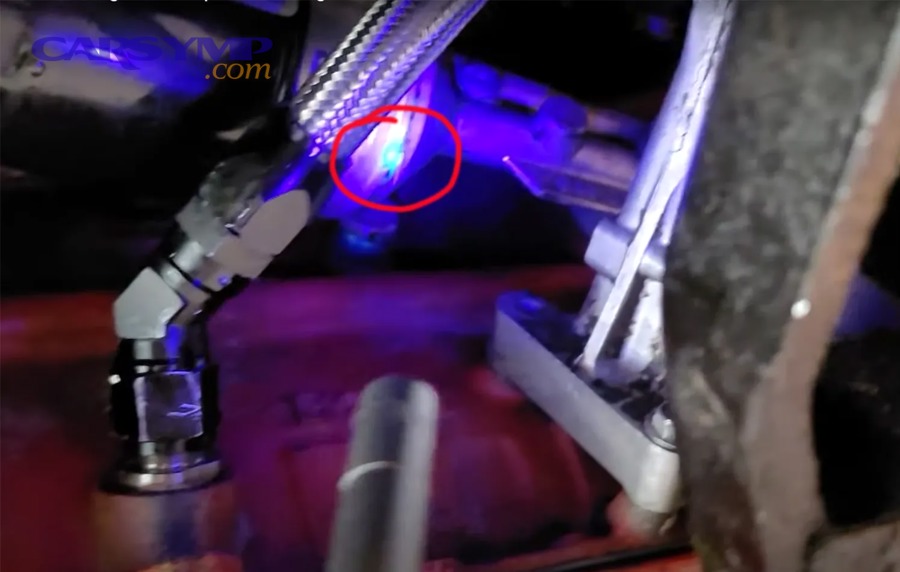
Yes/No: Is a dye test worth it if you already see oil dripping?
Yes, a dye test is worth it even if you already see oil dripping when (1) you can’t confidently identify the starting point, (2) multiple areas are wet, and (3) the drip point is not directly below a clear leak source.
Here’s why those three reasons matter:
- Drips lie. Oil often drips from a shield, crossmember, or oil pan lip after traveling from higher up.
- Multiple wet areas create false certainty. A valve cover seep can coat the entire side of the engine, making the oil pan look guilty.
- Small leaks become big messes quickly. A slow seep can spread widely at highway speeds, so “where it drips” is rarely “where it leaks.”
If you truly see a single, fresh wet point—like a drain plug that’s obviously wet immediately after an oil change—then you may not need dye. But if you’re planning an engine oil leak repair and want to replace only the part that’s actually failing, dye is often cheaper than trial-and-error parts swapping.
Yes/No: Should you avoid a dye test if the engine is actively smoking or losing oil fast?
Yes, you should avoid relying on a dye test as your main move if the engine is actively smoking or losing oil fast because (1) the situation can become a fire hazard, (2) low oil can cause engine damage, and (3) dye won’t help if you shouldn’t be running the engine.
More importantly, treat these as “stop and assess first” conditions:
- Smoke or burning smell near the exhaust manifold or turbo area
- Oil pressure warning light or rapid drop on the dipstick
- Oil visibly spraying or dripping onto hot components
- Driveway-sized puddles forming quickly
In those cases, your first step is safety: shut down, check oil level, and address immediate risk. Dye is still useful later, but only once it’s safe to run the engine long enough to circulate the oil.
What tools and supplies do you need for a UV dye oil leak test?
There are 6 main tools you need for a UV dye oil leak test—oil-specific UV dye, UV light, UV glasses, degreaser, basic safety gear, and simple inspection aids—because the result depends as much on visibility and prep as it does on the dye itself.
Below, the goal is to choose tools that make the dye unmistakable and the workflow safe and repeatable.
Which UV dye is correct for engine oil, and how much should you add?
The correct UV dye is one labeled for gasoline or diesel engine oil systems, and you should add only the recommended dose because (1) oil-specific chemistry improves mixing, (2) proper concentration makes leaks brighter, and (3) overdosing can make everything glow and reduce diagnostic clarity.
Practical selection rules:
- Choose “engine oil” on the label. Many products are formulated for specific fluids (engine oil vs ATF vs coolant).
- Follow dose guidance. Dye is typically concentrated; more is not better.
- Avoid guessing if capacity is unusual. If your engine takes very little oil (small engine) or a lot (some trucks), use the manufacturer’s ratio instructions.
Many leak detection dyes are marketed as compatible with engine oil systems and designed to fluoresce brightly under UV/blue light. (spectronicsmedia.com)
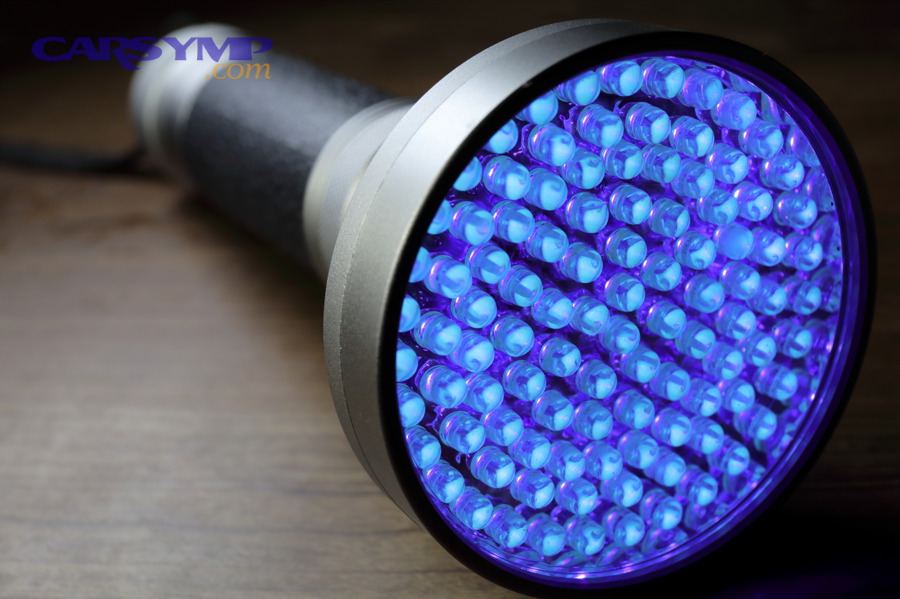
What’s the difference between a 365 nm and 395 nm UV light for leak detection?
A 365 nm UV light typically produces stronger fluorescence in many dyes, while a 395 nm UV light is often cheaper and still effective; the best choice depends on (1) dye response, (2) ambient light conditions, and (3) how “washed out” your inspection environment is.
Use this comparison to decide:
- 365 nm (often “UV-A” inspection grade):
- Pros: tends to make fluorescence pop more in many applications, better contrast in challenging conditions
- Cons: can be more expensive; quality varies widely by brand
- 395 nm (common consumer UV LED):
- Pros: widely available; budget-friendly; often “good enough” if you can darken the area
- Cons: can show more visible purple light and less “pure” fluorescence, which may reduce contrast
If you’re scanning a tight engine bay at night or in a dim garage, either can work. If you’re scanning outdoors, near bright shop lighting, or for micro-seeps, stronger contrast becomes more important.
What prep products help the most before you scan with UV?
The best prep products are a degreaser, shop towels, gloves, and optionally a non-residue cleaner because (1) clean surfaces prevent false trails, (2) dry surfaces show new dye faster, and (3) you can re-check and confirm repairs without old dye confusing you.
A simple prep kit:
- Degreaser: removes old oil film from suspected areas
- Absorbent towels and brushes: for seams and bolt heads
- Disposable gloves + eye protection: oil and cleaners irritate skin/eyes
- Inspection mirror + small pick: to see behind brackets and feel for fresh wetness
- UV glasses (yellow lenses): boosts contrast so the dye stands out more clearly
A major advantage of doing prep correctly is that your scan becomes a “map of now,” not a scrapbook of the last 20,000 miles.
How do you perform a UV dye test for an engine oil leak step-by-step?
Performing a UV dye test for an engine oil leak takes 6 steps—confirm oil level, add dye, circulate oil, scan high-to-low with UV, identify the highest glowing point, and confirm with wipe-and-recheck—so you can trace the leak back to its true origin.
Then, the key is to treat it like a controlled experiment: you’re creating a clean baseline, introducing a tracer, and observing where the tracer exits.
How do you prepare the engine so old grime doesn’t create false “leak paths”?
You prepare the engine by cleaning suspected leak zones, drying them, and documenting a baseline because (1) old oil residue fluoresces if it already contains dye or contaminants, (2) grime holds oil and creates fake trails, and (3) baseline photos help you see what changed after circulation.
A preparation routine that works for most DIYers:
- Work on a cool engine. Hot exhaust and spinning belts make inspection risky.
- Identify likely zones first. Look for wetness around the top edges (valve cover area) and around the filter housing.
- Degrease targeted areas. Focus on seams, corners, and bolt heads, not the entire engine if you don’t need to.
- Rinse/wipe and dry. Residual cleaner can make new oil spread oddly.
- Do a quick “no dye” scan. This isn’t always required, but it can reveal old fluorescent residue from a previous test.
If you can’t clean everything, clean strategically: the areas that sit “above” the drip point and the common seam lines where oil typically escapes.
How long should you idle or drive before checking with the UV light?
You should idle 5–10 minutes for quick checks and drive 10–30 minutes for most small leaks because (1) the dye needs circulation time, (2) pressure and temperature changes expose many leaks, and (3) airflow during driving can reveal leak direction you won’t see at idle.
A practical timeline:
- Immediate check (idle only): good for obvious leaks around the filter housing or drain plug area
- Short drive (10–15 minutes): good for seepage that appears under moderate temperature
- Longer drive (20–30 minutes or a normal commute): useful for intermittent leaks that appear only after full warm-up
If the leak is extremely small, you may need multiple short drive cycles with re-checks. The goal is not to “wait forever,” but to produce a clear, fresh dye trace you can follow.
What is the best scan order to find the true source instead of the lowest drip point?
The best scan order is high-to-low and clean-to-dirty because (1) gravity moves oil downward, (2) airflow moves oil rearward, and (3) the leak source is usually the highest bright point, not the lowest wet edge.
Use this scan sequence:
- Start at the top perimeter: valve cover seams, back corners, and the area around the oil fill cap and PCV plumbing
- Move to mid-engine components: oil filter housing, oil cooler area, pressure sensors/switches, VVT solenoids
- Scan front seams: timing cover edges and crank seal area (without touching belts)
- Scan lower rails last: oil pan gasket edges, drain plug, and the pan corners
- Check splash zones: underbody shields, crossmembers, and the subframe—these often show “where it lands,” not “where it starts”
If you’re documenting Common engine oil leak locations, this scan order also prevents a common DIY mistake: blaming the oil pan gasket when the valve cover seep is the real culprit.
How do you confirm the leak source once you see fluorescent traces?
You confirm the leak source by locating the highest bright point, wiping it completely, running the engine briefly, and re-scanning because (1) fresh dye reappears exactly where the leak is active, (2) wiping removes misleading runoff, and (3) you can distinguish seepage from residue.
A reliable confirmation technique:
- Find the “first glow” upstream. Don’t stop at the first thing you see—look above it.
- Wipe a small area clean. Use a towel to remove all visible dye at the suspected seam.
- Re-run briefly (idle 2–5 minutes). Enough to produce new evidence without creating a huge mess.
- Re-scan immediately. Fresh dye will show as a new, thin wet line or bright point at the active leak.
This wipe-and-recheck step is what turns a “cool glow” into a confident diagnosis.
How do you interpret UV dye results correctly?
You interpret UV dye results correctly by reading the dye pattern as a flow map—thin trails usually show runoff, bright concentrated spots usually mark the exit point, and pooling often indicates where oil collects—so you can separate origin, path, and drip point.
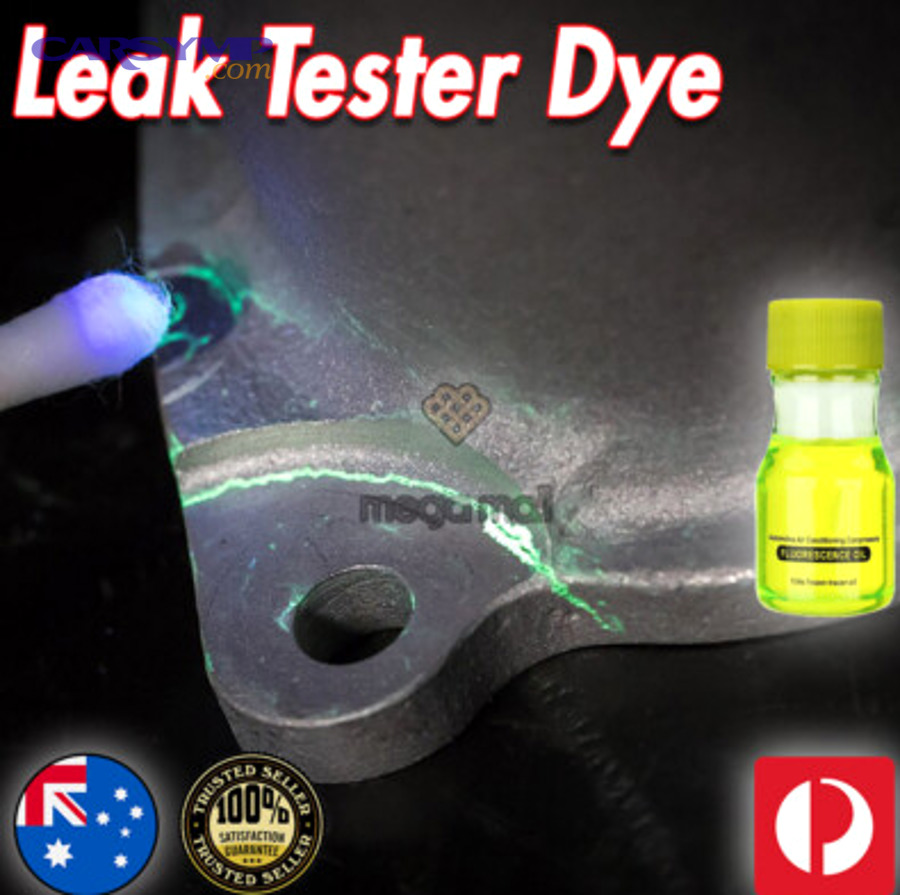
However, interpretation only works when you remember that oil behaves differently depending on heat, airflow, and surface texture.
What does a “thin glowing trail” vs a “glowing pool” usually indicate?
A thin glowing trail usually indicates oil is traveling from a higher source, while a glowing pool usually indicates oil is collecting at an edge or low point; the best conclusion comes from comparing (1) concentration, (2) location, and (3) directionality.
Use this quick pattern read:
- Thin trail:
- Often runoff from above
- Common along casting ridges, bracket edges, bolt heads
- Usually points “down and back” after driving
- Glowing pool:
- Oil pooling at a gasket lip, pan rail, or shield edge
- Can be the drip point, not the source
- May appear brighter simply due to volume
If you see both, treat the pool as a clue and follow the thinnest, highest trail back to where it begins.
How do you tell the difference between a spill during filling and an active leak?
You tell the difference by wiping the suspected spill area fully clean and checking whether fresh dye returns after a short run because (1) spills do not regenerate, (2) active leaks do, and (3) new dye typically appears as a distinct wet edge at a seam or fitting.
A simple decision rule:
- Spill: bright dye present in broad smears but disappears after cleaning and does not return in the same spot
- Active leak: dye reappears from a seam, gasket edge, sensor threads, or fitting after running
This is also why it’s smart to avoid spilling dyed oil during the test. When that happens, you can still diagnose—but you’ll need more cleaning and more confirmation passes.
Which common leak sources create confusing patterns ?
The most confusing sources are valve cover seepage, oil filter housing leaks, timing cover seepage, and rear leak zones because they spread widely; you decode them by focusing on (1) the highest glow, (2) seam boundaries, and (3) how airflow would move oil during driving.
Here’s how to decode four frequent “confusers”:
- Valve cover seepage
- Pattern: wide glow down the side of the engine
- Decode: scan the top edge and corners first; look for a bright line at the gasket seam
- Oil filter housing / cooler area
- Pattern: glow around the filter and running onto lower components
- Decode: check gasket seam lines around the housing and sensors; wipe-and-recheck works well here
- Front cover/timing area
- Pattern: dye near pulleys and lower front engine
- Decode: inspect seam edges carefully from above; avoid belts; look for a concentrated point rather than spray patterns
- Rear leak confusion (bellhousing area)
- Pattern: glow at the bottom of the transmission bellhousing
- Decode: check the back of the oil pan corners and valve cover rear corners first; a rear main seal is possible but not automatic
If you interpret patterns with “origin-first” logic, your diagnosis becomes consistent—even when the engine looks like it’s leaking from everywhere.
What should you do after you find the oil leak source?
After you find the oil leak source, you should (1) decide whether it’s safe to drive, (2) plan the correct repair based on the exact origin, and (3) clean and re-test to confirm the fix—because locating the leak is only useful if it leads to a verified solution.
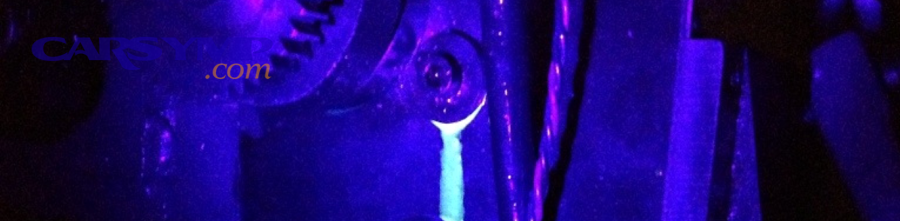
Next, you’ll use the dye evidence to choose the right next step instead of defaulting to the most expensive guess.
Yes/No: Can you keep driving once you’ve identified the leak with dye?
Yes, you can keep driving once you’ve identified the leak with dye only if (1) the leak rate is slow, (2) the oil level stays safe between checks, and (3) the leak is not contacting hot exhaust or creating smoke.
Use a clear safety checklist:
Okay to drive (with monitoring):
- Seepage or occasional drip
- No burning smell or smoke
- Oil level remains stable with frequent dipstick checks
- Leak is not spraying under pressure
Do not drive (or drive only to a shop safely):
- Active dripping onto exhaust components
- Visible smoke, burning odor, or oil mist
- Rapid oil loss or warning light
- Leak near turbo/exhaust manifold areas
This section directly answers the real-world question behind many dye tests: Can you drive with an oil leak? You can sometimes, but only when the risk and oil loss are controlled.
How do you clean off dye after diagnosis so you can verify the repair?
You clean off dye by degreasing the leak area, wiping until dry, and re-scanning with UV to ensure no residue remains because (1) leftover dye can look like a continuing leak, (2) clean surfaces reveal new leakage immediately, and (3) verification depends on a clean baseline.
A strong cleanup approach:
- Target only the dyed zones. Don’t soak electrical connectors unnecessarily.
- Use towels and brushes on seams. Dye often sits in crevices.
- Re-scan after cleaning. If you still see glow everywhere, keep cleaning until it’s truly reset.
Some dye manufacturers explicitly recommend cleaning remaining dye after repairs so it is not mistaken for a continuing leak, then re-checking with UV to confirm the repair. (spectronicsmedia.com)
How do you re-test after a repair to confirm the leak is gone?
You re-test by running the engine, scanning the repaired area under UV, and repeating a short drive cycle if needed because (1) some leaks appear only under load/temperature, (2) seals and gaskets may need full warm-up to prove stability, and (3) a “no fresh glow” result is the only reliable confirmation.
A simple confirmation protocol:
- Idle check (5–10 minutes): scan the exact seam or fitting you repaired
- Short drive (10–15 minutes): return and scan again
- Final check after cooldown: some leaks show after heat soak
If you performed an engine oil leak repair such as replacing a gasket or resealing a housing, this re-test step is the difference between “I think it’s fixed” and “it’s verified.”
You’ve now completed the full UV dye test process—from tool selection and preparation to scanning and confirming the leak source. The next section goes beyond the core how-to by expanding into advanced edge cases, alternatives, and decision-making scenarios that can improve accuracy and reduce misdiagnosis.
What are the best alternatives (and complements) to a UV dye test for finding oil leaks?
The best alternatives (and complements) to a UV dye test are clean-and-recheck, powder tracing, drip mapping, and professional smoke/pressure methods, because each option wins in a different situation—especially when dye is impractical, misleading, or unsafe.
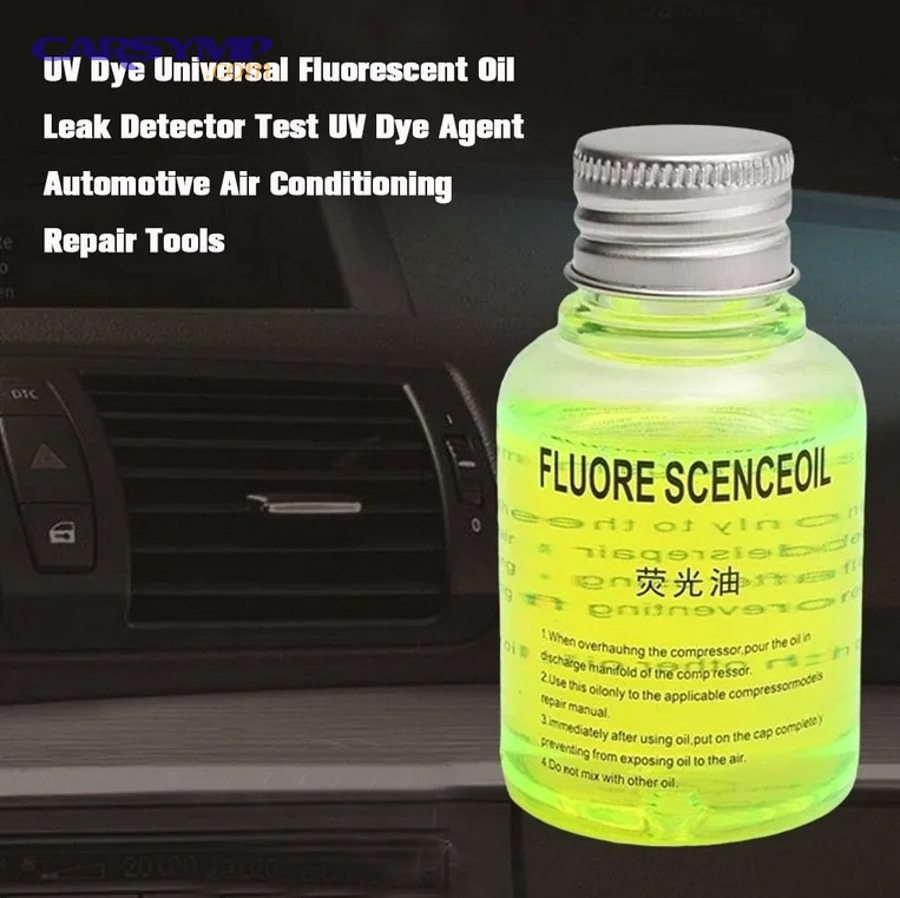
In addition, understanding these alternatives prevents overconfidence: dye is powerful, but it’s not magic, and edge cases are real.
What non-UV methods can help you find an oil leak when dye isn’t practical?
There are 4 main non-UV methods that can help you find an oil leak: cleaning and re-checking, powder tracing, cardboard drip mapping, and targeted inspection after specific drive conditions, based on how visible and repeatable the leak is.
Here’s how to use each method effectively:
- Clean-and-recheck (baseline method)
- Degrease suspected areas, then monitor for fresh wetness
- Works best for obvious leaks and accessible seams
- Weakness: slow for intermittent leaks
- Powder tracing
- Lightly apply powder to a clean seam; oil creates a visible track
- Works best for slow seepage at gasket lines
- Weakness: messy and less effective if airflow is strong
- Cardboard drip mapping
- Park over clean cardboard and note drip location and timing
- Works best for identifying general leak region
- Weakness: drip point may be far from source
- Condition-based inspections
- Check after idle-only, after highway driving, after heat soak
- Works best for leaks triggered by temperature or pressure changes
- Weakness: still requires careful interpretation
These methods often pair well with dye: you can use non-UV methods to narrow the zone, then use dye to pinpoint the exact origin.
When does a UV dye test fail or mislead ?
A UV dye test fails or misleads when (1) the engine is too dirty, (2) dye concentration is too high, or (3) the inspection environment is too bright; you fix it by resetting the baseline, using correct dosage, and scanning under controlled lighting.
Common failure modes and fixes:
- “Everything glows” problem (overdose or residue):
- Fix: clean more aggressively; reduce dye dose next time; focus on wipe-and-recheck
- Weak fluorescence (wrong light or too much ambient light):
- Fix: darken the area; use UV glasses; improve the UV lamp quality or wavelength match
- False trails from airflow:
- Fix: scan before a long drive; run shorter cycles; focus on the highest bright point near seams
- Unsafe conditions (smoke, hot oil near exhaust):
- Fix: stop running the engine until the immediate hazard is controlled
It also helps to remember that UV dyes are designed to be used as tracers and then observed under UV light after circulation, which means the method depends on stable conditions and proper setup.
How do oil, coolant, and transmission fluid fluorescence differ under UV ?
Engine oil dye is usually bright yellow-green under UV, coolant dyes may fluoresce differently depending on chemistry, and transmission fluid dye behavior depends on the dye used; you avoid mix-ups by confirming (1) fluid location, (2) texture/smell, and (3) which system you dosed.
A practical “avoid mix-up” system:
- Only add dye to one system at a time. If you dye engine oil and ATF at once, you lose diagnostic certainty.
- Use system logic.
- Engine oil leaks cluster around the engine block, filter housing, valve cover, timing cover seams
- Coolant leaks cluster around hoses, radiator area, water pump, thermostat housing
- ATF leaks cluster around transmission pan, cooler lines, axle seals (FWD), bellhousing (front pump seal)
- Verify physically.
- Oil feels slick and heavier
- Coolant often feels watery and may have a sweet smell
- ATF may have a distinct odor and different viscosity
If you want maximum clarity, stick to one dyed fluid and document the result with photos before moving to another system.
When should you stop DIY diagnostics and take the car to a professional shop?
You should stop DIY diagnostics and take the car to a professional shop if (1) the leak creates smoke or fire risk, (2) oil loss is rapid or pressure warnings appear, or (3) the suspected source requires specialized tools or major disassembly.
Specific “handoff” situations:
- Oil dripping onto hot exhaust components or turbo hardware
- Oil pressure warning light or repeated low-oil events
- Leaks that appear to come from inside the bellhousing (may require lift access)
- Leaks that require timing cover reseal, rear main seal work, or major component removal
- You need compliance-level dye compatibility guidance for a specific system standard (some industries reference standards such as SAE criteria for UV dye stability/compatibility in certain applications) (sae.org)
Finally, if you’ve done the dye test correctly and can show the shop the exact glowing source, you usually save labor time—because diagnosis becomes confirmation, not exploration.
Evidence (if any): According to a capstone study by Virginia Commonwealth University from the College of Engineering (Chemical Engineering), in 2017, researchers modeled fluorescent dye behavior for leak detection scenarios and established measurable dye concentration changes over time under elevated conditions, supporting the reliability of fluorescent tracers when used with controlled inspection methods. (scholarscompass.vcu.edu)