


A tire puncture repair performed at a professional shop is the only method that delivers a safe, permanent fix — and understanding exactly what that process involves helps every driver make smarter decisions after a flat. When a nail, screw, or road debris punctures your tire, the instinct is often to grab a roadside plug kit and move on. However, a proper tire puncture repair requires the tire to be fully demounted, inspected from the inside out, and sealed using a combination plug-and-patch unit bonded with vulcanizing cement. Anything less is a temporary measure, not a permanent solution.
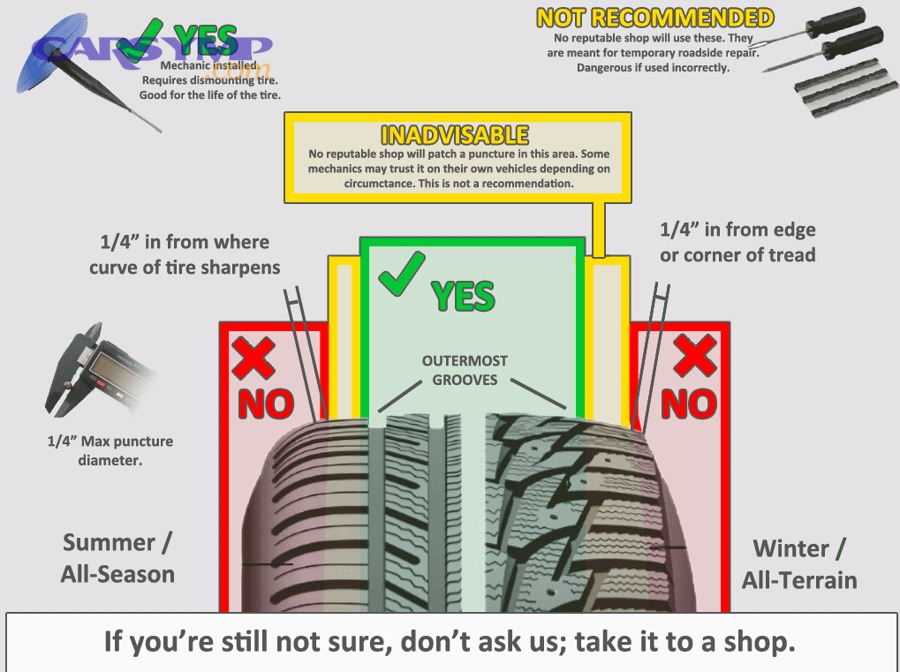
Knowing whether your tire is even eligible for repair is just as critical as knowing the repair steps themselves. Not every puncture can be fixed — the location, size, and angle of the injury all determine whether a shop will repair or replace your tire. Punctures confined to the central tread area with a diameter no greater than ¼ inch on passenger vehicles are generally repairable. Sidewall damage, shoulder injuries, and punctures made while a tire was run flat fall outside the boundaries of safe repair under USTMA and TIA standards.
Beyond eligibility, drivers often want to know what a trustworthy repair actually looks like compared to a shortcut. A plug inserted from the outside without demounting the tire is an emergency measure, not a shop-quality repair. Industry standards from the U.S. Tire Manufacturers Association are clear: a plug alone or a patch alone is an unacceptable repair. Only the combination method — a rubber stem filling the injury channel and a patch sealing the inner liner — creates a permanently airtight bond that is safe for highway speeds.
Finally, practical concerns like cost and time matter too. A professional tire puncture repair typically costs between $20 and $50 and takes 60 to 90 minutes to complete properly. Some shops offer free repairs as part of tire protection plans or loyalty programs. To better understand every stage of this process — from the moment a technician demounts your tire to the moment it’s back on your vehicle — the sections below walk through each step in full detail.
What Is a Tire Puncture Repair at a Shop?
A tire puncture repair at a shop is a permanent, professionally executed procedure that seals a tire’s injury channel and inner liner using a combination plug-and-patch unit, following USTMA and TIA industry standards. This definition matters because the term “tire repair” is often used loosely to describe everything from a quick roadside plug to a full demount-and-patch process — and these are not equivalent in safety or durability.
Specifically, what separates a professional shop repair from a DIY or emergency fix is the requirement that the tire be removed from the rim entirely, inspected both inside and out, cleaned, and then sealed using a vulcanizing bonding process. This is the only method that addresses both the injury channel and the inner liner simultaneously.
What Does a Professional Tire Puncture Repair Include?
A professional tire puncture repair includes three essential components working together: a rubber stem (plug) that fills and seals the injury channel, a patch unit that seals the inner liner, and vulcanizing cement that chemically bonds the repair to the tire rubber.
- The rubber stem is inserted from the inside of the tire outward through the puncture channel, filling the void left by the penetrating object
- The patch is pressed and stitched firmly onto the buffed inner liner surface, preventing moisture and air from entering
- Vulcanizing cement is applied to both the injury channel and the buffed area before the repair unit is installed; it air-dries to a tacky state and then forms a permanent chemical bond with the repair unit
- A one-piece combination unit integrates both the stem and the patch into a single repair component, which is the most common type used in passenger vehicle tire repairs today
The importance of this combined approach cannot be overstated. A plug without a patch leaves the inner liner unsealed, meaning water can enter the tire body and corrode the steel belts from the inside. A patch without a plug leaves the injury channel open, allowing air to slowly escape. Only the combination method addresses both failure points simultaneously, which is why it is the only repair type recognized as permanent by governing industry bodies.
What Is the Difference Between a Plug Repair and a Patch-Plug Repair?
A plug-only repair and a patch-plug combination repair differ fundamentally in safety, durability, and industry acceptance — and understanding that difference protects drivers from believing a temporary fix is a finished one.
| Feature | Plug-Only Repair | Patch-Plug Combination Repair |
|---|---|---|
| Inner liner sealed? | No | Yes |
| Injury channel filled? | Yes | Yes |
| Requires demounting? | No | Yes |
| Permanent? | No | Yes |
| Industry approved? | No | Yes (USTMA / TIA) |
| Safe for highway speeds? | No | Yes |
The table above summarizes the key differences between an emergency plug repair and a proper shop-quality patch-plug combination. As shown, a plug-only approach leaves the inner liner exposed and is not considered a permanent repair by any recognized tire industry standard.
A plug inserted from the outside without removing the tire is an emergency measure designed to get a driver to the nearest shop — nothing more. It cannot be verified for proper seating, it does not seal the inner liner, and it can be dislodged under highway load and speed. The patch-plug combination, by contrast, is chemically bonded to the tire and becomes structurally part of it once fully cured. According to the Tire Industry Association’s Basic Automotive Tire Service guidelines, performing an outside-in repair or an on-the-wheel repair is explicitly classified as unacceptable practice.
What Are the Steps of Tire Puncture Repair at a Shop?
A professional tire puncture repair follows five sequential steps — demounting and inspection, surface preparation, plug installation, patch application, and remounting with leak verification — each of which is required to achieve a permanent, safe result.
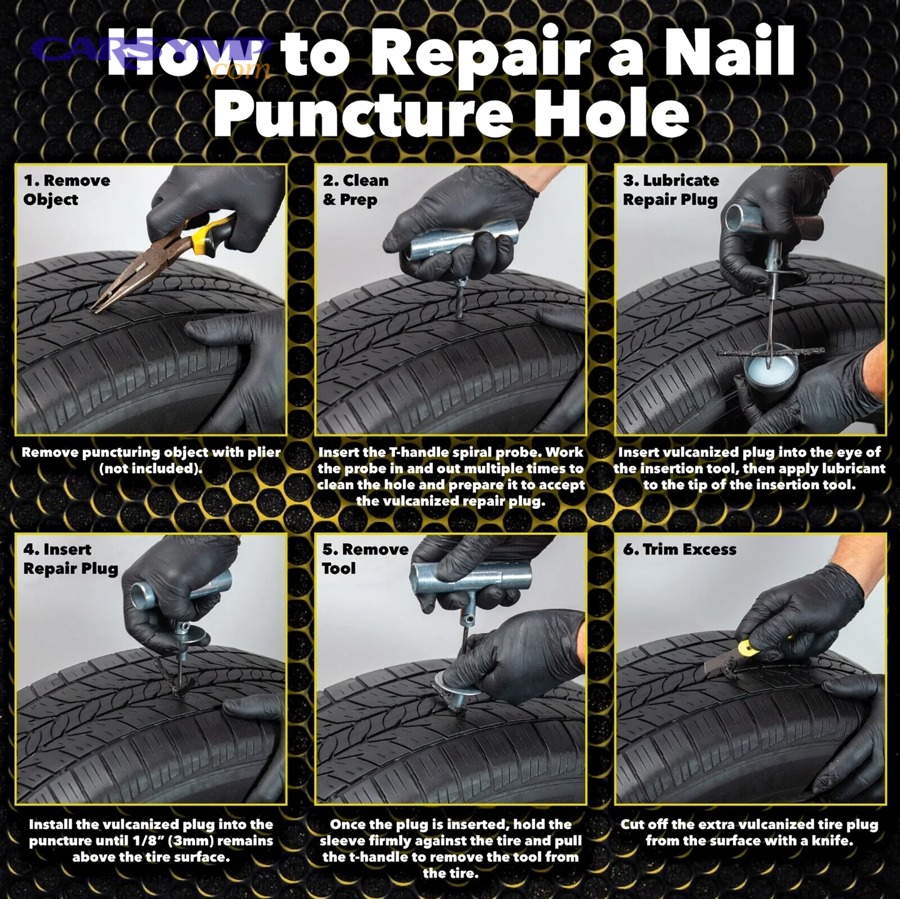
To better understand why each step exists, it helps to know what can go wrong when any one of them is skipped. A puncture that looks minor from the outside may have caused hidden internal cord damage. A repair applied to an unclean surface will fail to bond. Air trapped under the patch will allow the repair to lift over time. The steps below exist precisely to eliminate each of these failure modes.
Step 1 — How Does a Technician Remove and Inspect the Tire?
The technician begins by fully demounting the tire from the rim using a tire changing machine, then performing a thorough inspection of both the exterior tread surface and the complete interior of the tire.
- The exterior is checked for the location of the puncture, which is marked with a tire crayon
- The interior is examined for signs of inner liner damage, cord separation, belt damage, or evidence that the tire was operated while flat
- A blunt awl or probe is inserted into the injury to determine the precise angle of penetration, which determines whether a one-piece or two-piece repair unit is required
- Any tire showing separation, bubbling, exposed cords, or structural damage is flagged for replacement — not repair
This step is the reason why on-the-wheel repairs are never acceptable. A tire that appears to have a simple nail hole from the outside may have a cracked inner liner, damaged body plies, or a belt separation that is only visible once the tire is fully removed and laid flat for inspection. Skipping this step puts the driver at serious risk of repair failure at speed.
Step 2 — How Is the Puncture Area Prepared and Cleaned?
Surface preparation involves removing the puncturing object, cleaning the injury channel with a carbide cutter, and buffing the inner liner to create the proper texture for repair adhesion.
- The puncturing object is removed carefully, and the angle of the injury is noted
- A carbide cutter mounted on a low-speed drill (maximum 1,200 rpm) is used to ream the injury channel from the inside out, removing all damaged cord material and stabilizing the edges of the wound
- The inner liner surface surrounding the puncture is cleaned with a pre-buff cleaner using a clean cloth or scraper to remove dirt, mold release agents, and lubricants
- A low-speed buffer (maximum 5,000 rpm) fitted with a fine wire brush or gritted rasp is used to buff the inner liner to a velvety texture within the marked repair area
- All rubber dust is removed with a fine wire brush and vacuum — compressed air is never used, as air lines carry moisture and oil that contaminate the bonding surface
The quality of this preparation step directly determines the long-term integrity of the repair. Repair material manufacturers are explicit: if the buffed area is touched by bare hands or contaminated in any way before the repair unit is applied, adhesion is compromised and the repair may fail prematurely.
Step 3 — How Is the Plug Installed Through the Injury Channel?
The plug installation step involves applying vulcanizing cement to the prepared injury channel and inner liner, then pulling the rubber stem end of the combination repair unit through the puncture from the inside outward.
- Vulcanizing cement is applied through the injury channel using an applicator, ensuring full coating of the channel walls
- The cement is also applied to the buffed area of the inner liner and allowed to air-dry to a tacky state — typically 5 to 10 minutes, depending on ambient temperature and humidity
- The stem end of the one-piece combination repair unit is threaded from the inside of the tire outward through the injury channel using a pulling tool
- Once the stem is fully seated and the patch portion is flat against the inner liner, the technician cuts the excess stem material from the outside of the tire, leaving approximately ¼ inch above the tread surface
- The excess is not cut flush with the tread — a small amount of stem protrusion is intentional and protects the repair from tread flex during operation
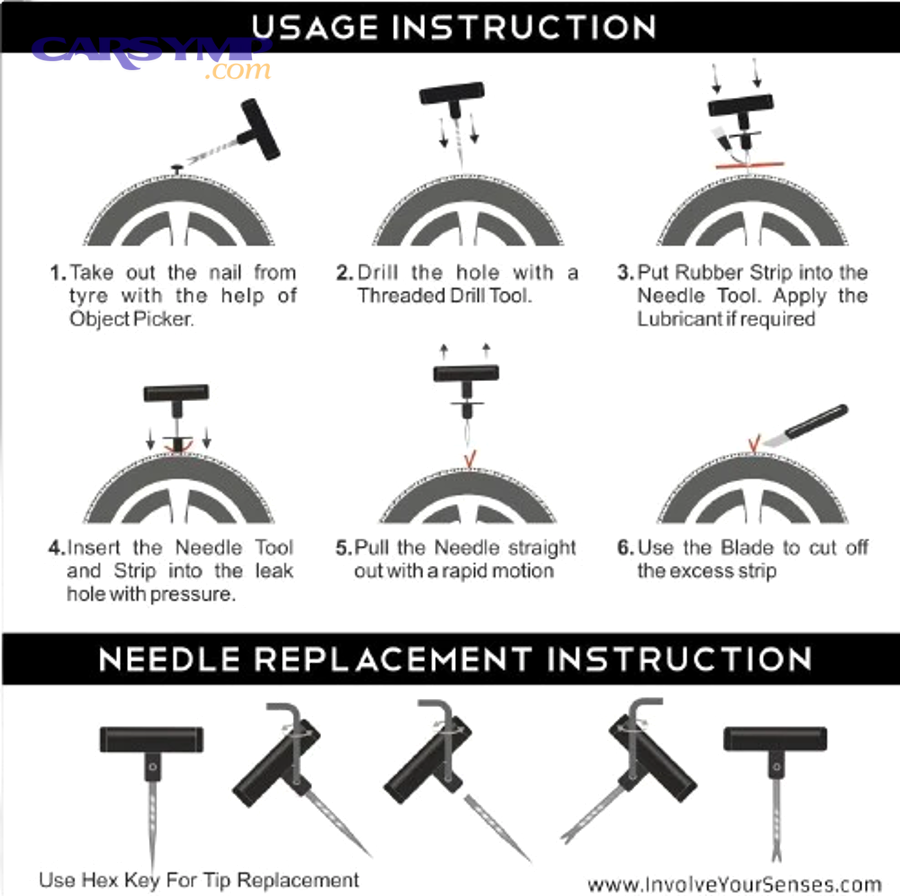
This is the step where a DIY puncture repair kit safety and limits become most apparent. Consumer plug kits do not require demounting, do not use vulcanizing cement on a prepared surface, and do not include the inner liner patch component. They fill the hole temporarily but do not replicate the chemical bonding and dual-seal integrity of a professional installation.
Step 4 — How Is the Patch Applied to the Inner Liner?
With the stem already seated, the patch portion of the combination unit is pressed firmly against the buffed and cemented inner liner surface, then stitched outward from the center using a specialized tire stitcher tool.
- The stitching process applies firm, progressive pressure from the center of the patch outward to all edges, expelling any air trapped beneath the repair unit
- Proper stitching requires significant hand and tool pressure — a loosely stitched patch will develop air pockets that cause the repair to lift over time
- Once stitching is complete, a thin layer of rubber sealant is applied over the buffed area surrounding the patch edges, sealing the transition between the repair unit and the native inner liner
- For injuries penetrating at an angle greater than 35 degrees, a two-piece repair system is used instead of a one-piece unit; the two-piece method provides independent control of the stem and patch angles, which is necessary when the injury channel direction and the inner liner plane are significantly misaligned
According to TECH International’s Puncture Repair Training Guide, the maximum recommended injury angle for a one-piece repair unit is 35 degrees; beyond this threshold, a two-piece repair is mandatory to ensure full sealing of the injury channel at its actual penetration angle.
Step 5 — How Is the Tire Remounted, Inflated, and Checked?
Once the repair is complete, the tire is remounted on the rim, inflated to the vehicle manufacturer’s specified pressure, and checked thoroughly for air leakage before being returned to service.
- The tire bead is seated on the rim using a controlled burst of air through a tire mounting machine
- The tire is inflated to the correct pressure as specified on the vehicle’s door placard or owner’s manual — not the maximum pressure listed on the tire sidewall
- A leak check is performed by applying soapy water or a commercial leak detection solution around the patch area on the inner liner and along the bead seating surfaces
- Any bubbling indicates a leak; if detected, the tire must be demounted again for a full re-inspection before the vehicle is returned to the driver
- The repaired tire is then balanced, remounted on the vehicle, and torqued to the manufacturer’s lug nut specification
This final stage also presents a key moment for TPMS considerations after puncture repair. If the vehicle is equipped with a Tire Pressure Monitoring System, the sensor in the affected wheel may need to be relearned or reset after the tire is remounted and inflated. Some TPMS sensors are located on the valve stem and may be disturbed during demounting; a qualified shop will verify TPMS function before releasing the vehicle. According to Sullivan Tire and Auto Service’s repair protocol, the full tire puncture repair process — when performed correctly — takes between 60 and 90 minutes.
Is a Punctured Tire Always Repairable at a Shop?
No — a punctured tire is not always repairable at a shop, because repairability depends on three strict criteria: the location of the injury, the size of the puncture, and the structural condition of the tire at the time of inspection.
This is one of the most misunderstood aspects of tire puncture repair. Many drivers assume that because the tire holds air after a roadside plug, a shop can simply make the fix permanent. In reality, a tire that has been driven on while flat, punctured near the sidewall, or damaged beyond the tread crown area may be structurally compromised in ways that cannot be safely addressed by any repair method.
What Are the Conditions That Make a Tire Puncture Repairable?
A tire puncture is repairable when the injury is located within the repairable crown area, measures no more than ¼ inch in diameter for passenger tires, and shows no evidence of structural damage during interior inspection.
The following table outlines the key repairability criteria that professional shops apply when evaluating a punctured tire:
| Criterion | Repairable | Not Repairable |
|---|---|---|
| Puncture location | Central tread crown (≥½ inch from shoulder) | Sidewall, shoulder, or near belt edge |
| Puncture diameter | ≤¼ inch (passenger); ≤3/8 inch (light truck) | Larger than maximum repair size |
| Prior repairs | No overlapping or adjacent repairs | Existing repair in the same area |
| Tire condition | Sufficient tread, no visible cord damage | Run flat damage, separation, or exposed cords |
| Injury angle | ≤35 degrees (one-piece); adjustable with two-piece | Excessive angle without proper two-piece unit |
The table above provides a clear reference for evaluating whether a puncture falls within repairable limits. The most critical factor is location: the crown area is defined as the center of the tread, generally at least ½ inch inward from each shoulder groove. Punctures within this zone — and within the size and condition limits above — can be permanently repaired using the plug-patch combination method described in the steps above.
- Tread depth must be at or above 2/32 inch in any two adjacent tread grooves; below this threshold, the tire is not legal for highway use in the United States regardless of repair quality
- Repairs must never overlap; if a second puncture occurs within the same repair zone as an existing patch, the tire must be replaced
- The tire must not show any evidence of having been operated in an underinflated or flat condition, as this stresses the internal cords and sidewall structure in ways that make the tire unsafe even after a visible puncture is repaired
When Will a Shop Refuse to Repair a Punctured Tire?
A shop will refuse to repair a punctured tire when the damage falls outside the repairable zone, when the tire shows internal structural damage, when the puncture is too large, or when the tire has already been driven on flat.
- Sidewall or shoulder punctures: The sidewall flexes continuously during driving; a repair in this area cannot withstand the repeated stress and will fail. No reputable shop will attempt a sidewall repair under any circumstance
- Run-flat damage: A tire operated while flat generates extreme heat and stress that damages the internal body plies and inner liner in ways that are not always visible but are structurally catastrophic; such tires must be replaced
- Cord or belt exposure: If the puncturing object damaged the steel belts or textile body cords, the structural integrity of the tire is compromised and repair will not restore it
- Existing improper repair: If the tire already has a plug-only repair or an outside-in repair that does not meet standards, the tire must be scrapped — it cannot be upgraded to a proper repair after the fact
- Tread separation or internal bubbling: Any evidence of delamination, tread separation, or sidewall bubbling indicates structural failure that makes the tire dangerous regardless of the visible puncture
According to the U.S. Tire Manufacturers Association’s tire repair guidelines, a tire with damage in the shoulder or sidewall area, or one that has been run underinflated to the point of internal damage, must be removed from service and replaced — no exceptions.
How Much Does Tire Puncture Repair Cost at a Shop?
Tire puncture repair at a shop costs between $20 and $50 per tire on average, with the total depending on the tire type, geographic location, severity of the injury, and whether a tire protection plan is in place.
Understanding the cost structure of professional tire repair helps drivers avoid two common mistakes: paying too much at a premium shop for a straightforward nail puncture, and accepting a suspiciously cheap fix that bypasses the proper demount-and-inspect process. A legitimate shop-quality repair includes labor, materials, remounting, and inflation — all of which contribute to the final price.
What Is the Average Cost of a Tire Puncture Repair at a Shop?
The average cost of a professional tire puncture repair ranges from $20 to $50 per tire, with price variation driven by the shop’s labor rate, local market, and whether additional services like rebalancing are included.
- Budget and chain shops (Walmart Auto, Discount Tire, Firestone): Repairs often fall in the $15–$25 range; some locations offer free repairs for tires purchased at that location
- Independent tire dealers: Typically charge $25–$40, with price reflecting labor quality and parts used
- Dealership service centers: Generally the most expensive option, ranging from $35–$60, as labor rates are higher across all services
- Free repairs: Many shops offer complimentary puncture repair to customers who purchased their tires there; programs like Discount Tire’s Certificate or Sullivan Tire’s Tire Maintenance and Protection Plan cover flat repairs at no additional charge
- Cost of replacement vs. repair: A new passenger tire typically costs $80–$150 or more; a $25 repair that extends the remaining life of a tire in good condition represents significant value for the driver
It is worth noting that shops are not required to repair every eligible tire — they may recommend replacement for tires that are near the end of their service life even if the puncture itself is technically repairable. A good shop will show you the tread depth reading and explain the recommendation before proceeding.
How Long Does Tire Puncture Repair Take at a Shop?
A proper tire puncture repair takes 60 to 90 minutes at a shop when performed correctly, with actual duration varying based on shop workload, the severity of the injury, and any additional factors discovered during inspection.
- Straightforward nail puncture in a low-traffic shop: As little as 45–60 minutes from check-in to vehicle return
- Multiple punctures or ambiguous damage requiring extended inspection: 90 minutes or more, particularly if the technician discovers inner liner damage that was not apparent from the exterior
- High-volume shops during peak hours: Wait times can extend the total visit to 2–3 hours even if the repair itself takes under an hour
- Factors that extend repair time: Run-flat tires requiring specialized tools, TPMS sensor complications, large-diameter rims with low-profile tires that are harder to demount without damage, or the discovery during inspection that the tire must be replaced rather than repaired
Many shops offer courtesy shuttles or waiting areas with Wi-Fi for customers dropping off vehicles during a repair. If time is a constraint, calling ahead to confirm current wait times and scheduling an appointment can significantly reduce total visit duration.
Now that you understand how a shop repairs a tire puncture from start to finish, it’s important to know the boundaries of what can and cannot be safely repaired — and how professional repairs compare to the temporary fixes you might do yourself.
What Are the Situations Where Tire Replacement Is the Only Safe Option?
Tire replacement is the only safe option when the puncture is located in the sidewall or shoulder, when the tire has been driven flat, when structural damage is found during inspection, or when the injury exceeds repairable size limits — and no combination of repair materials can safely restore the tire’s integrity in these cases.
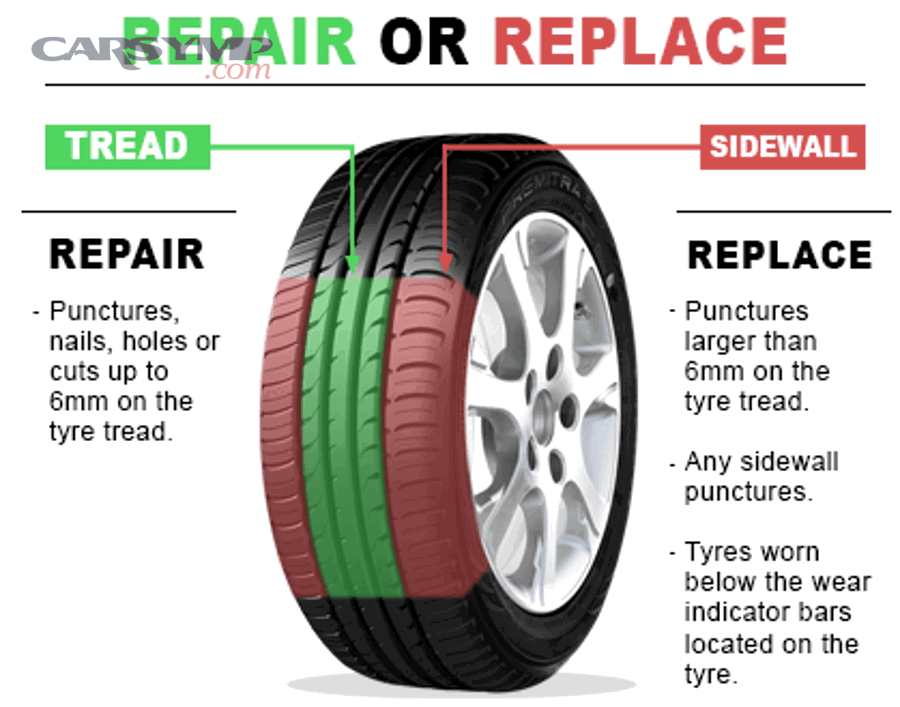
This boundary matters because some drivers arrive at a shop hoping for a repair and leave with a replacement recommendation they didn’t expect. Understanding why replacement is necessary in these cases — rather than viewing it as an upsell — comes down to the physics of how tires fail and the irreversible nature of certain types of damage.
Can a Tire With a Sidewall Puncture Ever Be Repaired at a Shop?
No — a tire with a sidewall puncture cannot be repaired at any shop under any circumstance, because the sidewall flexes thousands of times per mile and no repair material can withstand that repeated stress without failing.
The sidewall of a tire is not a static structure. Every rotation compresses and stretches the sidewall as it bears the weight of the vehicle, absorbs road impacts, and handles cornering forces. A patch or plug applied to this area will eventually separate, and when it does — potentially at highway speed — the consequences are sudden and severe.
- The repairable zone ends at the first major tread groove on each shoulder; anything beyond that, including the shoulder itself, is classified as non-repairable
- A small sidewall puncture from a thin nail may appear minor, but the constant flexing will cause it to widen and the repair to peel away within a relatively short distance of driving
- There is no exception to this rule, regardless of the tire brand, the repair material used, or the driver’s intended use case — sidewall repairs are universally prohibited under USTMA and TIA standards
- If a shop offers to repair a sidewall puncture, that is a significant red flag about the quality of their repair practices overall
How Does a Shop Handle a Run-Flat Tire With a Puncture?
A shop handles a run-flat tire with a puncture by first consulting the tire manufacturer’s specific repair guidelines — and in most cases, the manufacturer requires replacement rather than repair, because run-flat tires are structurally altered by being driven in a deflated state.
Run-flat tires are engineered with reinforced sidewalls that allow the vehicle to continue traveling at reduced speed (typically up to 50 mph for up to 50 miles) after a complete loss of air pressure. However, this reinforced structure is permanently stressed when the tire is operated without air, and that stress may not be visible during standard inspection.
- Most run-flat tire manufacturers explicitly state that their tires should not be repaired after they have been driven in a zero-pressure condition
- Even if the puncture itself falls within the repairable crown zone, the internal structure of the run-flat sidewall may be damaged in ways that standard inspection cannot fully detect
- Shops must contact the tire manufacturer or review the specific model’s repair policy before proceeding; attempting a standard patch-plug repair on a run-flat without this verification is a liability and safety risk
- Because run-flat tires are significantly more expensive than standard tires, some drivers push back on replacement recommendations — but the structural integrity argument is legitimate and supported by manufacturer documentation
What Is the Difference Between a Shop Repair and a DIY Roadside Plug Kit?
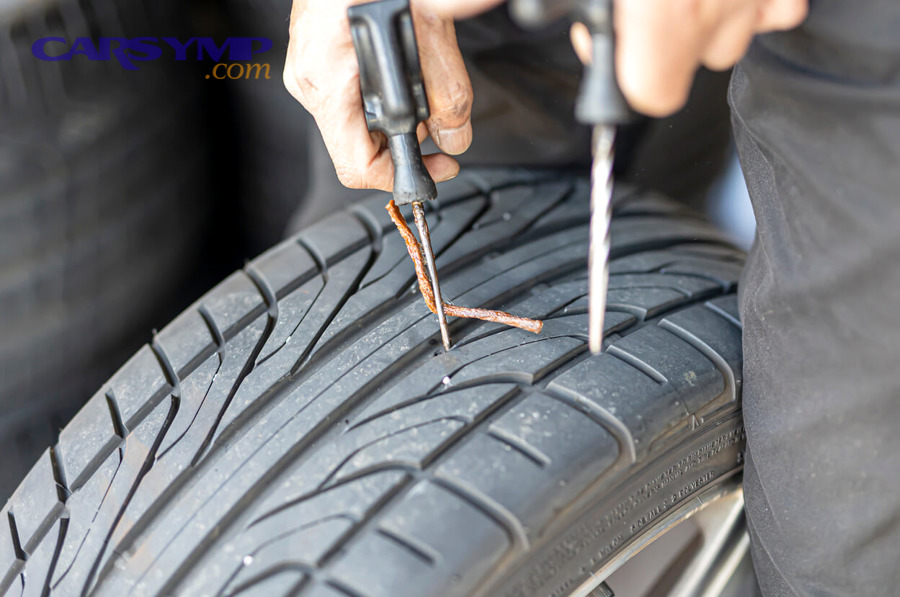
A shop repair permanently restores the tire using a demounted, internally inspected, vulcanized plug-patch combination, while a DIY roadside plug kit provides a temporary emergency seal inserted from the outside without removing the tire, inspecting the interior, or bonding the repair chemically.
The DIY puncture repair kit safety and limits are well-defined by the industry: a roadside plug is designed exclusively to get a driver to the nearest shop, not to serve as a finished repair. The distinction matters because many drivers mistake a plug that holds air for a plug that is safe long-term.
| Feature | Shop Repair (Plug-Patch Combo) | DIY Roadside Plug Kit |
|---|---|---|
| Tire demounted? | Yes | No |
| Interior inspected? | Yes | No |
| Inner liner sealed? | Yes | No |
| Vulcanizing bond? | Yes | No |
| Permanent? | Yes | No |
| Safe for highway use? | Yes | No (temporary only) |
| Industry approved? | Yes (USTMA/TIA) | Emergency use only |
As shown in the table above, the differences between these two repair approaches are substantial across every dimension that matters for long-term safety. A DIY plug may hold pressure for days, weeks, or even months — but it is not bonded to the tire, does not seal the inner liner, and cannot be verified for proper seating without demounting the tire. Drivers should treat a roadside plug kit as a bridge to a proper repair, not a substitute for one.
How Do Shops Handle Tires That Were Previously Filled With Puncture Sealant?
Shops handle sealant-filled tires by first consulting the tire manufacturer or sealant manufacturer before attempting any repair, because liquid sealant compounds can contaminate repair tools, compromise bonding surfaces, and obscure internal damage that would otherwise be visible during inspection.
Aerosol and liquid puncture sealants — such as those dispensed from cans like Fix-a-Flat — are a common emergency measure, but they create complications for the professional repair process that many drivers are unaware of.
- The sealant coats the inner liner surface, interfering with the buffing step and potentially preventing the vulcanizing cement from bonding properly to the tire rubber
- Sealant residue can contaminate buffing wheels, stitching tools, and work surfaces, requiring additional cleaning steps before any repair can proceed
- Some sealant formulations are corrosive to the steel belts and internal cord structure of the tire; if a sealant has been sitting in a tire for an extended period, internal deterioration may have occurred
- Shops that discover sealant in a tire will typically charge a cleaning fee before beginning any repair evaluation, and may decline the repair entirely if the sealant has caused visible contamination or damage to the inner liner
- Drivers who have used a sealant in their tire should inform the shop before check-in so the technician can plan accordingly and avoid cross-contaminating shop equipment
According to guidance from TECH International’s repair training materials, tires containing puncture sealants must be evaluated in consultation with both the tire manufacturer and the sealant manufacturer before any standard repair procedure is applied — the sealant’s presence fundamentally changes the repair assessment process.