


Choosing the right tire is one of the most consequential decisions a driver makes — and the answer is never one-size-fits-all. All-season, performance, and winter tires each serve a distinct purpose, engineered for different temperatures, road surfaces, and driving demands. Getting this decision wrong does not just affect how your car feels — it directly affects how quickly it stops, how well it corners, and whether it keeps you safe when conditions turn dangerous. Understanding the core differences between these three tire types gives every driver the foundation to make a confident, informed choice.
The comparison between all-season, performance, and winter tires comes down to three fundamental variables: tread compound, tread pattern, and the temperature range each tire is built to handle. All-season tires use a moderately firm rubber compound designed to stay functional across a broad range of conditions. Performance tires use a softer, stickier compound optimized for warm road surfaces. Winter tires use a specially formulated rubber that stays pliable in sub-freezing temperatures — a property that all-season and performance tires simply cannot replicate once the thermometer drops below 45°F.
Beyond compound and pattern, the decision depends heavily on where you live and how you drive. A driver commuting through Minnesota winters has radically different needs than a sports car enthusiast in Southern California. Climate zone, annual snowfall, typical low temperatures, and driving style all shape which tire category delivers the best combination of safety, performance, and value. Tread life, rolling resistance, and tire replacement cost also factor into the long-term equation — making this a financial decision as much as a technical one.
What many drivers overlook is that tire selection also varies by vehicle type. An all-wheel-drive SUV, a front-wheel-drive commuter sedan, and a rear-wheel-drive sports car each interact with tire compounds and tread patterns differently. Moreover, emerging vehicle categories — particularly electric vehicles — introduce additional load and torque demands that standard tire categories were not always designed to accommodate. Next, this guide walks through every dimension of the all-season vs. performance vs. winter tire decision, from definitions and comparisons to practical buying guidance, so you can choose with complete confidence.
What Are All-Season, Performance, and Winter Tires?
There are three main tire categories used by passenger vehicle drivers — all-season, performance, and winter — each defined by its tread compound formulation, tread architecture, and the temperature and road conditions for which it was engineered.
To better understand how these tires differ at a foundational level, it helps to examine each type on its own terms before placing them in direct comparison.
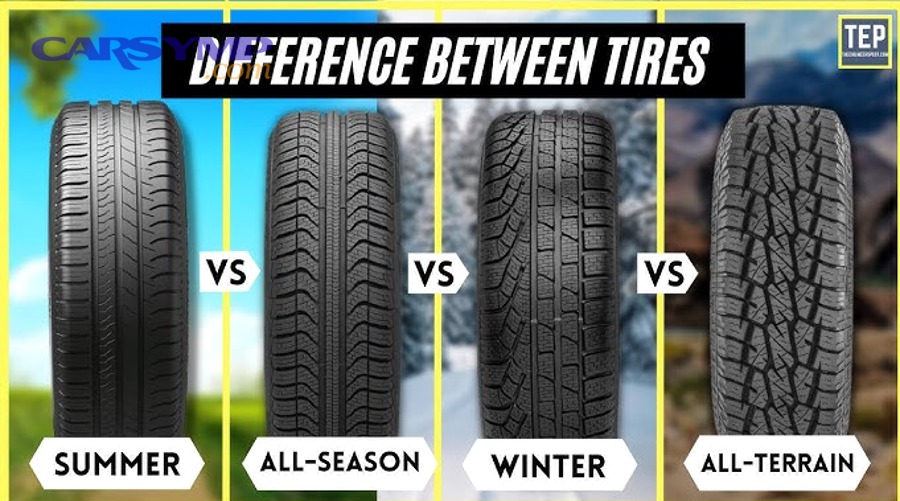
What Is an All-Season Tire and What Is It Designed to Do?
An all-season tire is a year-round passenger tire engineered to deliver balanced performance across dry roads, wet pavement, and light snow conditions in moderate climates. It represents the most widely fitted tire type in North America, favored by drivers who prioritize convenience and want a single set that covers most everyday situations without seasonal swaps.
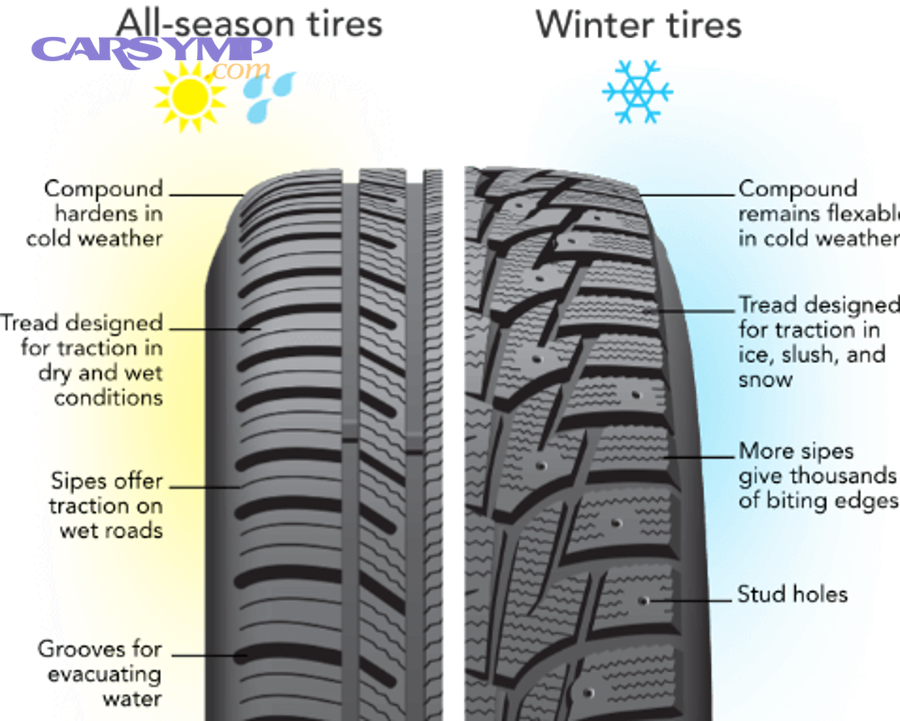
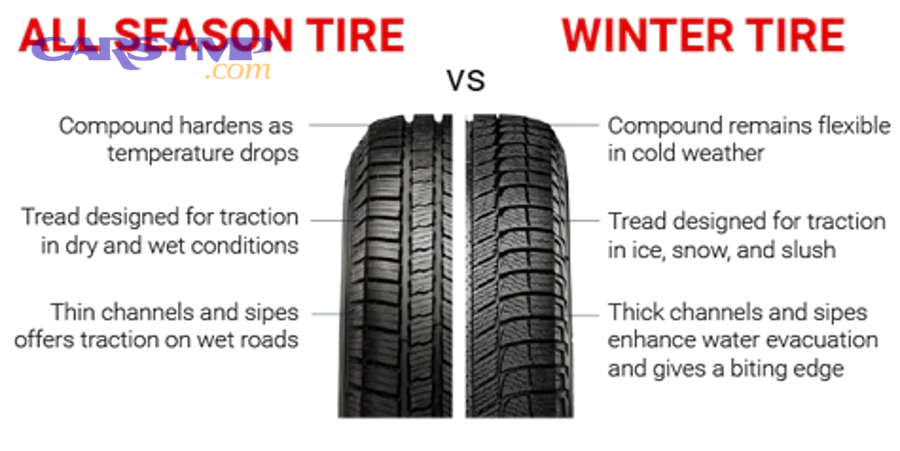
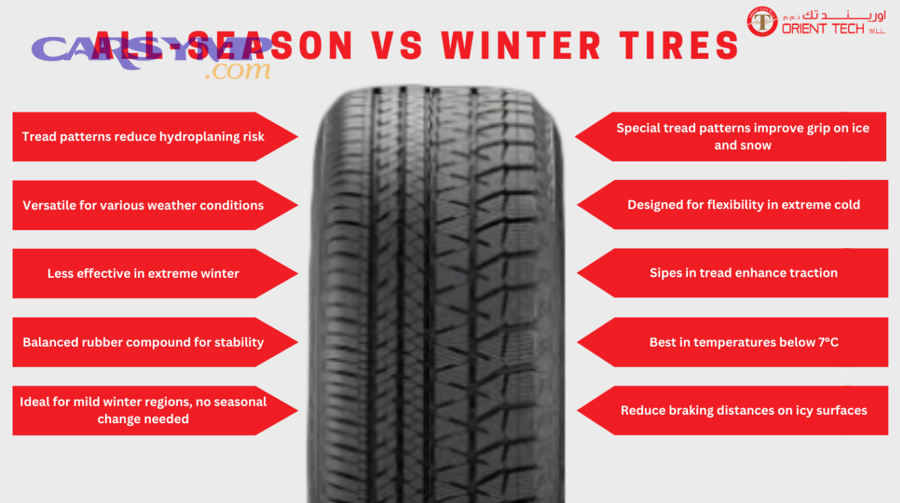
Specifically, all-season tires are built with a rubber compound that strikes a middle ground between the soft warmth-optimized compound of a performance tire and the cold-flexible compound of a winter tire. This compromise allows the tire to remain functional in a wide range of temperatures — but it means the tire does not excel at either extreme. The tread pattern typically features symmetrical or asymmetrical grooves designed to channel water away from the contact patch, reducing hydroplaning risk on wet roads while maintaining reasonable dry grip.
All-season tires carry the M+S (Mud and Snow) rating on their sidewalls, which indicates they meet a minimum threshold for traction in muddy and light snowy conditions. However, the M+S rating is not a winter certification — it does not guarantee performance in severe cold, heavy snow accumulation, or icy surfaces. Drivers often confuse M+S with winter readiness, and that misunderstanding can be dangerous. For truly wintry conditions, only the Three-Peak Mountain Snowflake (3PMSF) symbol — absent on standard all-season tires — indicates a tire has passed rigorous cold-weather traction testing.
From a tread life and tire replacement cost perspective, all-season tires are the most economical long-term choice. Many all-season models carry treadwear warranties of 60,000 to 80,000 miles, and because they do not require seasonal swapping, they reduce labor and storage costs over time.
What Is a Performance Tire and How Is It Different from a Standard Tire?
A performance tire — also called a summer tire — is a high-grip, warm-weather tire engineered for precise handling, rapid braking, and responsive cornering on dry and wet road surfaces in temperatures consistently above 44°F. It is the tire of choice for sports cars, performance sedans, and enthusiast drivers who prioritize dynamic driving feel over year-round versatility.
More specifically, performance tires achieve their handling advantage through a softer, stickier rubber compound that maximizes the size and quality of the contact patch between the tire and road. The tread pattern uses shallower, straighter grooves with continuous ribs running around the tire’s circumference — a design that keeps more rubber in constant contact with the road surface. This architecture dramatically improves cornering stability and braking response at speed, but it also accelerates tread wear relative to all-season tires.
Performance tires carry speed ratings — typically H (130 mph), V (149 mph), W (168 mph), or Y (186 mph) — which indicate the maximum sustained speed the tire is certified to handle safely. These ratings are not just marketing figures; they reflect the tire’s structural and compound engineering. The higher the speed rating, the more the compound is optimized for heat dissipation and high-load cornering.
The critical limitation of performance tires is temperature. When ambient temperatures drop below 44°F, the rubber compound in a performance tire begins to stiffen, reducing its ability to conform to road surface irregularities. This stiffening increases braking distances significantly and reduces lateral grip on both dry and wet cold roads. Using performance tires in winter conditions is not merely suboptimal — it is a safety hazard. Drivers in climates with true winters who rely on performance tires year-round should plan for either a dedicated winter tire set or an all-season swap.
What Is a Winter Tire and Why Is It Not Just a Snow Tire?
A winter tire is a cold-weather-specific tire engineered to maintain grip, handling, and braking performance in temperatures below 45°F, on road surfaces that include dry pavement, wet roads, slush, packed snow, and ice. The label “snow tire” is a common misnomer — winter tires are designed for cold temperatures first, and snow and ice performance is a downstream benefit of that cold-weather engineering.
The defining characteristic of a winter tire is its rubber compound. Winter tires use a hydrophilic tread compound that remains soft and pliable at sub-freezing temperatures. This elasticity allows the tread blocks to flex and conform to road surface textures even on ice, creating the micro-biting action needed for traction. An all-season or performance tire in the same conditions would have a stiffer compound that rides over surface irregularities rather than gripping them.
Winter tires also feature significantly deeper tread depths, dense sipe networks (small lateral cuts across tread blocks that act as biting edges), and tread voids designed to evacuate slush and snow from the contact patch. The combination of these features is what earns a winter tire the Three-Peak Mountain Snowflake (3PMSF) certification — the only industry-recognized symbol that confirms a tire has met standardized snow traction performance thresholds.
Within the winter tire category, two subtypes exist: studless and studded. Studless winter tires rely entirely on compound and sipe technology for ice traction and are legal in all North American jurisdictions. Studded winter tires embed small metal pins into the tread for additional ice grip but are restricted or prohibited in many U.S. states due to road surface damage. According to testing conducted by Consumer Reports, winter tires consistently outperform all-season tires on ice and packed snow by meaningful margins in both stopping distance and lateral traction — performance gaps that widen as temperatures fall further below freezing.
How Do All-Season, Performance, and Winter Tires Compare?
Performance tires lead in dry and warm-wet conditions, winter tires are unmatched in cold and snowy environments, and all-season tires deliver the most balanced middle-ground performance across moderate year-round conditions.
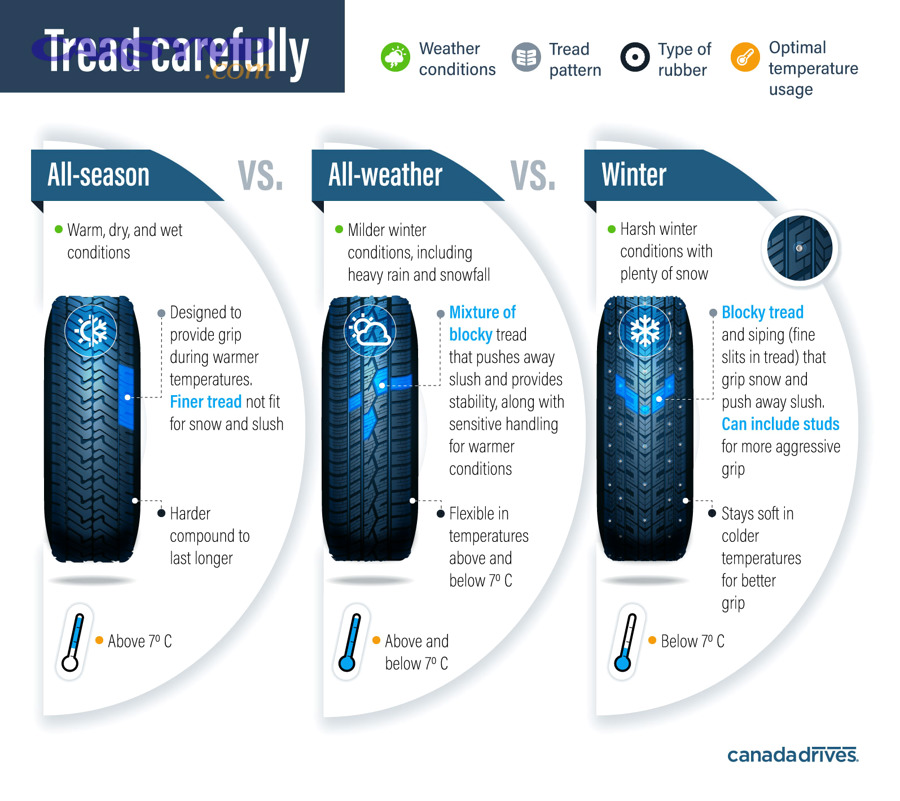
However, understanding where each tire type wins and loses across specific performance dimensions — rather than just climate — helps drivers make more precise choices. The following comparisons cover the three most decision-relevant criteria: dry/wet performance, snow and ice performance, and long-term value.
How Do the Three Tire Types Perform in Dry and Wet Conditions?
Performance tires deliver superior dry and warm-wet grip compared to both all-season and winter tires, followed by all-season tires in second place, with winter tires trailing significantly in warm conditions.
Specifically, the soft compound and continuous-rib tread design of performance tires maximize the rubber-to-road contact patch, which directly translates into shorter stopping distances and higher lateral cornering limits. On dry pavement at highway speeds, the gap between a performance tire and an all-season tire in braking distance can be substantial — particularly in emergency stop scenarios. On wet roads in warm temperatures, performance tires also excel due to wide circumferential grooves that efficiently evacuate water.
All-season tires, by contrast, offer respectable wet braking and adequate dry grip for the vast majority of everyday driving situations. Their tread patterns include both longitudinal grooves for water evacuation and lateral grooves for multi-directional traction, creating a versatile but not exceptional wet performance profile.
Winter tires, when used in warm conditions, suffer from accelerated tread wear and reduced dry handling precision. The soft compound that provides cold-weather flexibility becomes overly pliable in heat, causing the tread blocks to squirm under braking and cornering loads. This squirm increases stopping distances on dry warm roads and reduces handling sharpness — which is why running winter tires year-round is strongly discouraged. Signs of premature wear from warm-weather use also compound tire age concerns, potentially accelerating dry rot signs that compromise structural integrity.
How Do All-Season vs. Winter Tires Compare on Snow and Ice?
Winter tires significantly outperform all-season tires on snow and ice, and performance tires are genuinely unsafe in these conditions at any meaningful speed.
The performance gap between winter and all-season tires on snow and ice is not marginal — it is structural. On ice, a vehicle equipped with all-season tires traveling at 31 mph can take up to 26 more yards to stop than the same vehicle on winter tires, according to data published by Michelin. That is nearly the length of three car lengths of additional stopping distance in a scenario where fractions of a second determine outcomes.
The reason for this gap lies in the compound and sipe differences described above. When temperatures drop below freezing, all-season rubber stiffens to the point where it can no longer generate the micro-deformation needed to bite into ice crystals. Winter tires, by contrast, maintain their elasticity and allow the dense sipe network to act as thousands of small edges gripping the ice surface simultaneously.
On packed snow, winter tires’ deep tread voids also evacuate snow from the contact patch and compact it into the grooves — using snow-on-snow friction to generate traction. All-season tires have shallower voids that fill and pack quickly, reducing their ability to self-clean on deep snow passes. For drivers in regions with regular winter storms, mounting a full set of four winter tires before the season begins is not an over-the-top precaution — it is a safety fundamental.
Which Tire Type Lasts the Longest and Offers the Best Value?
All-season tires provide the longest tread life and lowest total cost of ownership for most drivers, followed by winter tires used seasonally, with performance tires offering the shortest lifespan due to their soft compound design.
The table below summarizes the key value and durability differences across the three tire types:
| Tire Type | Avg. Treadwear (Miles) | Seasonal Swap Required? | Avg. Cost Per Set | Notes |
|---|---|---|---|---|
| All-Season | 60,000–80,000 | No | $400–$800 | Best long-term value for moderate climates |
| Winter | 30,000–40,000* | Yes (spring removal) | $500–$900 | *Per total lifespan; 3–5 seasons if stored properly |
| Performance | 20,000–40,000 | Yes (in cold climates) | $600–$1,200 | Shortest lifespan; higher tire replacement cost |
This table reflects general industry ranges and will vary by brand, vehicle load rating, and driving habits. When calculating total tire replacement cost, drivers should factor in not just the sticker price but also mounting, balancing, and — for winter tires — seasonal storage costs. For all-season tires, the elimination of those additional costs frequently makes them the most economical option across a three-to-five year window, provided the climate does not demand winter-specific grip.
Performance tires also tend to show the earliest Tire age and dry rot signs if stored improperly between seasons, as the softer compound is more susceptible to ozone and UV degradation during off-season storage. According to industry guidance from the Tire Industry Association, all tires regardless of type should be inspected for cracking, sidewall bulging, and tread depth before each season of use, with most tires recommended for replacement within six to ten years of manufacture date regardless of visible wear.
What Factors Should You Consider When Choosing a Tire Type?
There are three primary factors every driver should evaluate when choosing between all-season, performance, and winter tires: climate and temperature range, personal driving style and vehicle use, and vehicle type and manufacturer specifications.
These factors do not operate in isolation — together, they form a decision matrix that points toward the most appropriate tire type for any individual situation. To begin, climate is the most non-negotiable factor, as it sets the baseline safety requirement that all other choices must meet.
Does Your Climate Determine Which Tire Type You Need?
Yes — climate is the single most critical factor in tire selection, because temperature directly governs which rubber compound can safely perform in your driving environment.
Specifically, the 45°F threshold is the most important number in tire selection. Below this temperature, all-season and performance tire compounds begin to stiffen noticeably, reducing grip and extending braking distances. This means that even in the absence of snow or ice, a driver in a region where temperatures regularly drop into the 30s should be on winter tires — not because of snow risk, but because of compound behavior in cold air.
The following climate-to-tire mapping provides a practical framework:
- Mild climate (rarely below 45°F, occasional rain, no snow): All-season or performance tires are appropriate. Dedicated winter tires are unnecessary.
- Four-season climate (temperatures regularly cross 45°F, some snow, occasional ice): All-season tires handle mild winters adequately. For heavier snow seasons, a winter tire set is the safer choice.
- Severe winter climate (persistent sub-freezing temperatures, regular snow and ice): Dedicated winter tires are essential from late fall through early spring. All-season tires carry measurable safety risk in these conditions.
Drivers in transition climates — where winters are unpredictable from year to year — may benefit from all-weather tires (discussed in the supplementary section), which carry the 3PMSF certification while remaining usable year-round without performance penalties in warm conditions.
Does Your Driving Style Affect Which Tire Is Right for You?
Yes — driving style directly affects both which tire type performs best for you and how quickly any given tire wears out under your specific usage patterns.
More specifically, a driver who logs 30,000 miles per year on highways at consistent speeds has fundamentally different tire demands than a driver who covers 8,000 miles of mixed urban commuting. High-mileage highway drivers benefit most from all-season tires’ long tread life and fuel-efficient rolling resistance. Spirited drivers who corner aggressively and brake hard derive a genuine safety and handling benefit from performance tires — their cars are engineered to exploit the added grip, and the tires respond accordingly.
Weekend drivers who use a performance-oriented vehicle primarily in warm months and park it in winter months are ideal candidates for performance tires — with a dedicated winter set for any cold-weather driving, or simply avoiding cold-weather driving altogether. Daily commuters in northern regions who need a single dependable tire for year-round use should gravitate toward all-season tires or consider a two-set strategy: all-season for spring through fall, winter tires from November through March.
Driving style also interacts directly with tire replacement cost timing. Aggressive acceleration, hard cornering, and frequent emergency braking all accelerate tread wear — and these habits have a proportionally larger impact on performance tires (due to their softer compound) than on all-season tires. Drivers who know they push their tires hard should weight the cost-per-mile calculation heavily when choosing a tire category.
Which Tire Type Is Best for Your Vehicle?
The best tire type varies by vehicle category: sports cars benefit most from performance tires in warm climates, SUVs and family sedans suit all-season tires for year-round use, and all vehicles benefit from winter tires in severe cold regardless of drivetrain configuration.
A common misconception is that all-wheel drive (AWD) or four-wheel drive (4WD) vehicles do not need winter tires. This is factually incorrect. AWD improves power distribution to all four wheels during acceleration, helping the vehicle get moving in snow. However, it does nothing to improve braking performance or lateral grip — both of which are governed entirely by the tire compound and tread in contact with the road. An AWD SUV on all-season tires will stop in the same distance on ice as a front-wheel-drive sedan on the same tires.
Your vehicle’s tire specifications — load index, speed rating, and recommended tire size — are printed on the door jamb placard and in the owner’s manual. These specifications must be matched or exceeded by any replacement tire. Deviating from the manufacturer’s recommended specifications can affect speedometer accuracy, suspension geometry, and safety system calibration — particularly on modern vehicles with advanced stability and traction control systems that are programmed around specific tire dimensions and load characteristics.
Which Tire Type Should You Choose for Your Situation?
The right tire type depends on matching your climate, driving habits, and vehicle requirements: all-season for mild year-round use, winter tires for cold and snowy regions, and performance tires for warm-climate enthusiast drivers.
Rather than declaring one tire type universally superior, the most useful answer is a decision framework built around three distinct driver profiles — each corresponding to a clear, evidence-supported recommendation.
Should You Choose All-Season Tires If You Live in a Mild Climate?
Yes — all-season tires are the right choice for drivers in mild to moderately variable climates where winter temperatures rarely remain below 45°F and snowfall is infrequent or light.
For the vast majority of North American drivers — particularly those in the southern United States, Pacific Coast, and other temperate regions — all-season tires deliver exactly what everyday driving demands: consistent wet traction during spring and fall rain, adequate dry grip for normal highway and urban speeds, and enough cold-weather capability to handle the occasional cold snap or light dusting of snow.
The long tread life of all-season tires makes them especially cost-effective. A quality all-season tire with a 70,000-mile treadwear warranty, mounted on a typical commuter sedan, can last five to seven years under normal use — reducing the frequency of tire replacement and spreading the per-mile cost across a substantial service life. Drivers who monitor tire age and dry rot signs annually and maintain proper inflation can maximize this lifespan. The key limitations to remember are that all-season tires will not provide the cornering sharpness of performance tires or the cold-grip capability of winter tires — and in the right climate, neither of those limitations matters.
Should You Choose Winter Tires If You Drive in Snow and Ice?
Yes — winter tires are essential for drivers in any region where temperatures consistently drop below 45°F, regardless of whether those conditions involve snow, slush, or simply cold dry pavement.
The word “essential” is not an exaggeration. The braking distance difference between winter and all-season tires at 31 mph on ice — documented at up to 26 additional yards by Michelin’s internal testing — represents a real-world stopping gap that can determine whether a vehicle stops safely before an intersection or slides through it. For drivers who commute daily through Minnesota, Quebec, the Rocky Mountain corridor, or similar severe-winter regions, this margin is a safety fundamental, not an optional upgrade.
Maximizing the value of a winter tire investment requires proper seasonal management. Winter tires should be mounted as a complete set of four — mixing tire types on the same axle or across axles creates uneven traction distribution that can cause unpredictable handling, particularly during emergency maneuvers. When spring arrives and temperatures reliably exceed 45°F, winter tires should be removed, cleaned, and stored in a cool, dry environment away from UV exposure and ozone sources such as electric motors. Properly stored winter tires typically deliver three to five full seasons of use before tread depth or rubber degradation warrants tire replacement — making the annual swap a sound long-term investment when spread over that service window.
Should You Choose Performance Tires If You Prioritize Handling and Speed?
Yes — performance tires are the right choice for drivers who prioritize handling precision and grip in warm, temperate climates and either do not face winter conditions or maintain a separate winter tire set for cold months.
Performance tires deliver a genuinely different driving experience. The combination of a soft, high-grip compound and a tread architecture designed to maximize road contact transforms how a car communicates through the steering wheel, responds to throttle inputs, and behaves at the limits of cornering. For sports cars, performance coupes, and enthusiast sedans whose suspension geometry and chassis tuning are calibrated around a high-grip contact patch, fitting anything less than a performance tire means leaving the vehicle’s engineering potential unrealized.
The practical requirement is simple: performance tires demand a warm-weather operating environment. Drivers in regions with genuine winters who want performance tires need to commit to a two-set strategy — performance tires for spring through fall, and a dedicated winter tire set from November through March. This adds cost through both the second set purchase and seasonal mounting fees, but it also effectively doubles the lifespan of both sets, since each is only being used during its optimal season. It also produces a better safety and driving experience in both seasons than any single compromise tire type can achieve. The higher tire replacement cost of a quality performance tire is offset by the performance dividend it delivers throughout its service life.
What Else Should Drivers Know Before Buying New Tires?
Beyond the three main tire categories, there are four additional layers of knowledge that help drivers make the most complete and informed tire purchase decision: understanding tire ratings and certifications, knowing legal winter tire requirements in their region, recognizing how electric vehicles and AWD systems affect tire selection, and understanding the emerging all-weather category that sits between all-season and dedicated winter tires.
What Do Tire Ratings and Certifications Actually Mean?
Tire ratings and certifications are standardized systems that communicate a tire’s tested performance capabilities across temperature resistance, traction, tread life, and speed handling — and understanding them prevents costly mismatches between tire capability and driving demand.
The UTQG (Uniform Tire Quality Grading) system, mandated by the U.S. Department of Transportation, grades every passenger tire on three dimensions: treadwear (a comparative index where 100 is the baseline — a tire rated 400 lasts roughly four times as long), traction (AA, A, B, or C — reflecting wet stopping performance), and temperature (A, B, or C — reflecting the tire’s ability to dissipate heat at sustained speed). These three numbers and letters are molded directly into the tire sidewall and give buyers an objective point of comparison across brands and models.
Speed ratings — expressed as letters like H, V, W, or Y — indicate the maximum sustained speed the tire is certified to handle. Critically, fitting a tire with a lower speed rating than the vehicle manufacturer specifies can void certain insurance coverages and compromise handling at high speeds. Fitting a higher speed rating than specified is generally permissible and sometimes beneficial.
The 3PMSF (Three-Peak Mountain Snowflake) certification is the most important safety certification in cold-weather markets. It indicates that the tire has passed a standardized snow traction test — accelerating on packed snow — and is approved for severe winter service. This symbol is found on winter tires and all-weather tires. It is absent on standard all-season tires, regardless of the M+S marking those tires carry. When considering tire replacement in any region with winter weather, prioritizing a 3PMSF-certified tire over an M+S-only tire represents a meaningful safety upgrade.
Are There Legal Requirements for Winter Tires in Your State or Region?
Yes, in a number of states, provinces, and countries, winter tire requirements are legally enforceable — either as mandatory fitment laws or as mandatory equipment during specific road or weather conditions.
In Canada, British Columbia and Quebec have among the most well-known legal requirements. Quebec mandates that all passenger vehicles be equipped with winter tires bearing the 3PMSF symbol from December 1 through March 15. Failure to comply carries fines and can affect insurance coverage in the event of an accident. British Columbia requires winter tires or chains on designated highways from October 1 through April 30.
In the United States, mandatory winter tire laws are less common at the state level, but chain requirements on mountain passes — in states including California, Colorado, Oregon, and Washington — effectively require either chains or tires with the 3PMSF rating to travel certain routes during winter conditions. These requirements are enforced at chain-up checkpoints and can result in fines or highway closure from vehicles that fail to comply.
In Europe, several countries including Germany, Austria, Slovenia, and the Scandinavian nations have seasonal or situational winter tire requirements. Drivers who travel across European borders in winter months should verify the specific requirements for each country on their route, as regulations vary significantly. Regardless of legal requirements, mounting winter tires in regions where temperatures regularly drop below freezing is a safety practice supported by the overwhelming weight of tire industry research and accident data.
Do Electric Vehicles and AWD Cars Need Different Tires?
Yes — electric vehicles have distinct tire requirements driven by their higher curb weight, instantaneous torque delivery, and regenerative braking characteristics, all of which accelerate wear and demand specific load and compound engineering beyond what standard tire categories typically address.
Electric vehicles are meaningfully heavier than comparable internal combustion vehicles due to battery pack weight. A Tesla Model 3 Long Range, for example, weighs approximately 4,250 lbs compared to roughly 3,300 lbs for a similarly sized gasoline sedan. This additional mass increases the load on all four tires simultaneously, which accelerates tread wear and raises the importance of choosing tires with a load index that matches or exceeds the vehicle’s actual wheel load requirements.
EV-specific tire lines — offered by Michelin (e.Primacy), Continental (EcoContact 6), and Pirelli (Elect), among others — address these demands through reinforced internal construction to handle greater loads, optimized tread compounds that balance low rolling resistance (to preserve battery range) with adequate wet and dry grip, and specific noise-reduction technologies to compensate for the absence of engine noise that makes tire roar more perceptible in EVs.
For AWD vehicles of all powertrain types, the key principle remains unchanged from the broader discussion: AWD improves traction during acceleration but has no effect on braking or cornering grip. A rear-wheel-drive sports car and an AWD crossover on identical all-season tires will stop in approximately the same distance on ice. The AWD system’s ability to distribute power to wheels with traction is valuable during initial movement from a stop in snow — but once the vehicle is moving and a braking event occurs, the tires alone determine stopping performance. This is why tire engineers, safety researchers, and automakers consistently recommend winter tires for any AWD vehicle operated in a climate where temperatures regularly drop below 45°F.
What Is the Difference Between All-Weather Tires and the Three Main Tire Types?
All-weather tires are a distinct fourth category that bridges the gap between all-season and winter tires — carrying the 3PMSF winter certification while remaining suitable for year-round use without the performance penalties that dedicated winter tires suffer in warm conditions.
The critical distinction from all-season tires is that all-weather tires pass the Three-Peak Mountain Snowflake certification standard — meaning they have demonstrated measurable snow traction capability beyond what M+S tires provide. This makes them a legally compliant alternative to dedicated winter tires in jurisdictions like Quebec and British Columbia, which is a significant practical advantage for drivers who do not want to manage two tire sets.
Compared to dedicated winter tires, all-weather tires represent a compromise. In head-to-head testing on ice and packed snow, dedicated winter tires outperform all-weather tires — particularly as temperatures drop well below freezing and road conditions become more severe. All-weather tires are engineered to remain competent in those conditions, but their compound and tread architecture must also perform in summer heat, which prevents them from being fully optimized for cold-weather extremes the way a dedicated winter tire can be.
Where all-weather tires excel is in genuinely unpredictable climates — regions where November might bring a blizzard one year and mild rain the next, where cold snaps are intense but brief, and where the cost and inconvenience of maintaining two complete tire sets is difficult to justify. Brands like Nokian Tyres — which invented the all-weather tire category — Michelin CrossClimate, and Continental AllSeasonContact offer mature, well-tested all-weather options that perform meaningfully better than standard all-season tires in cold conditions while matching them in warm-weather use. For drivers in those transitional climate zones, all-weather tires represent arguably the most balanced single-set solution currently available.