


Reading the sidewall of a tire is one of the most practical skills a car owner can develop. Every tire carries a standardized alphanumeric code that tells you exactly what size it is, how much weight it can safely support, and how fast it is rated to travel. Understanding this code is not a mechanic’s job — it is your first line of defense against unsafe tire choices, premature wear, and blowouts on the highway. Whether you are buying new tires for the first time or simply want to know what the numbers mean, this guide walks you through every marking, from the three-digit width code to the load index number that determines how much your tire can carry.
Beyond decoding the sidewall, choosing the right tire load rating has direct consequences for your vehicle’s safety and performance. The load index is a numerical shorthand — a two- or three-digit code matched to a specific weight in pounds or kilograms. When you replace tires without checking this number against your vehicle’s requirements, you risk running tires that are structurally undersized for the load your car, truck, or SUV actually places on them. This guide includes a full load index reference chart and explains how to calculate your vehicle’s total tire capacity in under a minute.
A second system — the load range — applies specifically to light trucks, towing vehicles, and trailers, and it is frequently confused with the load index. Understanding the difference between these two systems helps you avoid the common mistake of comparing an LT-rated tire to a passenger tire without accounting for the different standards each uses. Together, the load index and load range give a complete picture of a tire’s structural limits under real-world conditions.
Finally, tire size and load ratings do not exist in isolation. They connect directly to inflation pressure, speed ratings, vehicle gross weight, and even the type of tire you select — whether all-season, performance, or winter. Next, this guide covers each of these topics in a logical sequence, starting with the most fundamental question: what does a tire size code actually mean?
What Is a Tire Size Rating and What Do the Numbers on Your Tire Mean?
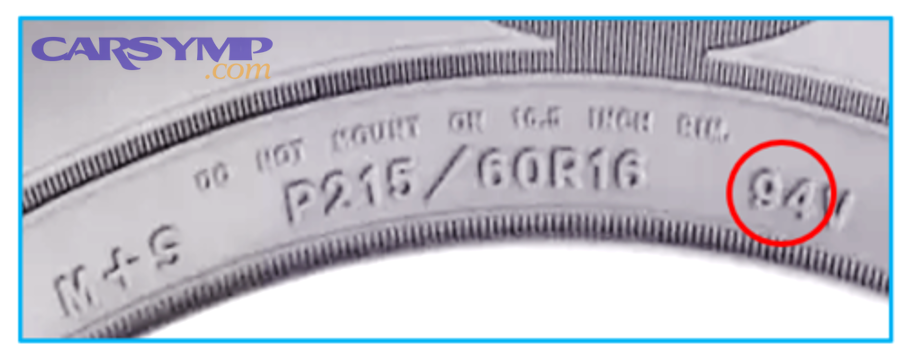
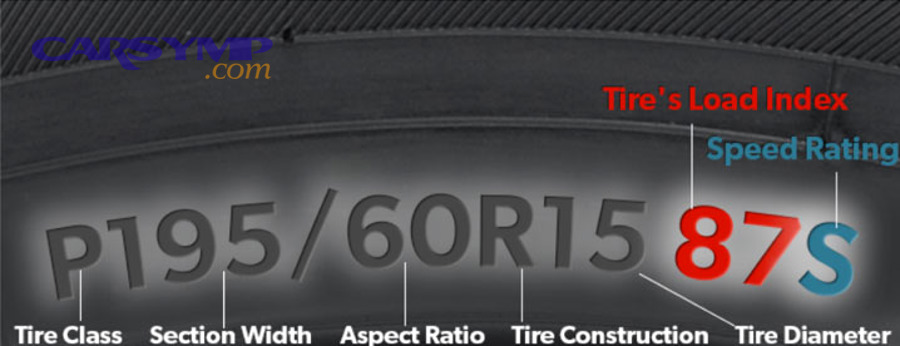
A tire size rating is a standardized alphanumeric code molded into the sidewall that identifies the tire’s type, dimensions, and construction — for example, P225/55R17 describes a passenger tire that is 225mm wide, with a 55% aspect ratio sidewall, on a 17-inch rim.
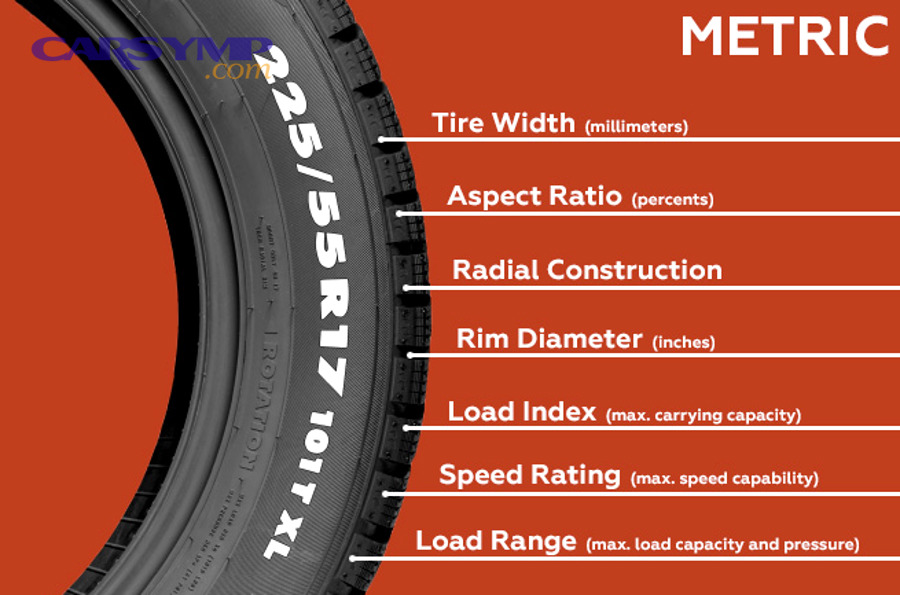
To better understand this, it helps to look at each segment of the code as a separate piece of information. Specifically, the tire size string is not one number but a sequence of values, each occupying a fixed position and communicating a specific dimension or construction attribute. The table below outlines what each part of a standard tire size code means.
| Code Segment | Example Value | What It Means |
|---|---|---|
| Type Prefix | P | Passenger vehicle tire |
| Section Width | 225 | Tire width in millimeters |
| Aspect Ratio | 55 | Sidewall height as % of width |
| Construction | R | Radial construction |
| Rim Diameter | 17 | Wheel diameter in inches |
| Load Index | 97 | Maximum weight capacity code |
| Speed Rating | H | Maximum sustained speed code |
This table shows the full breakdown of a code like P225/55R17 97H, where each value appears in a fixed position and carries a distinct meaning for sizing, load, and speed.
What Does the Letter Before the Tire Size Mean (P, LT, ST)?
The letter prefix at the start of a tire size code identifies the vehicle category the tire was engineered for, and this prefix directly affects the load capacity calculations that follow.
- P (Passenger): Designed for cars, minivans, and light-duty SUVs. Load ratings follow passenger-tire standards set by the Tire and Rim Association.
- LT (Light Truck): Engineered for pickups, heavy-duty SUVs, and towing vehicles. LT tires use stricter load standards and typically require higher inflation pressures than P-metric equivalents.
- ST (Special Trailer): Designed exclusively for trailers. These tires are built for static weight loads and are not engineered for the lateral forces created by steering or acceleration.
- No prefix (Euro-metric): Common on European vehicles. These tires use a slightly different load calculation standard than P-metric tires, which matters when comparing tires across brands.
The prefix matters most during tire replacement. Substituting an LT tire with a P-metric tire of the same size does not deliver equivalent load capacity, because the two systems measure load differently. Always match the prefix to the vehicle’s original equipment specification.
How Do You Read the Three Numbers in a Tire Size Code?
The three core numbers in a tire size code — width, aspect ratio, and rim diameter — work together to describe the physical dimensions of the tire in a precise and internationally standardized format.
- Section Width (e.g., 225): This is the tire’s width in millimeters, measured from sidewall to sidewall when the tire is mounted and inflated on its specified rim width. A wider tire has a larger contact patch with the road, which can improve grip but may also increase rolling resistance.
- Aspect Ratio (e.g., 55): This is the sidewall height expressed as a percentage of the section width. A 55 aspect ratio on a 225mm-wide tire means the sidewall is 123.75mm tall (225 × 0.55). A lower aspect ratio (e.g., 40 or 45) means a shorter, stiffer sidewall, common on performance vehicles. A higher aspect ratio (e.g., 70 or 75) means a taller sidewall, more common on trucks and SUVs designed for comfort or off-road use.
- Rim Diameter (e.g., 17): This is the diameter of the wheel in inches that the tire is designed to fit. This number must match the wheel exactly — a tire rated for a 17-inch rim cannot be mounted on a 16-inch or 18-inch wheel.
To illustrate: a tire marked 225/55R17 is 225mm wide, has a sidewall height of 123.75mm, uses radial construction, and fits a 17-inch rim. Changing any one of these three numbers produces a physically different tire with different handling, speedometer accuracy, and load characteristics.
What Is a Tire Load Rating and Why Does It Matter?
A tire load rating is a standardized numerical index — typically ranging from 70 to 126 for passenger tires — that represents the maximum weight a single tire can safely carry when inflated to its maximum recommended pressure.
This matters because every vehicle has a defined maximum operating weight, and the tires must be capable of supporting that weight at all four corners combined. More specifically, the load index is not an arbitrary marketing figure — it is an engineering threshold backed by physical testing, and exceeding it creates predictable mechanical failure modes including heat buildup, sidewall flexion fatigue, and in serious cases, catastrophic blowout.
What Is the Tire Load Index Chart and How Do You Use It?
The load index chart is a standardized reference table that converts the two- or three-digit load index number on a tire’s sidewall into an actual weight in pounds and kilograms.
The following table shows a selection of common load index values and their corresponding weight capacities. This is a practical reference for matching your tire’s load index to the weight your vehicle needs to support.
| Load Index | Max Load (lbs) | Max Load (kg) |
|---|---|---|
| 75 | 853 | 387 |
| 80 | 992 | 450 |
| 85 | 1,135 | 515 |
| 90 | 1,323 | 600 |
| 94 | 1,477 | 670 |
| 97 | 1,609 | 730 |
| 100 | 1,764 | 800 |
| 105 | 2,039 | 925 |
| 110 | 2,337 | 1,060 |
| 116 | 2,756 | 1,250 |
| 121 | 3,197 | 1,450 |
To use this chart in practice, locate the load index number on your tire’s sidewall (immediately after the tire size string), find the corresponding weight in the table, and multiply by four to get the total load-carrying capacity of your full set of tires. For example, a tire with a load index of 94 carries 1,477 lbs per tire, giving a total vehicle capacity of 5,908 lbs across four tires.
One important note: load index ratings are based on maximum inflation pressure, not the vehicle manufacturer’s recommended door-jamb PSI. Since most vehicles recommend inflating tires to a lower pressure than the tire’s maximum, the effective real-world load capacity under normal operating pressure is somewhat lower than the chart value. This is why tire professionals recommend always matching or exceeding the OE (Original Equipment) load index when purchasing replacement tires, rather than trying to operate precisely at the rated limit.
Where Can You Find the Load Rating on Your Tire?
The load rating appears in three places, each of which provides a reliable reference for checking your tire’s specifications.
- Tire Sidewall: The load index is printed immediately after the tire size code as part of the service description. In the example P225/55R17 97H, the number 97 is the load index and H is the speed rating. Additionally, the phrase “Max Load” followed by a weight in lbs and kg is also molded into the sidewall, giving the maximum capacity in plain units.
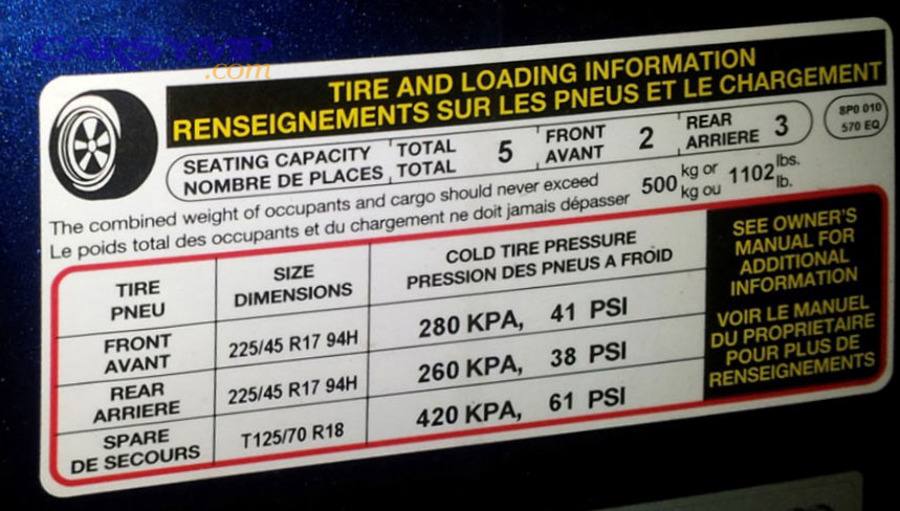
- Driver’s Side Door Jamb Placard: Every vehicle has a sticker inside the driver’s door frame that lists the manufacturer’s recommended tire size, load index, and inflation pressure. This is the most authoritative source for what your specific vehicle requires.
- Owner’s Manual: The tire chapter of the owner’s manual provides the same information as the door jamb placard and often includes notes on load-rated alternatives approved by the manufacturer.
When buying tires, cross-reference all three sources. The sidewall tells you what the tire is rated for; the door jamb placard and owner’s manual tell you what your vehicle requires. If these two ratings do not align — specifically, if the tire’s load index is lower than what the placard specifies — the tires are not appropriate for that vehicle.
What Is the Difference Between Load Index and Load Range?
Load index wins for precision on passenger cars and SUVs, while load range is the correct reference system for light trucks, commercial vehicles, and trailers — both describe a tire’s weight-carrying ability, but via different measurement standards applied to different tire categories.
This distinction is a persistent source of confusion, particularly among drivers who switch between a personal vehicle and a work truck. However, understanding which system applies to which context makes tire selection significantly more straightforward.
Is Load Range the Same as Ply Rating?
No — load range and ply rating are not the same, although they are historically related and are still sometimes used interchangeably in informal contexts.
The ply rating system was the original standard used to describe tire strength. It was literally a count of how many rubber-coated cord layers (plies) were built into the tire. More plies meant more strength and higher load capacity. A 10-ply tire was physically constructed with ten layers.
Modern tire manufacturing changed this relationship. Today’s tires use fewer but far stronger synthetic cord materials — polyester, nylon, aramid, and rayon — meaning a tire rated as “Load Range E” (equivalent to a 10-ply rating) may contain only two or four actual plies of high-strength material. The load range letter is now an indicator of the tire’s structural strength class and inflation limits, not a literal ply count.
The practical takeaway is straightforward:
| Load Range | Ply Rating Equivalent | Typical Application |
|---|---|---|
| B | 4-ply | Light passenger vehicles |
| C | 6-ply | Light trucks, small trailers |
| D | 8-ply | Medium trucks, campers |
| E | 10-ply | Heavy-duty trucks, large trailers |
| F | 12-ply | Commercial trucks, heavy trailers |
This table shows how the letter-based Load Range system maps to the older ply rating system, along with the vehicle types each level is commonly used for.
Load Range E remains the most commonly referenced standard for heavy-duty truck and trailer tires, and it is still printed on tire sidewalls today alongside the numerical load index.
Which Load Rating System Should Car Owners Use?
There are two primary tire load rating systems in use today — the Load Index (used for passenger and SUV tires) and the Load Range (used for light truck and trailer tires) — and the correct system to reference depends on your vehicle type and the tire’s prefix designation.
- Passenger cars and standard SUVs: Use the Load Index system. When choosing tire replacement tires, match or exceed the load index specified on the door jamb placard. For most passenger cars, this falls between load index 75 and 100.
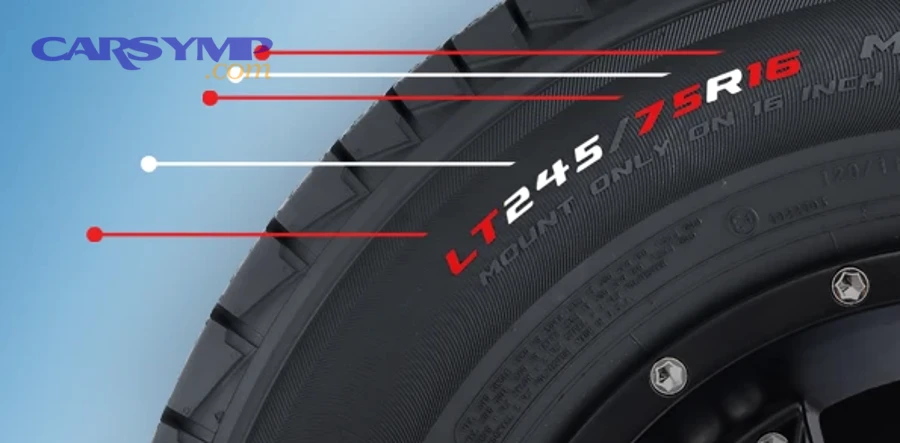
- Light trucks, pickups, and towing vehicles: Use both the Load Index and the Load Range. An LT-designated tire will display both values, such as LT275/70R18 118/115S Load Range E. The dual load index (e.g., 118/115) reflects single-tire and dual-rear-wheel configurations respectively.
- Trailers and RVs: Use the Load Range as the primary reference, specifically ST-prefixed tires with Load Range D or E depending on the trailer’s gross weight.
The most important rule across all vehicle types: never choose a replacement tire with a lower load index than the vehicle’s original equipment specification. Choosing tire type — whether all-season vs performance vs winter — is a separate decision that comes after confirming the correct load index is met. Both the tire category and the load rating must be correct independently.
What Is the Speed Rating on a Tire and How Does It Relate to Load Rating?
A tire speed rating is an alphabetical code printed immediately after the load index — for example, the H in 97H — that indicates the maximum sustained speed at which the tire can safely carry its rated load under controlled test conditions.
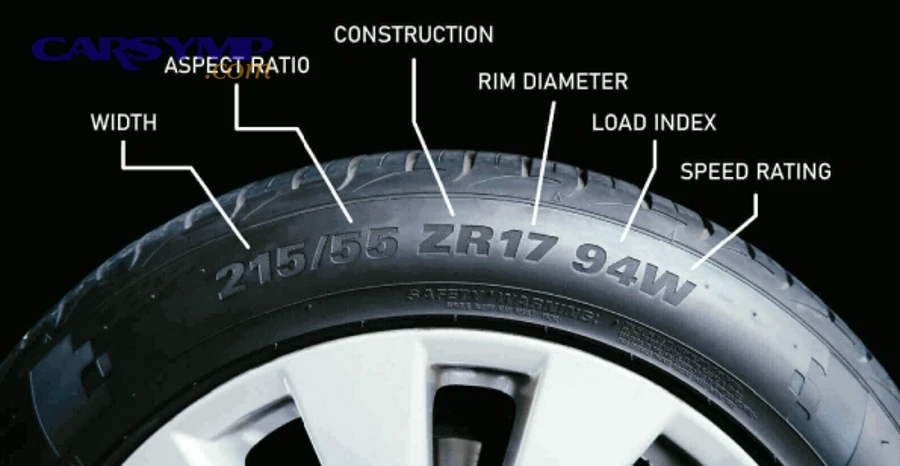
The speed rating and load rating together form what is technically called the “service description,” and both values must be matched or exceeded when replacing tires. Specifically, the speed rating is not simply a performance specification for sports cars — it affects ride quality, steering response, braking distance, and heat management at highway speeds, which means it is relevant for all drivers, not only those who push their vehicles to high speeds.
The following table shows the most common speed ratings, their maximum speed equivalents, and the vehicle types they are most associated with.
| Speed Rating | Max Speed (mph) | Max Speed (km/h) | Typical Application |
|---|---|---|---|
| S | 112 | 180 | Family sedans, minivans |
| T | 118 | 190 | Sedans, light trucks |
| H | 130 | 210 | Sport sedans, coupes |
| V | 149 | 240 | Performance cars |
| W | 168 | 270 | High-performance sports cars |
| Y | 186 | 300 | Exotic sports cars |
| Z | 149+ | 240+ | Ultra-high performance (with W or Y sub-rating) |
This table provides a practical reference for matching speed rating to vehicle type, with the understanding that exceeding a tire’s speed rating — even briefly — generates heat that degrades tire integrity over time.
Can You Mix Tires With Different Load and Speed Ratings?
No — mixing tires with different load indexes or speed ratings on the same vehicle is not recommended, because mismatched ratings create uneven handling, braking imbalance, and increased risk of tire failure under load or at speed.
However, the nuance here is important. The blanket restriction specifically applies to mixing tires where some have a lower load index or lower speed rating than the vehicle’s specification. Installing four tires with a higher load index than required is safe. Installing four winter tires with a lower speed rating than the OE specification is permitted under specific conditions — Michelin and other manufacturers note that if the driver is aware of and respects the lower speed threshold, this substitution is acceptable for seasonal winter use. The restriction is against unknowingly reducing a vehicle’s operational limits without adjusting driving behavior accordingly.
Mixing tire brands and tread patterns carries its own risks beyond load and speed ratings. Different tread designs and rubber compounds generate different levels of grip, water evacuation efficiency, and wear rates, which can create handling imbalances — especially during emergency braking or cornering in wet conditions. Tire professionals consistently advise against mixing tread patterns across axles, even when the load index and speed rating are matched.
According to guidelines published by Michelin, tires should always be replaced in sets of four or at minimum in matched pairs on the same axle to preserve the vehicle’s engineered handling balance.
How Do You Choose the Right Tire Size and Load Rating for Your Vehicle?
Choosing the right tire size and load rating involves four steps: check the door jamb placard for OE specifications, confirm the vehicle’s Gross Vehicle Weight Rating (GVWR), match or exceed the load index and speed rating from the placard, and verify that the chosen tire prefix (P, LT) aligns with your vehicle type and use case.
To better understand this process, it helps to work through each step systematically rather than relying on brand recommendations alone, because the correct tire for one version of a vehicle model may not be correct for a different trim or load configuration of the same model.
Step 1 — Check the Door Jamb Placard: Open the driver’s side door and locate the sticker on the door frame. This placard lists the manufacturer-recommended tire size, load index, inflation pressure for front and rear tires, and maximum vehicle load. This is the definitive specification for your vehicle.
Step 2 — Confirm the GVWR: The Gross Vehicle Weight Rating is the maximum total weight your vehicle is certified to operate at, including its own curb weight plus passengers, cargo, and fuel. GVWR is listed on the door jamb placard or in the owner’s manual. Your tires’ combined load capacity (load index × 4) must exceed the GVWR.
Step 3 — Match or Exceed OE Load Index and Speed Rating: When selecting replacement tires, never choose a tire with a lower load index or speed rating than the original specification. You may go higher, but not lower.
Step 4 — Match the Prefix to Your Use Case: If your vehicle is a standard passenger car, P-metric tires are correct. If you use a pickup truck for towing or carrying heavy payloads, LT-rated tires with an appropriate load range may be necessary even if the vehicle came from the factory with P-metric tires.
Does Tire Load Rating Change When You Add Cargo or Tow a Trailer?
Yes — the effective load demand on your tires increases significantly when you add passengers, cargo, or a tow trailer, which means you must verify that your current load index can handle the actual loaded weight, not just the curb weight of the vehicle alone.
When towing, the tongue weight of the trailer — typically 10 to 15 percent of the trailer’s total loaded weight — transfers directly onto the rear axle of the tow vehicle. This additional downward force is added to the vehicle’s existing rear axle load, which can push rear tires close to or past their rated limit if the load index is not sized for it. For drivers who regularly tow, upgrading to LT-rated tires with a higher load index is a practical safety measure even if the vehicle’s door jamb placard lists P-metric tires as standard.
Similarly, filling a truck bed with dense cargo — gravel, lumber, or equipment — adds hundreds or thousands of pounds to the rear axle. When to replace tires becomes a more pressing question for truck owners who regularly exceed 60 to 70 percent of their tire’s rated load, because cyclic overloading accelerates internal structural fatigue even when no visible damage appears on the sidewall.
What Happens If You Use a Tire With the Wrong Load Rating?
Using a tire with an insufficient load rating creates three predictable failure pathways: excessive heat buildup inside the tire structure, accelerated and uneven tread wear, and in severe cases, sudden sidewall failure or blowout.
Tires that are consistently operated above their load rating flex more aggressively at the sidewall with each wheel rotation. This flexion generates internal heat, and heat is the primary cause of tire degradation. The rubber compounds and cord layers that form the tire’s structure begin to degrade at elevated temperatures, reducing the tire’s effective service life long before any visible sign of damage appears on the surface.
Conversely, installing tires with a higher load index than required is generally safe and has no negative safety consequences, though it may result in a marginally firmer ride depending on the tire’s construction. Knowing when to replace tires includes monitoring for sidewall cracking, tread depth below 2/32 of an inch, and any visible bulging — all of which indicate structural compromise that can occur prematurely when a tire has been operated at or beyond its load limit.
According to data from the National Highway Traffic Safety Administration (NHTSA), tire-related crashes in the United States are frequently associated with under-inflation and overloading — two conditions directly connected to mismatched or underrated load indexes.
Advanced Tire Load Ratings: Special Cases and Niche Applications
There are four specialized tire load rating contexts that go beyond standard passenger car use: XL (Extra Load) tires, the relationship between inflation pressure and load capacity, ST-rated trailer and RV tires, and run-flat tire load behavior after pressure loss.
These topics represent the micro-semantic depth of tire load ratings — they apply to specific vehicle types, driving conditions, or tire constructions where the standard rules of the load index system work differently or require additional interpretation. More importantly, misunderstanding these special cases is a common cause of tire failure for drivers who upgrade their vehicles, switch to aftermarket wheels, or tow equipment without updating their tire specifications accordingly.
What Is an XL or Extra Load Tire and When Do You Need One?
An XL (Extra Load) tire is a reinforced tire construction that can carry a greater maximum load than a standard tire of the same size, because it is engineered to operate safely at higher inflation pressures than conventional tires in the same size class.
XL tires are marked on the sidewall with the letters “XL” or the words “Extra Load” adjacent to the tire size string. Their significance becomes clear when comparing them to standard-load tires of the same size. For example, a standard 225/45R17 in load index 91 carries 1,356 lbs per tire, while an XL-rated 225/45R17 in load index 94 carries 1,477 lbs per tire — the same physical size, but with a 9 percent higher load capacity achieved through reinforced sidewall construction.
XL tires are increasingly specified as OE fitment on:
- European vehicles (where Euro-metric XL tires are common on compact and mid-size cars)
- Loaded crossovers and SUVs that carry frequent near-maximum passenger and cargo weight
- Performance vehicles where the OEM requires a higher load capacity within a specific low-profile tire size
When replacing tires on a vehicle that originally came with XL-rated tires, it is essential to replace them with XL-rated tires of the same size. Installing standard-load tires in the same size — which will have a lower load index — means the replacement tires are structurally undersized for the vehicle’s load demands, even though they physically fit the rim.
How Does Tire Inflation Pressure Affect Load Carrying Capacity?
Tire inflation pressure directly controls how much load a tire can safely carry, because the load index printed on the sidewall is only valid when the tire is inflated to its maximum rated pressure — and most vehicles recommend a lower operating pressure than the tire’s maximum.
This creates a practical gap that drivers frequently overlook. The load index chart gives maximum capacity at maximum PSI, but the vehicle manufacturer’s recommended PSI — printed on the door jamb placard — is deliberately lower than the tire’s maximum for ride quality, handling balance, and even tread wear. At the recommended operating PSI, the tire’s effective load capacity is slightly reduced from the chart value.
The consequences of under-inflation are more serious than this slight capacity reduction suggests:
- Heat buildup: An under-inflated tire flexes more aggressively with each rotation, generating internal heat that degrades rubber compounds and cord integrity over time.
- Reduced load capacity: Every 6 PSI of under-inflation reduces a tire’s effective load-carrying capacity by approximately 4 to 6 percent.
- Tread wear pattern: Under-inflated tires wear faster on both outer edges while the center tread remains relatively unworn — a pattern that also signals the tire has been carrying loads near or above its inflated limit.
- Over-inflation: Inflating beyond the maximum PSI does not increase load capacity — it simply creates a rigid tire with less compliance, resulting in center-heavy tread wear, reduced wet traction, and a harsher ride.
The correct approach is always to inflate to the vehicle manufacturer’s recommended PSI (from the door jamb placard), not to the maximum PSI printed on the tire sidewall.
What Load Rating Do Trailer and RV Tires Require?
Trailer and RV tires require ST-prefix tires with a minimum of Load Range C, and in most full-size trailer and RV applications, Load Range D or Load Range E is the correct specification due to the static, concentrated nature of trailer loads.
ST (Special Trailer) tires are engineered specifically for the load profile of trailers, which is fundamentally different from tow vehicle tires. A trailer tire supports a constant, static downward load without the lateral forces created by steering inputs or the rotational torque created by a driven axle. This means ST tires use stiffer sidewall construction optimized for load-bearing stability rather than cornering agility.
Key specifications for trailer and RV applications:
- Boat and utility trailers: Load Range C or D (6 to 8-ply equivalent) depending on trailer GVWR
- Fifth-wheel and travel trailers: Load Range D or E (8 to 10-ply equivalent)
- Class A and Class C motorhomes: Specialized RV tires with load indexes above 120, often rated for 3,000+ lbs per tire
- Never substitute P-metric or LT tires for ST-designated trailer applications. P-metric tires used on trailers are subject to the swaying, oscillating loads of trailer movement without the structural reinforcement ST tires provide, significantly increasing the risk of sidewall failure.
Do Run-Flat Tires Have a Different Load Rating Than Standard Tires?
Yes — run-flat tires operate under two distinct load rating conditions: a standard load index when properly inflated, and a reduced emergency load capacity that allows limited driving after complete pressure loss.
When fully inflated to the recommended PSI, a run-flat tire carries the same load as a conventional tire with the same load index. A run-flat tire marked 225/45R17 91W carries the same 1,356 lbs per tire as a conventional tire with the same specifications. In normal operation, the run-flat designation changes nothing about load capacity — the standard load index rules apply.
After a pressure loss event, run-flat tires are designed to support the vehicle’s weight through reinforced sidewall construction — typically a rigid rubber insert or self-supporting sidewall that prevents the tire from fully collapsing onto the rim. However, this emergency capacity is significantly reduced:
- Distance limit: Most run-flat tires are rated for up to 50 miles of post-deflation driving
- Speed limit: Maximum speed after pressure loss is typically 50 mph (80 km/h)
- Load limit: The vehicle should carry minimum load — ideally driver only, no heavy cargo — during post-deflation driving to stay within the emergency structural limits
Run-flat tires must still meet or exceed the OE load index specification for the vehicle. Choosing tire type for a run-flat application — whether all-season vs performance vs winter — follows the same load index rule that applies to conventional tires: match or exceed the vehicle’s original specification. When to replace run-flat tires after a zero-pressure event depends on the manufacturer’s guidance, as many run-flats cannot be repaired after operating in the deflated state and must be replaced. According to Michelin’s technical documentation, run-flat tires that have been driven beyond their post-deflation distance or speed limits should be inspected by a professional before any further use, as internal damage may not be visible on the sidewall.