How To Identify Bad Radiator Symptoms Before They Cause Engine Damage
A bad radiator announces itself through a predictable set of warning signs, and learning how to identify these symptoms early is the single most effective way to prevent serious engine damage. The most common Signs of a failing radiator include persistent car overheating, visible coolant leaks pooling beneath the vehicle, a sweet smell and steam from the front of the car, discolored or thickened coolant, unusual gurgling or hissing noises, and a cabin heater that barely produces warmth. Each of these symptoms points to a specific failure mode inside the cooling system, and recognizing them promptly can mean the difference between a manageable repair bill and a catastrophic engine rebuild.
Understanding why each symptom appears is just as important as spotting it. A radiator does not fail all at once — it deteriorates gradually through internal corrosion, external damage, or simple wear on seals and hoses. When you know how a healthy radiator functions, the warning signs become far easier to interpret. For instance, Rusty coolant and internal corrosion signs often show up as a change in coolant color long before the engine temperature gauge climbs into the red zone.
Once symptoms are present, the next decision is equally critical: what do you actually do about it? Some problems call for a simple radiator flush and fresh coolant, while others demand a full replacement. The repair vs. replace radiator decision depends on the type and severity of the failure, the age of the vehicle, and the Typical costs for radiator problems in your area. Making the wrong call can leave you stranded or waste money on a fix that does not hold.
Beyond the well-known warning signs, there are also uncommon radiator problems that most drivers never hear about — issues like electrolysis corrosion, transmission fluid cross-contamination, and the unique cooling demands of hybrid and electric vehicles. Below, this article walks through every symptom, diagnosis method, and action step you need to protect your engine and your wallet.
What Is a Car Radiator and Why Does It Matter for Engine Health?
A car radiator is a heat exchanger in the cooling system that transfers excess engine heat to the surrounding air, preventing the engine from reaching destructive temperatures. Without a properly functioning radiator, the coolant that circulates through the engine block cannot shed its heat, and the engine’s internal components begin to warp, crack, and fail.
To better understand why radiator problems lead to such expensive consequences, it helps to look at exactly how this component works and what happens when it stops doing its job.
How Does a Radiator Keep Your Engine From Overheating?
The radiator keeps the engine cool through a continuous loop of heat transfer. Coolant — a mixture of water and antifreeze — absorbs heat as it passes through channels in the engine block and cylinder head. A water pump pushes this heated coolant through a rubber hose into the radiator, where it flows through a network of narrow aluminum or copper tubes. Thin metal fins attached to these tubes dramatically increase the surface area exposed to outside air. As the vehicle moves forward, air passes through the grille and across the fins, carrying heat away from the coolant. A thermostat positioned between the engine and the radiator controls when coolant is allowed to circulate; it remains closed while the engine is cold and opens once the operating temperature is reached, allowing coolant to flow into the radiator for cooling.
The coolant reservoir, or overflow tank, acts as a pressure buffer. As coolant heats up and expands, excess fluid flows into the reservoir. When the engine cools, vacuum draws that fluid back into the radiator. This closed system relies on every component — the radiator core, hoses, thermostat, water pump, radiator cap, and reservoir — working in concert. A failure in the radiator disrupts the entire cycle, and the engine begins to overheat.
Can a Bad Radiator Destroy Your Engine?
Yes, a bad radiator can destroy your engine, and it can do so faster than most drivers expect. There are at least three critical reasons why radiator failure leads directly to engine destruction.
First, sustained overheating warps the cylinder head. The cylinder head is a precision-machined component that must maintain a perfectly flat mating surface against the engine block. When overheating at speed causes the metal to expand unevenly, the head warps, breaking the seal of the head gasket. A blown head gasket allows coolant to leak into the combustion chambers or oil passages, contaminating the lubrication system and creating a cascade of internal failures.
Second, extreme heat can crack the engine block itself. Cast iron and aluminum alloy blocks are designed to handle operating temperatures in the range of 195°F to 220°F (90°C to 105°C). When a failing radiator allows temperatures to climb well beyond that range, thermal stress fractures the block, and the engine becomes irreparable.
Third, overheating degrades the engine oil. Oil that is subjected to sustained high temperatures breaks down and loses its viscosity, meaning it can no longer protect moving parts from metal-on-metal contact. Bearings, piston rings, and camshaft lobes wear at an accelerated rate, shortening the engine’s life dramatically.
According to a study referenced by the National Institute for Automotive Service Excellence (ASE), cooling system failure remains one of the leading causes of mechanical breakdowns on U.S. highways, underscoring the direct relationship between radiator health and engine longevity.
What Are the Most Common Bad Radiator Symptoms?
There are six main bad radiator symptoms that drivers encounter most frequently: engine overheating, coolant leaks, a sweet or syrupy smell, discolored coolant, strange noises, and steam from under the hood. These symptoms can be grouped into three categories — visible, audible, and olfactory — based on how they present themselves to the driver.

Specifically, each symptom maps to a distinct type of radiator failure, and understanding the category helps you diagnose the root cause more quickly.
Is Your Engine Overheating More Than Usual?
Yes, frequent or worsening car overheating is the most reliable indicator that something is wrong with the radiator. There are three primary reasons why a failing radiator causes the engine temperature to climb.
The first reason is a clogged radiator core. Over time, rust, mineral deposits, and degraded coolant form sediment that blocks the narrow tubes inside the radiator. When enough tubes are obstructed, the radiator can no longer transfer sufficient heat. Clogged radiator symptoms typically begin with the temperature gauge creeping slightly above normal during highway driving and progressively worsen as more passages become restricted.
The second reason is low coolant level caused by a slow leak. Even a small leak at a hose connection, a cracked plastic end tank, or a corroded seam reduces the volume of coolant available to absorb engine heat. With less coolant in the system, the remaining fluid heats up faster and the engine reaches dangerous temperatures sooner.
The third reason is a failed radiator cap. The cap is designed to maintain a specific pressure within the cooling system — typically around 13 to 16 psi. This pressure raises the boiling point of the coolant, allowing it to absorb more heat before turning to steam. Radiator cap and overflow issues, such as a weakened spring or a cracked seal, reduce system pressure and lower the effective boiling point, making overheating more likely even when coolant levels appear adequate.
If you notice your temperature gauge rising higher than its usual midpoint, especially during stop-and-go traffic or when driving uphill, the radiator should be the first component you investigate.
What Do Coolant Leaks Under Your Car Look Like?
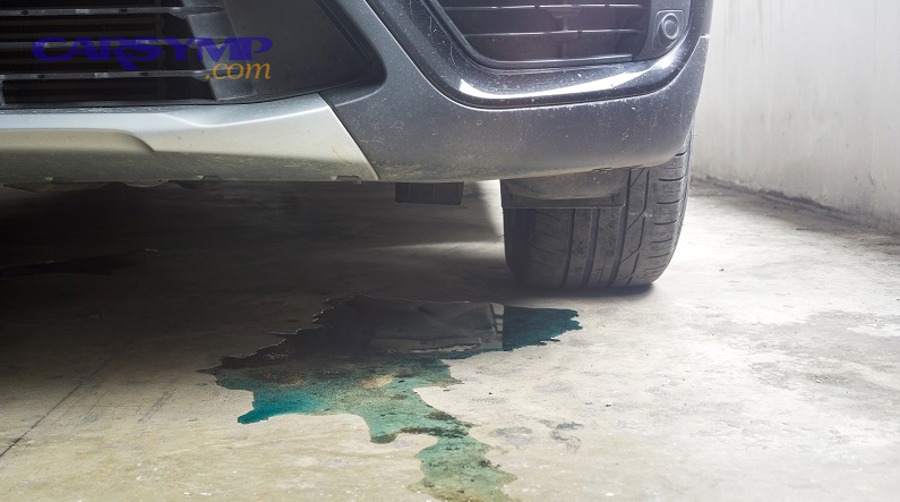
Coolant leaks appear as bright green, orange, pink, or yellow puddles beneath the front half of the vehicle, depending on the type of coolant your car uses. The fluid typically has a slightly slippery texture and a faintly sweet odor that distinguishes it from other automotive fluids like oil or transmission fluid.
For example, a small seep from a deteriorating radiator hose clamp might leave only a few drops on the pavement after the car has been parked overnight. A more serious failure, such as a cracked radiator tank or a corroded core, can produce a steady stream of coolant that pools rapidly. Coolant leaks at radiator tanks diagnosis often begins with a visual inspection of the plastic end tanks — the molded caps at the top and bottom (or sides) of the radiator where the hoses connect. These tanks are bonded to the aluminum core with a gasket, and age and thermal cycling cause the plastic to become brittle and the gasket to shrink, creating leak paths.
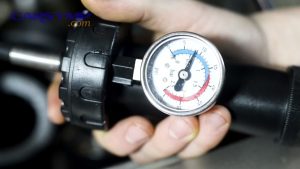
To confirm the source of a leak, a mechanic performs a cooling system pressure test. The radiator cap is removed and replaced with a hand pump adapter that pressurizes the system to its rated specification. With the system under pressure, the technician inspects every joint, hose, and seam for escaping coolant. Pressure test results for radiator failure will show a rapid drop in system pressure and a visible wet spot at the failure point. This test is inexpensive and definitive, and it is the standard diagnostic method used by professional shops.
Why Does Your Car Smell Sweet or Syrupy Inside the Cabin?
The sweet or syrupy smell inside the cabin comes from ethylene glycol, the primary chemical compound in most conventional engine coolants. When a radiator or one of its hoses develops a leak, coolant drips onto hot engine components and evaporates, releasing that distinctive aroma into the air that enters the cabin through the ventilation system.
More specifically, a sweet smell and steam from the front of the car almost always indicates an active coolant leak in the engine bay. If the smell is strongest when the heater is running, the leak may be coming from the heater core — a small radiator-like unit inside the dashboard — rather than the main radiator. However, both failures are related to the same cooling circuit and require immediate attention.
Ethylene glycol is toxic to humans and animals. Prolonged inhalation of coolant vapors in an enclosed cabin can cause headaches, dizziness, and nausea. If you detect a sweet smell while driving, roll down the windows, turn off the recirculation mode on your climate control, and have the cooling system inspected as soon as possible.
What Does Discolored or Thick Coolant Tell You About Your Radiator?
Discolored or thick coolant tells you that the radiator’s internal passages are corroding and that contaminants are accumulating in the cooling system. Healthy coolant is translucent and maintains a consistent color — green, orange, or pink depending on the formulation. When that fluid turns brown, muddy, or develops a sludge-like consistency, it is a clear sign of internal degradation.
Rusty coolant and internal corrosion signs develop when the coolant’s corrosion inhibitors break down over time. Fresh coolant contains chemical additives that form a protective film on metal surfaces inside the radiator, engine block, and water pump. As those additives deplete — typically after 30,000 to 50,000 miles or two to five years, depending on the coolant type — exposed metal begins to oxidize. Rust particles flake off and circulate through the system, discoloring the fluid and creating abrasive sediment that accelerates wear on seals and gaskets.
To check your coolant condition, allow the engine to cool completely, then carefully remove the radiator cap and look inside. If the fluid is opaque, brown, or has visible particles floating in it, a coolant flush is overdue. A coolant flush involves draining the old fluid, circulating a cleaning solution through the system, and refilling with fresh coolant mixed to the manufacturer’s recommended ratio.
What Are the Less Obvious Warning Signs of Radiator Failure?
There are three less obvious warning signs of radiator failure that many drivers overlook: weak cabin heating, strange noises from the cooling system, and steam or white smoke billowing from beneath the hood. These symptoms are easy to dismiss or attribute to unrelated causes, but each one connects directly to a deteriorating radiator.

However, because these signs are subtler than a puddle of coolant on the driveway, they often go unaddressed until the problem escalates into a full overheating event.
Does Weak Cabin Heating Mean Your Radiator Is Failing?
Yes, weak cabin heating can mean your radiator is failing, and there are three interconnected reasons for this. The vehicle’s heater core — a small heat exchanger located inside the dashboard — relies on a steady flow of hot coolant from the engine to warm the air blown into the cabin. When the radiator is compromised, the heater core’s performance suffers.
The first reason is reduced coolant volume. A leaking radiator lowers the total amount of coolant circulating through the system. With less fluid reaching the heater core, the air coming through the vents is lukewarm rather than hot. The second reason is a clogged radiator restricting flow. If corrosion debris and sludge partially block the radiator, the water pump must work harder to push coolant through the circuit, and the overall flow rate drops. Less coolant passing through the heater core per minute means less heat delivered to the cabin. The third reason is air pockets in the system. When coolant leaks out, air enters the closed loop. Air pockets do not transfer heat the way liquid coolant does, so they create cold spots in the heater core, resulting in inconsistent or absent cabin heat.
If you notice that your car’s heater takes much longer than usual to produce warm air, or if the heat fluctuates between warm and cool while driving, investigate the cooling system before assuming the heater core itself has failed.
What Strange Noises Can a Failing Radiator Produce?
A failing radiator can produce three distinct types of noise: gurgling, hissing, and — indirectly — engine knocking. Each noise points to a different stage or type of failure.
Gurgling sounds, often heard after shutting off the engine or during acceleration, indicate that air has entered the cooling system. Air bubbles moving through the heater core or the radiator hoses create the bubbling noise. This typically results from a slow coolant leak that allows air to be drawn in as the system cools and contracts.
Hissing sounds suggest that pressurized coolant or steam is escaping through a small crack or a compromised seal. The cooling system operates under pressure, so even a pinhole leak can produce an audible hiss, especially when the engine is hot and the system is at peak pressure. A hissing sound from the front of the car while the engine is running warrants an immediate inspection.
Engine knocking, while not produced by the radiator itself, can be a downstream consequence of severe overheating caused by radiator failure. When the engine runs too hot, fuel in the combustion chambers ignites prematurely — a condition known as pre-ignition or detonation. This produces a metallic knocking or pinging noise. By the time you hear this sound, the engine is already sustaining damage, and the car should be stopped and turned off as quickly and safely as possible.
Is Steam or White Smoke From Under the Hood a Radiator Problem?
Yes, steam or white smoke from under the hood is frequently a radiator problem, and it signals one of two conditions: coolant is boiling over due to overheating, or coolant is leaking onto a hot engine surface and evaporating on contact.
In the first scenario, the radiator has lost the ability to keep the coolant below its boiling point. This can happen because of a clogged core, a failed radiator cap that cannot maintain pressure, or a critically low coolant level. The coolant boils inside the radiator or the engine, and the resulting steam escapes through the overflow tube or through any weak point in the system.
In the second scenario, a crack in the radiator, a loose hose, or a deteriorating gasket allows liquid coolant to drip onto the exhaust manifold or another hot component. The coolant vaporizes instantly, producing a visible plume of white steam and that characteristic sweet smell.
It is important to distinguish radiator-related steam from exhaust smoke. White smoke coming from the tailpipe — rather than from under the hood — may indicate a blown head gasket, which allows coolant to enter the combustion chambers and burn off as white vapor. While a blown head gasket can be caused by prolonged radiator failure, it represents a separate and more expensive repair. If you see white smoke from the exhaust pipe, the problem has likely progressed beyond the radiator alone.
How Do You Diagnose a Bad Radiator vs. Other Cooling System Problems?
A bad radiator is best diagnosed by comparing its specific symptom profile against other cooling system components: a radiator typically presents with visible external leaks, a discolored or clogged core, and gradual overheating, while a faulty thermostat or water pump each produce their own distinct patterns. Accurate diagnosis prevents you from replacing the wrong part and wasting time and money.

On the other hand, cooling system components are interconnected, so a failure in one part can mask or mimic symptoms of another. Knowing the distinguishing characteristics of each failure type is essential.
The following table summarizes the key diagnostic differences between the three most commonly confused cooling system failures:
| Symptom | Bad Radiator | Faulty Thermostat | Failed Water Pump |
|---|---|---|---|
| Overheating pattern | Gradual, worsens over days/weeks | Rapid, often sudden onset | Gradual to moderate |
| Visible coolant leak | Common — at core, tanks, or seams | Rare | Possible — weep hole drip |
| Coolant condition | Often discolored, rusty, or thick | Usually normal | Usually normal |
| Distinctive noise | Hissing at radiator body | None typical | Whining or grinding at front of engine |
| Cabin heater affected | Yes — reduced heat output | Yes — if stuck closed, engine overheats before heater warms; if stuck open, engine stays cool | Possible — reduced flow |
What Is the Difference Between a Bad Radiator and a Faulty Thermostat?
A bad radiator causes gradual overheating accompanied by visible leaks or discolored coolant, while a faulty thermostat causes sudden temperature spikes with no external leaks.
Meanwhile, the distinction matters because the two failures require completely different repairs. A thermostat stuck in the closed position prevents coolant from flowing to the radiator at all. The engine temperature climbs rapidly — often within minutes of starting the car — because the coolant is trapped in the engine block with no way to release its heat. The temperature gauge shoots straight to the red zone, but there are no puddles under the car, no sweet smell, and no discoloration of the coolant itself.
A bad radiator, by contrast, still allows coolant to circulate. The overheating develops more slowly because the radiator is partially functional — it just cannot shed heat efficiently. You may notice the gauge creeping upward only during demanding conditions like highway driving, climbing hills, or sitting in traffic on a hot day. Over time, the condition worsens as corrosion progresses or a leak grows. Signs of a failing radiator include visible wetness on the radiator body, discolored coolant in the reservoir, and clogged radiator symptoms like uneven temperature distribution across the radiator surface (one section feels cool while another is hot to the touch).
A simple test can help distinguish between the two: with the engine warmed up, carefully feel the upper radiator hose. If the thermostat is stuck closed, the hose will remain cool because no coolant is flowing through it. If the radiator is the problem, the hose will be hot — coolant is flowing, but the radiator is not cooling it effectively.
How Can You Tell If the Problem Is Your Radiator or Your Water Pump?
A radiator problem produces visible external leaks on the radiator body and discolored coolant, while a water pump failure produces a distinctive high-pitched whining or grinding noise from the front of the engine and a coolant weep from the pump’s weep hole.
To illustrate, the water pump is a belt-driven or electric component that physically pushes coolant through the entire cooling circuit. When its internal bearings wear out, they create a characteristic noise — a whine or squeal that increases in pitch with engine RPM. Additionally, every water pump has a small weep hole designed to leak coolant when the internal seal begins to fail. A drip from the weep hole — located on the underside of the pump — is a definitive sign that the pump needs replacement.
A radiator, on the other hand, does not have moving parts and does not produce noise on its own. Its failures are passive: cracks, corrosion, and clogs. When you see coolant leaking from the flat face of the radiator core, from the seam between the aluminum core and the plastic end tanks, or from a deteriorated hose connection at the radiator inlet or outlet, the radiator is the culprit.
In some cases, both components fail at the same time, particularly in high-mileage vehicles where the entire cooling system has aged uniformly. A thorough cooling system pressure test, combined with a visual inspection of the water pump weep hole and a listen for bearing noise, will clarify which component — or components — need attention.
What Should You Do When You Notice Bad Radiator Symptoms?
When you notice bad radiator symptoms, take three immediate steps: stop driving the vehicle if the engine is actively overheating, perform a visual inspection of the cooling system, and schedule a professional diagnostic as soon as possible. The speed of your response directly determines whether the outcome is a modest repair or a major engine overhaul.

More importantly, some situations demand that you pull over immediately, while others allow a short drive to a repair shop. Knowing the difference can save your engine.
Can You Safely Drive With a Failing Radiator?
No, driving with a failing radiator is not safe, and there are three reasons why continuing to drive risks severe damage.
First, every minute the engine operates above its designed temperature accelerates wear on critical internal components. Head gasket failure, cylinder head warping, and bearing damage can all begin within a few minutes of sustained overheating. The typical costs for radiator problems — a new radiator ranges from roughly $300 to $900 including labor — are a fraction of the $2,000 to $4,500 cost of a head gasket replacement or the $3,000-plus cost of an engine rebuild.
Second, a radiator leak can worsen suddenly. A slow seep can become a burst under the stress of driving, especially at highway speeds where engine temperatures and coolant pressures are highest. Overheating at speed radiator clues, such as the temperature gauge rising above normal only during highway driving, suggest the radiator is nearing its breaking point.
Third, coolant leaking onto the road surface creates a slippery hazard for other drivers, and coolant dripping onto electrical components or the serpentine belt can cause secondary failures.
If your temperature gauge enters the red zone or if the engine overheating warning light illuminates, pull over safely, turn off the engine, and allow it to cool for at least 30 minutes before opening the hood. Do not attempt to remove the radiator cap while the engine is hot — the pressurized system can erupt and cause severe burns. If the vehicle cannot safely be driven even a short distance, have it towed to a repair shop.
When Should You Get a Radiator Flush vs. a Full Replacement?
A radiator flush is the right choice when the coolant is discolored but the radiator structure is intact, while a full replacement is necessary when the core is cracked, severely corroded, or leaking from the tanks.
Besides the physical condition of the radiator, several other factors inform the repair vs. replace radiator decision. The table below outlines the key scenarios for each option:
| Scenario | Recommended Action | Estimated Cost |
|---|---|---|
| Coolant is brown or sludgy, no visible leaks | Radiator flush | $100 – $200 |
| Minor seep at a hose clamp or connection | Tighten or replace the clamp/hose | $20 – $150 |
| Crack in plastic end tank | Replace radiator | $300 – $900 |
| Corrosion holes in the aluminum core | Replace radiator | $300 – $900 |
| Persistent overheating after flush and hose replacement | Replace radiator (likely internal clog) | $300 – $900 |
| Vehicle is over 10 years old with original radiator | Replace radiator proactively | $300 – $900 |
A radiator flush is effective for removing accumulated sediment, rust particles, and degraded coolant additives. The process involves draining the old coolant, running a chemical cleaning solution through the system, flushing with distilled water, and refilling with fresh coolant at the manufacturer’s specified concentration. This restores flow and heat transfer efficiency when the radiator’s physical structure is still sound.
However, if a pressure test reveals a leak in the core or tanks, or if overheating persists even after a flush, the radiator’s internal passages are likely too compromised to salvage. In these cases, replacement is the only reliable solution. Most aftermarket radiators come with a one- to two-year warranty and are designed as direct-fit replacements for the original equipment, making the swap straightforward for a qualified technician.
What Are the Uncommon Radiator Problems Most Drivers Never Hear About?
There are four uncommon radiator problems that fall outside the scope of routine maintenance guides: electrolysis corrosion, transmission fluid cross-contamination, damaged radiator fins, and the unique cooling challenges of hybrid and electric vehicles. These issues are rarely discussed in mainstream automotive content, yet each one can cause significant damage if left undetected.

In addition to the common symptoms covered above, understanding these less frequent failures adds a valuable layer of diagnostic knowledge, especially for owners of older, high-mileage, or specialized vehicles.
What Is Electrolysis Corrosion and How Does It Silently Destroy a Radiator?
Electrolysis corrosion is an electrochemical process in which stray electrical current passes through the engine coolant, accelerating the breakdown of metal surfaces inside the radiator and engine block. It is one of the most difficult radiator problems to detect because it produces no external leaks, no unusual noises, and no visible symptoms until the damage is already severe.
For example, a faulty engine ground strap or a poorly grounded aftermarket accessory can introduce a small voltage into the cooling system. The coolant becomes an electrolyte, and the electrical current flowing through it causes the aluminum or copper in the radiator to dissolve at a molecular level. Over months or years, this process eats pinholes through the radiator core from the inside out.
A mechanic can test for electrolysis by placing one probe of a digital voltmeter in the coolant (with the radiator cap removed and the engine running) and connecting the other probe to the battery’s negative terminal. A reading above 0.3 volts indicates that stray current is present and corrective action — typically repairing or replacing a ground strap — is needed before the radiator sustains irreversible damage.
Can Transmission Fluid Leak Into Your Radiator?
Yes, transmission fluid can leak into your radiator in vehicles equipped with an integrated transmission cooler — a small heat exchanger built into the radiator that uses engine coolant to regulate transmission fluid temperature.
When the internal barrier between the transmission cooler and the radiator’s coolant passages fails, the two fluids mix. The telltale sign is a milky pink or strawberry-colored substance in the coolant reservoir. This is not simply a cosmetic problem — coolant contaminated with transmission fluid loses its ability to transfer heat efficiently, and transmission fluid contaminated with coolant loses its lubricating and hydraulic properties. If left uncorrected, the result is damage to both the radiator and the transmission, turning a single component failure into a double repair bill.
Vehicles most susceptible to this issue include trucks and SUVs from the mid-2000s to mid-2010s that use factory-integrated transmission coolers. The repair involves replacing the radiator, thoroughly flushing the transmission cooler lines, and in some cases flushing or servicing the transmission itself. Many owners who have experienced this failure choose to install a separate, standalone transmission cooler to eliminate the risk of future cross-contamination.
Do Damaged Radiator Fins Cause Overheating Even When Coolant Is Fine?
Yes, damaged radiator fins can cause overheating even when coolant level, color, and condition are all within normal parameters. The fins are responsible for the majority of the radiator’s heat dissipation, and three types of fin damage reduce their effectiveness.
Bent fins are the most common problem. Road debris — small rocks, gravel, and even insects at highway speeds — strikes the delicate aluminum fins and bends them flat against each other. When fins are pressed together, air cannot flow between them, and the radiator loses cooling capacity in that section. A tool called a fin comb, available for a few dollars at any auto parts store, allows you to carefully straighten bent fins and restore airflow.
Blocked fins are the second issue. A thick layer of bugs, dirt, leaves, or road grime on the front face of the radiator acts as insulation, preventing air from reaching the fins. This is especially common in vehicles that drive frequently on unpaved roads or in agricultural areas. A gentle rinse with a garden hose from the engine side of the radiator (spraying outward through the fins) removes most surface debris without bending the fins.
Corroded fins are the third and most serious form of damage. In regions where road salt is used heavily during winter, the salt spray attacks the aluminum fins and causes them to disintegrate over time. Once the fins have corroded away, no amount of cleaning or straightening can restore the radiator’s efficiency, and replacement is the only option.
Are Radiator Problems Different in Hybrid and Electric Vehicles?
Yes, radiator problems in hybrid and electric vehicles differ from those in conventional cars because the radiator’s primary job shifts from cooling a combustion engine to managing the temperature of the battery pack and power electronics.
In a traditional gasoline or diesel vehicle, the radiator handles coolant temperatures that typically range from 195°F to 220°F. In a battery electric vehicle (BEV), the thermal management system operates at much lower temperatures — often between 60°F and 95°F — because lithium-ion batteries perform best and degrade least within a narrow thermal window. This means EV radiators (sometimes called chillers or coolant-to-refrigerant heat exchangers) use different coolant formulations, operate at lower pressures, and are integrated into more complex circuits that may include a heat pump and multiple cooling loops.
The failure modes are also distinct. In an EV, a failing thermal management radiator may not produce the classic car overheating symptoms that combustion vehicle drivers recognize. Instead, the vehicle’s battery management system may display a warning about reduced power output, limited charging speed, or restricted regenerative braking. The dashboard may show a battery temperature warning rather than a traditional engine temperature gauge in the red zone.
Hybrid vehicles face a combination of both worlds. They have a conventional radiator for the internal combustion engine and a separate cooling circuit for the electric motor and battery. A failure in either system produces different symptoms, making diagnosis more complex. Owners of hybrid and electric vehicles should ensure their service technicians are familiar with the specific cooling architecture of their vehicle, as conventional radiator diagnostic techniques do not always apply.
According to data published by the U.S. Department of Energy’s Vehicle Technologies Office, battery thermal management is one of the most critical factors affecting EV battery lifespan and performance, reinforcing the importance of keeping the EV cooling system — including its radiator components — in optimal condition.