How to Replace a Transmission Solenoid: Cost, Symptoms, and Repair Guide for Car Owners
A transmission solenoid replacement is the right repair when testing confirms that a faulty solenoid is disrupting hydraulic control, gear changes, or torque converter operation inside an automatic transmission. In practical terms, that means the job is not just about swapping a small electrical part. It starts with symptom review, moves through code scanning and electrical checks, and ends with correct installation, fluid service, and verification. That direct path matters because replacing the wrong part wastes money and can leave the real shifting problem unresolved.
Symptoms come first because most drivers notice behavior before they see a diagnosis. Common Solenoid failure symptoms include delayed engagement, harsh or erratic shifts, limp mode, overheating, or a check engine light paired with poor shift quality. Those symptoms can point toward a bad solenoid, but they can also overlap with low fluid, contaminated fluid, valve body wear, internal clutch damage, or wiring faults. That overlap is why a proper repair guide must explain both replacement and diagnosis.
Cost is the next concern for most car owners. A realistic Transmission solenoid replacement cost estimate depends on whether the transmission uses one serviceable solenoid, a solenoid pack, or a valve body assembly that bundles multiple control parts together. Labor also changes depending on Access: pan-drop vs full teardown differences can move a job from manageable to expensive very quickly. Solenoid replacement labor time can be modest on some units and much longer on others.
Introduce a new idea: the most useful way to understand this repair is to move from function, to symptoms, to testing, to replacement steps, to cost, and finally to the repair decisions that separate a single-solenoid fix from a broader transmission service.
What Is a Transmission Solenoid and Why Does It Matter?
A transmission solenoid is an electronically controlled valve inside an automatic transmission that opens or closes hydraulic passages to manage shift timing, pressure, and torque converter functions.
To better understand why transmission solenoid replacement matters, it helps to look at what the solenoid actually controls inside the transmission before any parts are removed.

Is a Transmission Solenoid the Part That Controls Gear Shifts?
Yes, a transmission solenoid helps control gear shifts because it regulates fluid flow, responds to electronic commands, and affects when and how the transmission changes gears.
Specifically, the solenoid acts as a bridge between the transmission control logic and the hydraulic hardware. The powertrain control module or transmission control module reads speed, load, throttle, and temperature data. It then commands one or more solenoids to open or close specific passages in the valve body. Those commands change pressure and route fluid to the clutch packs or bands that create each gear.
That means a bad solenoid can disturb much more than one shift. A sticky or electrically failed unit can delay engagement into drive or reverse, create flares between gears, force hard shifts, or trigger limp mode. In some vehicles, the transmission can default to a single gear to prevent further damage. In others, the problem shows up only when the unit is hot and viscosity changes. This is one reason Solenoid-related codes and meanings must always be interpreted alongside real-world symptoms rather than by code description alone.
The reason this matters to car owners is simple: the transmission may feel like it has a major mechanical failure when the root cause is electrical or hydraulic control. On the other hand, a worn clutch pack may mimic a solenoid issue. That is why the correct sequence is function first, symptoms second, testing third, and replacement fourth.
According to CarParts, transmission solenoids regulate hydraulic fluid between circuits and can cause delayed shifting and sluggish operation when they malfunction. ([carparts.com](https://www.carparts.com/blog/what-does-a-transmission-solenoid-do/?srsltid=AfmBOorHM-w_F0WuoBbbAdX2Ez3Xu0c08M-OsuOyyHfg6C1sAJ5mp1Jn&))
What Does a Transmission Solenoid Do in an Automatic Transmission?
A transmission solenoid controls hydraulic pressure and fluid routing inside the valve body, which lets the transmission engage gears at the correct time and with the intended shift feel.
More specifically, different solenoids perform different jobs. Shift solenoids command gear changes by moving fluid to specific circuits. Pressure control solenoids modulate line pressure so the transmission can shift smoothly without slipping or banging into gear. Torque converter clutch solenoids help lock or unlock the converter for efficiency and heat control. In many newer designs, these functions operate together as part of a tightly calibrated control strategy.
This is where terminology stays important. A car owner may hear “bad transmission solenoid” and assume there is one identical part on every vehicle. In reality, the design may use several individual solenoids, a combined solenoid pack, or a valve body assembly with integrated electronics. That design difference directly affects cost, access, and the Valve body vs single solenoid repair decision later in the article.
Solenoids also matter because they operate in fluid, heat, and debris. Dirty fluid can restrict movement. Metal contamination can score the valve body. Internal wear can reduce control accuracy. For that reason, Fluid and filter service during solenoid replacement is often recommended whenever the design allows it. A clean fluid environment protects the new part and gives the repair a better chance to succeed.
What Symptoms Suggest You May Need Transmission Solenoid Replacement?
The most common signs are delayed shifting, harsh shifts, slipping, limp mode, warning lights, and poor gear engagement, especially when those symptoms appear with transmission trouble codes.
Let’s explore these symptoms carefully because the best repair decisions begin with pattern recognition rather than guesswork.

Can a Bad Transmission Solenoid Cause Slipping, Delayed Shifts, or Limp Mode?
Yes, a bad transmission solenoid can cause slipping, delayed shifts, or limp mode because it disrupts fluid control, weakens clutch apply timing, and can trigger protective software strategies.
More importantly, the way those symptoms appear often tells you what kind of failure you may be dealing with. A delayed engagement when shifting into drive can point to hydraulic leakage, low pressure, or a sticking control element. A flare on the 2-3 or 3-4 shift may suggest a commanded event that is not happening on time. Limp mode often appears when the control module sees a circuit fault or a gear ratio error severe enough to protect the transmission.
Solenoid failure symptoms are especially confusing because they overlap with broader transmission faults. Low or contaminated fluid can delay apply timing. A clogged filter can starve the pump. A worn clutch pack can slip even if the solenoid command is correct. A damaged internal harness can interrupt the signal and mimic a failed solenoid. That is why experienced shops do not jump straight to parts replacement just because a code starts with P07xx.
For drivers, the practical takeaway is this: repeated harsh shifting, sudden neutral-like flares, stuck-in-gear behavior, or limp mode should be treated early. Continuing to drive with uncontrolled slipping creates heat, and heat accelerates clutch and fluid damage. A simple control problem can grow into an internal overhaul if ignored long enough.
According to CarParts code references, P0751 can be associated with transmission slipping, overheating, limp mode, and getting stuck in gear, while general shift-solenoid faults can also cause improper shifting and reduced fuel economy. ([carparts.com](https://www.carparts.com/blog/p0751-code-shift-solenoid-a-performance-stuck-off/?srsltid=AfmBOoosIFoll_JjTUnaZ2bdDMH8x_qsDm-kuI6q-duYgqebSACRO9jT&))
What Symptoms Should Car Owners Watch for Before Replacing a Transmission Solenoid?
There are three main groups of symptoms to watch: shifting behavior changes, dashboard warnings and codes, and performance or heat-related drivability problems.
The first group is shifting behavior. This includes delayed shifts, hard shifts, flare shifts, refusal to upshift, refusal to downshift, or an engine that revs higher than normal before the next gear engages. These are the symptoms most owners notice first.
The second group is dashboard feedback. A check engine light, transmission warning, or stored code such as P0750, P0753, P0755, P0757, P0763, or P0974 often appears when the control module sees a circuit or performance issue. Solenoid-related codes and meanings matter here, but they do not all mean the solenoid itself is physically defective. Some indicate an electrical problem in the circuit, while others indicate performance that may be influenced by pressure, contamination, or valve body wear.
The third group is broader drivability. A vehicle may feel sluggish, run hotter, enter failsafe mode, lose fuel economy, or show intermittent problems only under load or after warming up. These patterns can point to electrical resistance changes, fluid breakdown, or internal wear that becomes more obvious at operating temperature.
Owners comparing resources such as carsymp.com and shop-based diagnostic guides should focus on symptom patterns rather than symptom lists alone. Pattern-based thinking leads to better diagnosis and a better repair outcome.
How Do You Diagnose a Bad Transmission Solenoid Before Replacing It?
A correct diagnosis combines scan data, code review, fluid inspection, electrical testing, and symptom confirmation so you can separate a true solenoid failure from other transmission problems.
Next, the key point is that replacement should follow proof, not suspicion.

What Tests Confirm That a Transmission Solenoid Is Bad?
The most useful tests are code scanning, live data review, resistance checks, circuit verification, fluid inspection, and functional actuation when the transmission design and scan tool allow it.
Start with a full scan, not just a generic code pull. Read all powertrain and transmission codes, then freeze-frame or event data if available. Look for whether the module logged a circuit code, a performance code, or a gear ratio code. A circuit code suggests wiring, connector, or solenoid coil issues. A performance code suggests the command was issued but the expected hydraulic or ratio result did not occur.
Then inspect the fluid. Burnt odor, dark color, suspended debris, or clutch material in the pan can change the diagnosis. A clean electrical failure and a contaminated mechanical failure do not carry the same repair plan. This step is why transmission service sometimes becomes part of the diagnostic process rather than an afterthought.
After that, test the circuit. Many service manuals provide expected resistance ranges for each solenoid. A coil that is open, shorted, or out of range may support replacement. You should also inspect the harness, connector pins, grounds, and power supply. A corroded pin can cause the same symptoms as a failed unit. On some vehicles, an advanced scan tool can command the solenoid on and off while the technician monitors response.
A good diagnosis also includes context. If the transmission slips only when hot and the pan contains clutch material, the bad behavior may be mechanical even if a solenoid code is present. If the fluid is clean and the circuit test fails, a targeted replacement may make sense. This is the difference between smart diagnosis and expensive guesswork.
According to CarParts, P0750 indicates a shift solenoid “A” circuit malfunction, while P0753 points to an electrical fault in the same circuit and P0763 identifies an electrical fault in shift solenoid C. ([carparts.com](https://www.carparts.com/blog/p0750-code-shift-solenoid-a/?srsltid=AfmBOopy1oBWcvN7Idi10enA2FShOmaSUY7L275ds_ABuzcinITBZccT&))
Is a Bad Solenoid the Same as a Bad Valve Body or Low Transmission Fluid?
No, a bad solenoid is not the same as a bad valve body or low transmission fluid because each problem has different causes, failure patterns, and repair paths.
However, they can overlap in ways that confuse diagnosis. Low fluid reduces hydraulic pressure and can create delayed engagement, flare shifts, or overheating. Contaminated fluid can cause valves to stick, which makes the transmission behave as though the solenoid is not commanding correctly. A worn valve body can leak pressure internally even when the solenoid is doing its job. Internal clutch wear can create ratio errors that appear after a correct command but before a successful gear apply.
The valve body vs single solenoid repair decision depends on what testing and inspection show. If one serviceable solenoid fails electrically and the rest of the hydraulic system looks healthy, replacing one unit may be reasonable. If the transmission has multiple related shift complaints, debris in the pan, pressure loss patterns, or a history of valve body wear, replacing the broader assembly may be the smarter long-term solution.
Factory bulletins reinforce this logic. Some manufacturers specify clutch inspection and broader component replacement when slipping evidence is present alongside certain control-solenoid faults. That means a code alone never answers the whole problem.
According to a General Motors service bulletin published by NHTSA, evidence of slipping clutch plates can require inspection and replacement of affected clutch plates along with solenoid body and valve body replacement procedures on certain transmissions. ([static.nhtsa.gov](https://static.nhtsa.gov/odi/tsbs/2024/MC-11000362-0001.pdf?))
How Do You Replace a Transmission Solenoid Step by Step?
Transmission solenoid replacement usually follows eight steps: verify the fault, access the unit, drain fluid, remove the pan or assembly, replace the solenoid, reassemble, refill fluid, and road test.
To better understand the repair, the most important issue is access, because access: pan-drop vs full teardown differences often determines whether the job is DIY-friendly or professional-only.

What Tools, Parts, and Safety Steps Are Needed for Transmission Solenoid Replacement?
There are four main categories to prepare: lifting and safety tools, hand tools, service parts, and fluid-management items.
The first category is safety. Use jack stands or a lift on a level surface, wheel chocks, eye protection, gloves, and a drain pan large enough for transmission fluid. Automatic transmission fluid spreads quickly and creates slip hazards, so stable vehicle support matters.
The second category is hand tools. Most jobs require sockets, extensions, torque tools, a pick set, screwdrivers, pliers, a scraper for gasket surfaces, and sometimes Torx or Allen bits. A multimeter is valuable if you are confirming coil resistance before installation.
The third category is service parts. You may need the replacement solenoid, internal harness clips or seals, a pan gasket or RTV sealant where specified, a filter, and fresh fluid. Fluid and filter service during solenoid replacement is often the smartest add-on when the pan is already off because the marginal labor is low and the benefit to the new part is high.
The fourth category is information. A torque chart, refill procedure, fluid specification, and fill-level method are essential. Many late-model transmissions do not use a simple dipstick and instead require a temperature-based fill check. Skipping that detail can make a good installation behave like a bad repair.
How Is a Transmission Solenoid Replaced on Most Automatic Transmissions?
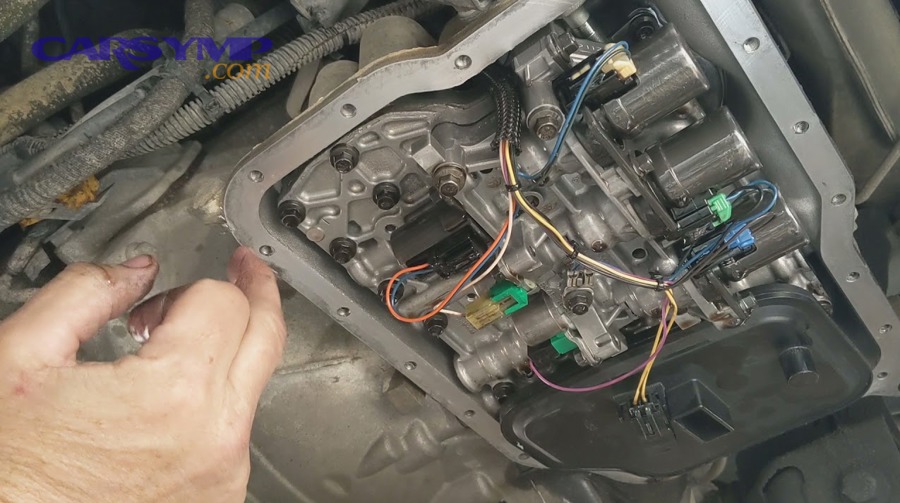
On most serviceable automatics, the process involves confirming the failed circuit, draining fluid, removing the pan and filter, accessing the valve body or solenoid pack, replacing the part, then refilling and testing.
Here is the typical sequence:
- Confirm the code, symptom, and affected solenoid using scan data and testing.
- Raise and support the vehicle safely.
- Remove splash shields or braces if needed for access.
- Drain or control the fluid spill and remove the pan.
- Inspect the pan for metal, clutch material, or excessive debris.
- Remove the filter where applicable.
- Disconnect the affected solenoid or solenoid pack from the internal harness.
- Remove fasteners, clips, or retainer plates holding the solenoid.
- Install the new part with correct seals and orientation.
- Reassemble with correct torque.
- Refill with the specified fluid.
- Clear codes, perform adaptation if required, and road test.
This is where DIY solenoid replacement risks become very real. Over-torquing valve body bolts can warp components. Dirt on a gasket surface can create leaks. Installing the wrong fluid can change shift quality. Misrouting an internal harness can damage wiring on startup. On some transmissions, the “solenoid replacement” job is really a precision valve body service that demands experience.
For many owners, the best dividing line is access complexity. A simple pan-drop design may allow reasonable DIY work. A unit requiring full teardown, special tools, or mechatronic calibration is usually best left to a shop.
How Much Does Transmission Solenoid Replacement Cost?
Transmission solenoid replacement usually costs less than major internal transmission repair, but the final bill depends on part design, labor access, fluid requirements, and whether related components must be replaced.
More specifically, cost only makes sense when separated into single-solenoid, solenoid-pack, and broader valve body repair scenarios.
What Is the Average Cost of Transmission Solenoid Replacement?
The average cost for replacing a single transmission solenoid is often a few hundred dollars or less, while solenoid-pack or integrated assembly repairs can cost much more.
A basic single-solenoid job may include a relatively inexpensive part, one to a few hours of labor, fluid, a filter or gasket, and a diagnostic charge. In a simpler case, the repair may stay in the low hundreds. In a more complex case, especially when access is restricted or the unit uses an integrated control pack, the total can rise quickly.
That is why a transmission solenoid replacement cost estimate should always separate these lines:
- part price
- labor
- diagnostic time
- fluid and filter
- gasket or sealant
- adaptation or relearn requirements
- tax and shop supplies
Solenoid replacement labor time varies widely. On a pan-drop transmission with easy access, labor may be relatively modest. On designs that require extensive disassembly, subframe movement, or deeper teardown, labor can become the dominant part of the bill. This is also where owners should ask whether the quote includes a transmission service, because many good repairs include fresh fluid and filter replacement when the unit is opened.
According to AutoNation Mobile Service, replacing a single solenoid typically ranges from about $75 to $450, with parts around $15 to $100 and labor around $60 to $350, while a multi-solenoid pack can run about $250 to $600. ([autonationmobileservice.com](https://www.autonationmobileservice.com/i/blog/transmission-solenoid-replacement-cost/?))
Is Replacing One Solenoid Cheaper Than Replacing a Solenoid Pack or Valve Body?
Yes, replacing one solenoid is usually cheaper up front, while a solenoid pack is often better for clustered electronic failures, and a valve body repair is better when wear, leakage, or contamination affects the whole control system.
That comparison matters because cheap does not always mean economical. A single-solenoid replacement makes sense when testing isolates one failed unit and the rest of the system is healthy. A solenoid pack replacement becomes more reasonable when the design bundles the components together or when multiple related faults appear at once. A valve body repair or replacement becomes the strongest option when wear, bore damage, pressure loss, or contamination is affecting hydraulic control beyond one coil or valve.
The table below shows what the buyer is really comparing.
| Repair option | Best when | Cost tendency | Main risk |
|---|---|---|---|
| Single solenoid | One verified failed serviceable unit | Lowest | Missing a wider hydraulic issue |
| Solenoid pack | Integrated pack or multiple related faults | Medium | Replacing more than necessary |
| Valve body repair/replacement | Wear, leakage, debris, widespread shift issues | Highest of the three | Higher parts cost, but often more complete |
In practice, the valve body vs single solenoid repair decision should be based on evidence from scan data, pan inspection, and pressure behavior, not just on the cheapest line item in the estimate.
Should You Replace a Transmission Solenoid Yourself or Hire a Professional?
DIY replacement can save money on simple pan-drop transmissions, but professional repair is safer when access is difficult, diagnosis is uncertain, or the unit requires calibration and precise fluid-level procedures.
Then the real question becomes not “Can I do it?” but “Can I do it without increasing the cost of the final repair?”
Can DIY Transmission Solenoid Replacement Save Money?
Yes, DIY transmission solenoid replacement can save money because labor is avoided, basic pan-drop jobs are straightforward, and part prices are often manageable for one failed unit.
Still, those savings depend on three conditions. First, the diagnosis must be correct. Second, the transmission must be reasonably accessible. Third, the installer must be able to refill and verify the fluid correctly. If any one of those conditions fails, the repair can become more expensive than paying a shop from the start.
DIY solenoid replacement risks include fluid contamination, broken connector locks, stripped fasteners, wrong fluid specification, incorrect gasket sealing, misdiagnosing a wiring problem as a solenoid problem, and skipping post-repair adaptation. Even the road test matters. If you do not verify shift timing, converter lockup, and code return status, you may think the repair worked when the control module is already setting the same fault again.
The strongest DIY cases are older or simpler transmissions with clear pan access, documented procedures, and one confirmed electrical failure. The weakest DIY cases are sealed transmissions, mechatronic assemblies, CVTs with strict procedures, and vehicles whose internal electronics are closely integrated with the valve body.
Which Cars or Transmission Designs Make Solenoid Replacement Easier or Harder?
There are three broad groups: pan-drop serviceable designs, integrated solenoid-pack designs, and teardown-intensive or highly integrated transmissions.
Pan-drop serviceable designs are the easiest. These often let the technician remove the pan, inspect debris, change the filter, and access the shift solenoids directly. For these vehicles, a combined transmission service and solenoid repair can be efficient and relatively affordable.
Integrated solenoid-pack designs sit in the middle. The pack may bolt into the valve body area and still be accessible, but the part cost is higher and the replacement involves more connectors, seals, or alignment considerations.
Teardown-intensive or highly integrated units are the hardest. Some require much more disassembly, careful mechatronic handling, or temperature-based and scan-tool-based setup procedures. Those repairs are where access: pan-drop vs full teardown differences matter most. On these units, professional replacement usually provides better odds of success.
For owners reviewing articles or comparing repair experiences online, the smartest approach is to search by exact transmission model, not just by vehicle model. Two cars from the same brand can have very different repair difficulty depending on the transmission family installed.
What Related Transmission Repairs or Edge Cases Should Car Owners Know About?
Car owners should know the difference between solenoid types, understand that some shift issues remain after replacement, and recognize that wiring, TCM, or broader hydraulic faults can mimic a bad solenoid.
Besides the core repair, these edge cases deepen the decision-making process and prevent the most common misdiagnoses.

What Is the Difference Between a Shift Solenoid, Pressure Control Solenoid, and TCC Solenoid?
A shift solenoid changes gear circuits, a pressure control solenoid manages line pressure, and a TCC solenoid controls torque converter clutch apply and release.
That distinction matters because different solenoids create different symptoms. A failed shift solenoid may cause missed or harsh shifts between specific gears. A bad pressure control solenoid may create generally harsh, soft, or inconsistent shift feel across multiple events. A failed TCC solenoid may trigger converter clutch codes, shudder, poor fuel economy, or stalling-like behavior when coming to a stop in some designs.
This is also why solenoid-related codes and meanings should be read carefully. For example, P0750 and P0755 refer to shift-solenoid circuit malfunctions, P0757 points to a shift solenoid stuck on, and P0974 refers to a high control-circuit condition for shift solenoid A. Those codes sound similar, but they do not describe exactly the same failure mode.
According to OBD-Codes and CarParts references, P0755 identifies a shift solenoid “B” circuit malfunction, P0757 is commonly defined as shift solenoid “B” stuck on, and P0974 indicates a high control-circuit condition for shift solenoid “A.” ([obd-codes.com](https://www.obd-codes.com/p0755?))
Can a Transmission Still Shift Poorly After Solenoid Replacement?
Yes, a transmission can still shift poorly after solenoid replacement because adaptation may be needed, fluid level may be incorrect, or the original problem may include valve body or clutch wear.
More specifically, Post-repair adaptation and road test checklist items are often what separate a complete repair from an incomplete one. After installation, the system may need code clearing, reset or relearn procedures, fluid-temperature verification, and a structured road test through light throttle, moderate throttle, coastdown, and converter clutch engagement.
A useful checklist includes:
- verify no leaks
- verify fluid level using the correct method
- clear codes
- complete any manufacturer adaptation steps
- road test all forward shifts and reverse
- monitor converter lockup where applicable
- rescan for pending or returning codes
- confirm that harshness or delay has improved under hot conditions
If the transmission still shifts poorly after those steps, the next suspects usually include valve body wear, low pressure, internal clutch damage, a bad internal harness, or a TCM issue. That does not always mean the new part was unnecessary, but it does mean the fault tree was broader than one component.
When Is Wiring, the TCM, or the Internal Harness the Real Problem Instead of the Solenoid?
Wiring, the TCM, or the internal harness becomes the real suspect when the code points to a circuit fault, the solenoid tests good, or the problem appears intermittent with temperature or vibration changes.
This comparison is important because electrical failures can perfectly imitate a bad solenoid. A broken wire, fluid intrusion into a connector, poor ground, failing module driver, or cracked internal harness can open or short the circuit. In those cases, replacing the solenoid may do nothing. Intermittent issues are especially tricky because the solenoid may test within spec in the shop but fail to receive or transmit a clean signal on the road.
The best clue is pattern plus testing. If live data shows a command but the circuit behaves erratically, inspect the wiring path. If the resistance is good at the component but bad at the module side, inspect the harness. If several unrelated solenoid codes appear together, think beyond one part. These are the moments when a professional electrical diagnosis saves real money.
Is Transmission Solenoid Replacement Better Than Temporary Fixes Like Fluid Additives?
Yes, verified transmission solenoid replacement is better than temporary fixes like additives because it addresses the failed control part, restores correct operation, and avoids masking a worsening hydraulic or electrical problem.
In contrast, additives may change feel temporarily in some worn units, but they do not repair an open circuit, a sticking valve caused by debris, or a damaged internal harness. They also do not replace worn clutch material or restore a leaking valve body bore. At best, they may delay a decision. At worst, they create false confidence while heat and slip continue to damage the transmission.
Preventing solenoid failures is a better strategy than chasing temporary cures. That means using the correct fluid, following reasonable service intervals, fixing leaks early, avoiding chronic overheating, and responding quickly when check-engine or transmission codes appear. A good transmission service can reduce contamination and help the control system operate in cleaner fluid, but service is preventive support, not a substitute for a failed electrical component.
In short, real repair beats symptom masking. When diagnosis confirms the solenoid, replacement plus correct fluid care and verification is the durable answer.